



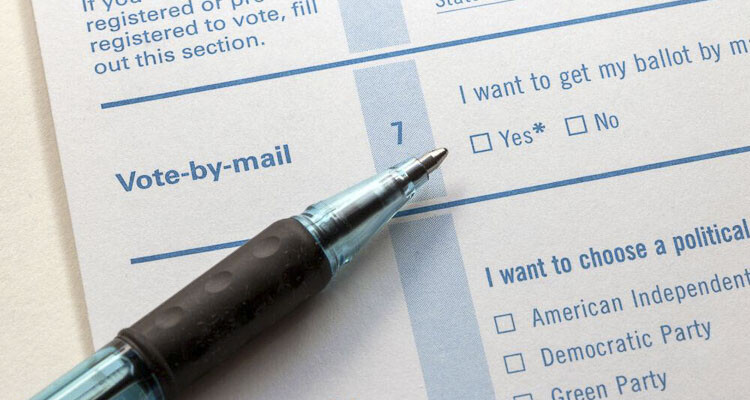
State law does not require a person to prove they can vote when registering
TJ Martinell
The Center Square Washington
In the state of Washington, a person must prove they’re 21 to purchase alcohol, rather than the seller presuming their age until shown otherwise.
But that presumption exists regarding voter registration.
State law does not require a person to prove they can vote when registering. Instead, it adheres to a “presumptive right” to vote, and registered voters are only removed if discovered to be ineligible by the county auditor or the Secretary of State’s Office.
Although this approach has led to some instances of people ineligible to vote registering thinking they could vote, or being unknowingly registered, state and local officials say these occurrences are rare.
“It’s fair to say that there’s a presumptive right for a person who is seeking registration,” Washington Association of County Auditors President Lori Larsen told The Center Square. Larsen is also the Stevens County Auditor.
“We start with the assumption that they [a person registering to vote] are eligible,” she added. “If something comes up that suggests otherwise, we can take action.”
Many people in Washington register to vote when registering with the state Department of Licensing, or DOL, for a driver’s license. Under state law, anyone seeking an enhanced driver’s license must prove they are a U.S. citizen. Gov. Jay Inslee signed SB 5112 this week, automatically registering these individuals to vote. This requirement does not apply to non-enhanced driver’s licenses. Unless it’s delayed again, an enhanced driver’s license will be required for domestic airline travel starting May 7, 2025.
The lack of direct verification can result in people, such as foreign nationals, accidentally being registered to vote when obtaining a driver’s license. DOL Licensing Service Manager Saralyn Door wrote in a June 2022 email to other DOL employees that this happens “every so often maybe once a month if that.”
Larsen told The Center Square that her county is looking at two similar incidents of people not being eligible to vote registering. One accidentally registered but never voted, while another registered to vote, believing they were legally allowed to vote in elections not involving the federal government.
The Center Square has previously reported that foreign nationals reached out to DOL as far back as 2018 to notify them that they had been registered to vote despite insisting they were not eligible to do so and lacked the documents to prove their citizenship.
Door’s email was in response to an August 2021 incident where a 17-year-old foreign national was registered to vote while obtaining a non-enhanced driver’s license at a licensing service office, or LSO. The incident was reported to the Secretary of State’s Office. Deputy Director of Elections Stuart Holmes contacted DOL about it in June 2022.
While registering for a non-enhanced driver’s license, a DOL representative is supposed to list the requirements for a resident to be eligible to vote, though Larsen said, “our lived experience is that it’s not always happening.”
Those eligibility requirements are that the person be:
- a citizen of the United States;
- a legal resident of Washington state for at least 30 days immediately before the next election at which they vote
- at least 18 years old by election day, or 16 years old to pre-register to vote when they turn 18;
- not disqualified from voting due to a court order; and
- not currently serving a sentence of total confinement under the jurisdiction of the Department of Corrections for a Washington felony conviction, and not currently incarcerated for a federal or out-of-state felony conviction.
The DOL representative is then supposed to ask the person two questions:
- “Are you a United States citizen?”
- “Are you at least eighteen years old or are you at least sixteen years old and will you vote only after you turn eighteen?”
In an email to The Center Square, DOL Communications Manager Christine Anthony wrote, “to the best of our capabilities, we provide those questions in the customer’s native language, and we allow them to bring family or friends to help with interpreting the questions. If the customer answers no to either of the two questions, we do not give them a voter registration application. If they say yes, we transfer the information to the Secretary of State for further verification.”
According to an email from DOL Licensing Services Manager Matthew Murray to Door, the foreign national’s application had him marked “yes” when asked those questions, “which would come after the LSR [license service representative] provides the customer with the voter oath that lists the citizenship requirement. I do see that the customer provided a foreign birth certificate, which suggests that they are indeed not a citizen, but as no other citizenship documentation was presented at the time of issuance (not required for this non-EDL transaction), that doesn’t prove/disprove they don’t have a U.S. citizenship document at home or in a lockbox somewhere.”
Anthony wrote in the email to The Center Square that DOL does not verify a person’s claim of voter eligibility, stating it “rests exclusively with the Secretary of State’s Office and the county auditors. They [the voter] are passed to the SOS for further verification and that’s something that would be caught there.”
She added that “the affidavit signed at registration indicating the applicant is declaring themselves eligible to register to vote and knowingly providing false information is a Class C felony in accordance with RCW 29A.84.130. They would be risking a lot to fraudulently claim they are eligible to vote.”
The Washington State Voter Registration Database was created in 2002 and is maintained by SOS. It is required under state law to “screen against any available databases maintained by other government agencies to identify voters who are ineligible to vote due to a felony conviction, lack of citizenship, or mental incompetence.” Among the agencies SOS partners with are county auditors, election management system vendors, the Social Security Administration, DOL, the Department of Health, the Department of Corrections and the Office of the Administrator of the Courts.
The Secretary of State’s Office became aware of the August 2021 incident not through screening but because the foreign national’s immediate family reported his voter registration to one of their local legislators.
According to Pierce County, “state law does not provide for citizenship verification upon registration.” Instead, it allows private citizens and the county prosecutor to challenge a voter’s eligibility, but the burden of proof rests on the accuser.
The county reports that “election officials may not verify citizenship when they receive a voter’s registration, and there exists no official list of citizens to check citizenship status against. If the required information for voter registration is included – name; address; date of birth; a signature attesting to the truth of the information provided on the application; and an indication in the box confirming the individual is a U.S. citizen – the person must be added to the voter registration file.”
“When we talk about voter eligibility verification, the voter himself or herself by their attestation by their oath on their voter registration form, they are making an assert of eligibility,” Larsen said.
Yet, like with DOL, Larsen said the issue of people accidentally being registered to vote or even illegally registering had not been a significant issue for her county, as the two recent incidents are the only ones she’s seen in five years and out of 35,000 registered voters in the county.
“At this point in time, I believe our process while not perfect in all cases
This report was first published by The Center Square Washington.
Also read:
- POLL: Do you agree with requiring board members to follow council direction?
 Disagreement among county councilors centers on whether C-TRAN board members should reflect the council’s collective wishes or act independently, highlighting ongoing concerns about public accountability.
 - 18th District lawmakers to host town hall meeting on Saturday, March 28, in Battle Ground
 Stephanie McClintock and John Ley will meet with Battle Ground constituents to answer questions, review the new income tax, and discuss the effects of the $80 billion budget.
 - Opinion: In plain sight – yielding to pedestrians
 Drivers often fail to see pedestrians due to inattentional blindness, which highlights the need for more focused awareness at intersections and stronger safety practices.
 - NBA vote clears way for expansion to Seattle
 The NBA Board of Governors has voted to explore adding teams in Seattle and Las Vegas, moving Seattle closer than ever to hosting pro basketball again.
 - Opinion: The legislature has committed $2.4 billion to recurring pension increases since 2018
 Six legislative COLAs have raised public employer costs by $2.38 billion since 2018, driving up unfunded pension liabilities and increasing burdens on county and city budgets.
 - Opinion: ‘Just because they got away with it doesn’t mean they weren’t wrong’
 A Skamania County deputy’s report found violations of county rules and the Open Public Meetings Act, but no prosecutor acted on the findings.
 - More drama at Clark County Council in regard to its representatives on the C-TRAN Board
 Councilors debated whether C-TRAN board representatives must follow group mandates, with Michelle Belkot refusing to commit to new voting rules and Glen Yung opposing her nomination.
 wpDiscuz
