


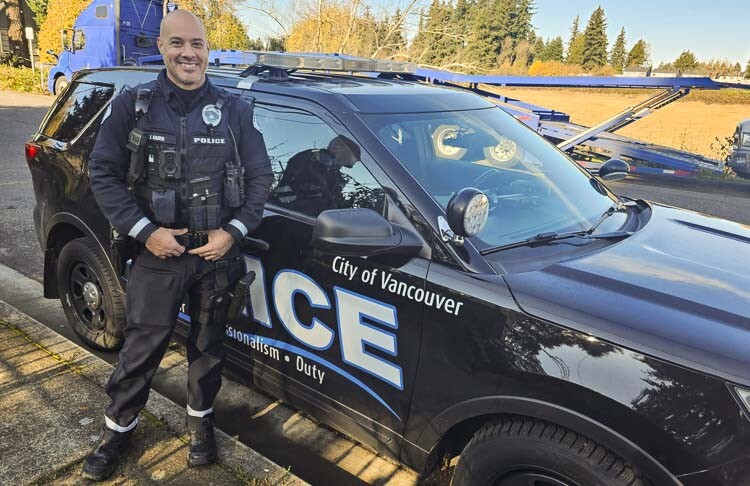
The weather is changing, and it there is less daylight hours, with brings more challenges to driving in the region
Paul Valencia
ClarkCountyToday.com
The clocks changed. The weather changed.
Driving habits should change, too.
“The sun is going down quicker. We’re getting more hours of darkness. The rain has kicked in, too. We’re seeing more rainy days,” noted Jeff Anaya of the Vancouver Police Department. “Darkness is showing up at 4:30 in the afternoon. By the time you’re driving home, it’s almost pitch black. And we’re still seeing a lot of excessive speed.”

The word is out: Slow down. Keep your distance. Stay focused.
November’s emphasis for Target Zero is speed, low visibility, and risk factors. Target Zero is a statewide campaign with the goal to have zero deaths on state highways and roads by 2030. Law enforcement officials throughout Clark County take part in the campaign, hoping to educate drivers while also enforcing the law.
Anaya said that fatalities on the roadways are down just a bit from last year, but last year was one of the worst in recent history. It is frustrating for law enforcement and other first responders to see so many drivers traveling 15, 20, or even more miles per hour over the speed limit.
Those dangerous habits are worse now after the big changes: Daylight Savings Time to Daylight Standard Time comes about the time the rain returns and foggy conditions roll in to the region.
To law enforcement officials, it is a simple equation. Just about everything associated with operating a vehicle becomes more of a challenge in the fall and winter months.
“With more speed, you have a decrease in reaction time,” Anaya said. “When you crash, you’re going to do more damage because you’re carrying more energy, more momentum behind you. With the low visibility, with darkness coming so early, you’ll have slower reaction time. You’re going to see things later.
“And then we’ve got our wet roadways. Your stopping distance is going to increase because you’re going to slide farther,” Anaya added. “The roadway is going to be slicker. You’re not going to stop as well as you would on a dry surface.”
Among the risk factors that law enforcement officers are on the look out for is following too close. That is illegal at any time of the year, but is more dangerous in the fall and winter months — for the reasons already stated.
Anaya has seen the horrific effects of crashes.
“The on-scene stuff, it hits hard because it’s real,” Anaya said. “You’re seeing that person’s life is no longer here.”
Even more difficult for Anaya, though, is notifying a family member that a person has died. He has been on the receiving end of that notification, as well.
“I know what they’re going through,” Anaya said. “For me, that’s the hardest part.”
Target Zero, Anaya, and first responders are hoping drivers follow their advice: Slow down, keep your distance, and stay focused during challenging driving situations.
Also read:
- Opinion: Were Republican voters just sleeping during the August primary election?
 CCRP Chairman Matt Bumala says 60% of primary no-shows in the 17th and 18th districts were Republicans.
 - High school football: New coach prepares for long-term success at Prairie High School
 James Young-Lewis, a Clark County native who graduated from Evergreen in 2009, became Prairie’s head coach in May after working as an assistant coach across various programs since 2015, joining Prairie’s staff in 2024.
 - Cost to battle 20 wildfires in WA has topped $200M
 Twenty wildfires have cost Washington $207M in one month, more than two-thirds of what DNR spent all last fiscal year.
 - Opinion: WA Cares’ launch showcased care WA Cares did not provide
 Gov. Ferguson showcased a caregiving arrangement at the WA Cares launch that the program had not paid for a single day of.
 - Former State Rep. Liz Pike provides update on husband Neil Cahoon
 Neil Cahoon, a Camas resident, has undergone multiple surgeries including five on Aug. 15 after the Aug. 10 crash near La Center’s Daybreak Airport.
 - Opinion: Portland’s War on Cars Part 4 – A smarter automobile strategy to end gridlock
 O’Toole argues fuel wasted in Portland-area congestion has sextupled since 1982, generating 250,000 tons of extra greenhouse gases annually.
 - $1,000 first prize for Camas Plein Air Art Event honoring Marquita Call on Sept. 26
 Plein air artists compete Sept. 26 in Camas for $1,000 first prize honoring gallery founder Marquita Call.