



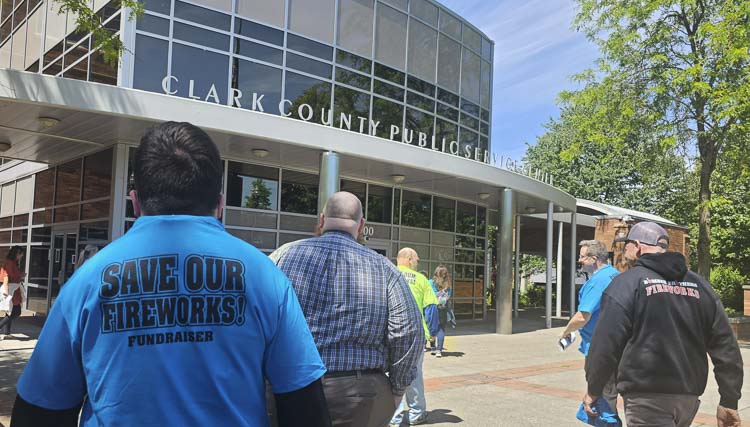
Clark County councilors agree to bring up the subject of fireworks at a later date after dozens made their appeals in public comment, and Chair Sue Marshall made it clear that there is no current proposal to ban fireworks in unincorporated Clark County
Paul Valencia
Clark County Today
Clark County councilors spent nearly two hours on the subject of fireworks on Wednesday during Council Time, listening to passionate arguments from dozens of citizens and giving their own opinions.
The council agreed to continue the discussion later in the year, and the county chair made it clear that there is no proposed ban on fireworks at this time.
Last week, during a work session, the council did talk about the impact fireworks had on the community. “Fireworks” was listed on Wednesday’s agenda under “old business.” In the time between last week’s discussion and this week’s meeting, many in the fireworks industry grew concerned that the council was considering a ban of the sale and use of fireworks in unincorporated Clark County.
“The council has not taken any position on fireworks,” County Chair Sue Marshall told the large gathering just before public comment.
The five councilors then listened to public comment for more than 90 minutes. Of the dozens who spoke in person Wednesday, one was for the banning of fireworks. The others were passionate in their defense of not only fireworks, but of the nonprofit organizations that use the sale of fireworks to fund so many projects.
One man said he started selling fireworks in 1985 to help fund his nonprofit organization. Since then, 100 percent of the proceeds from fireworks sales has gone back to the community. That includes paying utility bills for people in need, grocery bills, scholarships, and musical instruments for students in need. All told, he said, he has given back more than $300,000.
“If I were to lose that source of income, I would still have my nonprofit, but I couldn’t do what I do,” he said.
A representative of TNT Fireworks noted that studies have shown that fireworks bans do not work. People would just find fireworks elsewhere, and some of those fireworks could be illegal.
“We want to make sure people are buying fireworks that are regulated,” he said.
The first speaker of public comment was against fireworks.
“I’m tired of hearing the sirens. I’m tired of the garbage left over from the fireworks. I want to see these fireworks banned,” he said.
There was nearly 80 minutes of in-person public comment. Several more people spoke remotely via online media, with three of them opposed to fireworks, as well.
On this day, though, most were against any potential ban — now or in the future.
When it was the council’s time to speak on the subject, the five council members eventually agreed to continue the discussion at a later date.
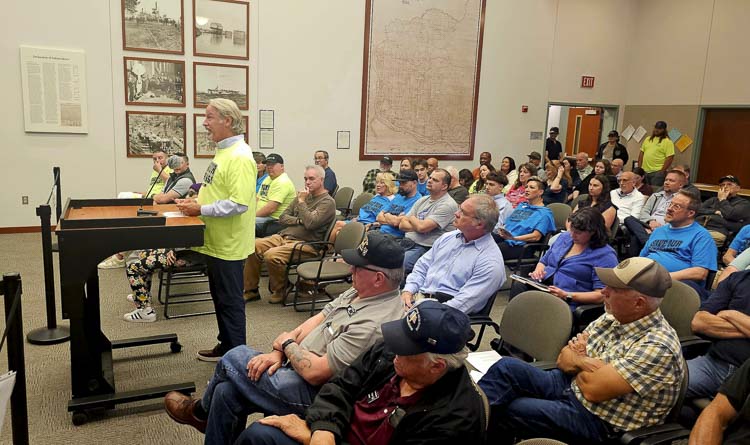
Councilor Glen Yung had a long list of items he wanted to have researched by the county staff. He spoke for nearly 10 minutes on his own, describing fireworks as a “hard issue on so many levels.”
Yung mentioned that a ban could potentially reduce the amount of injuries, fires, and reduce costs associated with emergency services. He said a ban could help with noise pollution and bring less anxiety to those who suffer from PTSD.
At the same time, before taking any action, he would want to support anyone affected by the ban, including the nonprofit organizations. He also would want professional alternatives available, including a fireworks show for the community.
“It needs to be not about fireworks or no fireworks,” Yung said. “It needs to be, what is currently happening? What do we need to change? And how do we do it that has the least impact on people? We need to weigh the cultural traditions and civil liberties against public safety, in general, and the livability of our citizens.”
With all that said, he added: “I don’t feel ready at this point to make any changes.”
Michelle Belkot, a council member who has already spoken publicly against a ban on fireworks, wondered just how long it would take to go through Yung’s list of questions.
Councilor Matt Little asked Yung if he would be receptive to delaying all those questions until later in the year, noting the council should prioritize other public safety concerns.
“I’m not interested in making rushed decisions,” Yung said.
Yung added that he is open to changes but he has no preconceptualized idea of those changes. He said he wants to exhaust every tool before making a decision.
“If we can get there without any ban or reduction, let’s go for it because that’s a win-win,” he said.
Little made his position known:
“I support the American family traditions” regarding fireworks. “I really support the nonprofits that sell the fireworks that use the money for their important missions. I don’t support a ban,” Little said.
Marshall acknowledged that before Wednesday’s discussion she was not sure there could be some common ground between the pro-fireworks and anti-fireworks people. She said in her first year in office, she received around 200 emails regarding the subject, most against fireworks. The next year, she received about 30 emails.
After Wednesday’s discussion, she said, she is more optimistic that there can be a compromise. She and her colleagues all appreciated their discussion with a representative of TNT Fireworks and the industry’s enthusiasm to educate the public on fireworks safety.
“There is more to learn about all the various components related to fireworks,” Marshall said. “We are not going to be able to do it before the Fourth of July. I think extending this dialogue would be good. I think we’ve had a positive give-and-take today. I think there is a way to find middle ground.”
Councilor Wil Fuentes pointed out how public comment did make an impact on him.
“I was highly educated today. I didn’t realize how much that fireworks sales contribute to nonprofits,” Fuentes said.
As someone who works with nonprofit organizations, he said he understands how difficult it could be to potentially lose such a key fundraising tool.
On the other hand, he noted by his research that in 2023 there were six fires caused by fireworks in unincorporated Clark County.
In the end, he, too, wants more time.
“It’s a very complex issue that I personally, at this time, do not feel comfortable making a decision,” Fuentes said.
Early in the meeting, Marshall noted that if there is a proposed ban, it would come back in ordinance and there would be public hearings on that ordinance.
Also read:
- State Representatives McClintock and Ley answer questions at town hall in Battle Ground
 Residents voiced rising concerns about property taxes, school funding debates, the impact of new income tax legislation, and major costs tied to the Interstate Bridge plan.
 - As Washington gets an income tax, the fight to overturn it begins
 Opponents are organizing lawsuits and potential ballot measures to challenge the new 9.9% income tax on Washington households earning over $1 million.
 - Battle Ground Police arrest suspect in fatal 2025 crash
 Laboratory results from a blood sample collected in 2025 provided probable cause for police to arrest Michael T. Smith, more than a year after the Battle Ground crash.
 - Vancouver Police seeking missing person
 Vancouver Police are searching for 62-year-old Carrie Ann Winters, who was last known to be near Frenchman’s Bar in west Vancouver. She has distinctive tattoos.
 - VIDEO: WA diesel hits record $6.53, crushing truckers and school budgets
 With diesel nearing $6.53 per gallon in Washington, trucking businesses and school districts now confront sharply higher fuel expenses affecting budgets and workers.
 - WA’s status solidifies as one of the most expensive places in US
 A new study shows Washington outpaces most states on cost of living, with metrics revealing a sharp rise in daily expenses and major metro areas ranking among the nation’s most expensive.
 - Opinion: Someone explain the Democrat Party to me please
 Lars Larson criticizes Democrat politicians for shutdown threats, Homeland Security funding refusals, and positions on election laws, housing, and gun rights.
 wpDiscuz
