



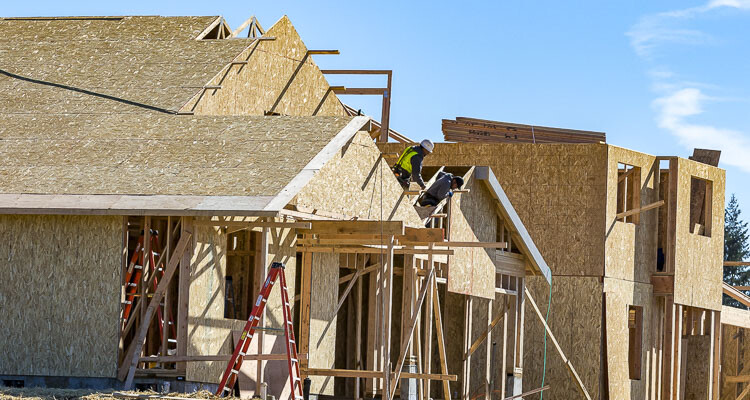
Clark County needs 15,703 units according to Building Industry Association of Washington study
Brett Davis
The Center Square Washington
Washington state needs nearly 252,000 new housing units to meet current demand, according to a new Building Industry Association of Washington study detailing the state’s housing supply shortage on a county-by-county basis.
The BIAW study utilized the same formula as government-sponsored mortgage finance giant Freddie Mac in calculating housing demand in the Evergreen state. Said formula takes into account estimated long-term vacancy rates and the target number of households to calculate approximate housing demand.
Washington’s most populous counties had the biggest housing shortages in terms of raw numbers.
Per the study, King County needs more than 76,364 units to meet the current demand of its 902,308 households. Pierce County is short 28,212 units. Snohomish County needs 25,371 units. Spokane County needs 17,589 units. Clark County needs 15,703 units.
The top three counties, according to the study, with the most acute housing shortage based on the percentage of the population that needs housing are San Juan County (12.8%), Pacific County (12.5%) and Pend Oreille County (10.9%).
The study, which also breaks down new permits issued by county, notes that local governments processed just over 49,000 building permits for new housing units last year. BIAW estimates fewer than 46,000 of these permitted units made it to market.
“At this rate, it will take five and a half years to catch up to current demand, assuming no new inward migration or population growth,” said BIAW Executive Vice President Greg Lane in a news release about the study. “This is why permit and zoning reforms were so critical during the 2023 legislative session.”
In May, Gov. Jay Inslee, who has repeatedly stated Washington’s homeless crisis is due to a lack of housing, signed into law several housing bills that passed the Legislature this session.
“Because the housing supply crisis has escalated the last 10 years, now 80 percent of Washington households can’t afford to purchase a median-priced home,” Lane said. “Policymakers need to ensure that more than just 20 percent of families can purchase homes in Washington. And that can only be addressed by increasing supply and reducing regulation.”
In May, the BIAW put out a report that found median-priced homes are out of reach of 76% of Washington households.
The BIAW’s most recent study recommends four major strategies to stimulate more housing construction in Washington: reforming the project approval process, accelerating the permit process, reassessing the effectiveness of impact fees and reviewing design standards and building codes.
The Center Square reached out to the Governor’s Office for comment on the recommendations from the state’s largest trade organization.
Reforming the project approval process
“The governor has supported numerous efforts to ensure worthwhile projects are able to move quickly while we maintain adequate local engagement,” Inslee spokesperson Mike Faulk emailed The Center Square. “This past session he supported transit-oriented development, middle housing, consolidation of local permit review, accessory dwelling unit construction and SB 5258 regarding condo construction.
“The governor also signed SB 5412 marking a major shift in how SEPA [State Environmental Policy Act] treats residential development and making exemptions for residential construction. He also signed HB 1293 instructing cities to apply only clear and objective regulations to exterior designs of new developments to close off NIMBY tools often used for slowing down or rejecting developments. He wants to find more ways to improve the project approval process.
Accelerating the permit process
“The governor supports policies that would create a so-called ‘express lane’ for developments like affordable housing and higher density housing,” Faulk said. “There is also a statewide task force that will be looking at how to improve permit timelines and could inform that discussion.”
REASSESSING THE EFFECTIVENESS OF IMPACT FEES
“Local governments already have the ability to waive impact fees to encourage development,” Faulk noted. “The governor would prefer to focus efforts on deeper investments in housing programs we know work and to make them financially feasible via public investment and incentives.”
Reviewing design standards and building codes
“Building codes are an important part of planning for healthy, safe, sustainable communities long-term,” Faulk said. “Residents will pay less over time when their buildings are energy efficient and their families and communities will suffer less from pollution and climate impacts.”
This report was first published by The Center Square Washington.
Also read:
- VIDEO: WA diesel hits record $6.53, crushing truckers and school budgets
 With diesel nearing $6.53 per gallon in Washington, trucking businesses and school districts now confront sharply higher fuel expenses affecting budgets and workers.
 - WA’s status solidifies as one of the most expensive places in US
 A new study shows Washington outpaces most states on cost of living, with metrics revealing a sharp rise in daily expenses and major metro areas ranking among the nation’s most expensive.
 - Opinion: Someone explain the Democrat Party to me please
 Lars Larson criticizes Democrat politicians for shutdown threats, Homeland Security funding refusals, and positions on election laws, housing, and gun rights.
 - CCSO to conduct search related to 1971 disappearance of Jamie Grissim
 Clark County Sheriff’s Office is coordinating a targeted search in Dole Valley, aiming to recover the remains of Jamie Rochelle Grissim, missing since 1971.
 - Business Profile: Columbia River volleyball coach teaches The Elite Competitor
 Bre Smedley co-founded The Elite Competitor to help young athletes handle the mental demands of sports by offering support, resources, and ongoing training for players, parents, and coaches.
 - POLL: Do you agree with requiring board members to follow council direction?
 Disagreement among county councilors centers on whether C-TRAN board members should reflect the council’s collective wishes or act independently, highlighting ongoing concerns about public accountability.
 - High-value WA home listings increase by 65% after income tax passage
 After lawmakers approved an income tax targeting millionaires, listings for homes priced at $2 million or more jumped 65 percent compared to last year, with experts urging caution about interpreting the spike.
