


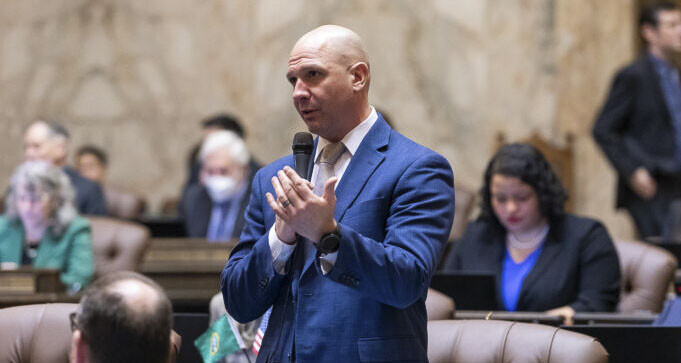
Lawmaker states that while the bill establishes drug possession as a gross misdemeanor, it creates opportunities for violators to ‘game the system’ without punishment or undergoing treatment
Rep. Peter Abbarno released the following statement after Senate Bill 5536 – a flawed effort to address the state’s drug possession laws – failed to pass the House on the final day of the 2023 legislative session:
“Senate Bill 5536 takes the very policies that have failed to address substance abuse on the local level and expands those failed policies statewide. It will lead to more substance abuse, more homelessness, more preventable tragedies, and less local control. If the majority party were serious about addressing this crisis, they would work with us, on a bipartisan basis, and pass legislation that effectively helps people recover from addiction. Sadly, this bill will do the opposite.”
While the bill establishes drug possession as a gross misdemeanor, it creates opportunities for violators to “game the system” without punishment or undergoing treatment. The measure would also prevent local governments from restricting the distribution of dangerous drug paraphernalia; house recovering addicts with active drug users; establish “safe” injection sites open to all ages, including children; and eliminate the public notice requirement for siting opioid treatment facilities.
For these reasons, House Republicans were unanimous in their opposition to the bill and were joined by 14 House Democrats. A tentative, bipartisan agreement was struck the day prior, but House Democrats offered only a partisan conference report to vote on as the House approached the final hours of session.
“Drug abuse, addiction, and the rise in crime are serious issues in communities across Washington state,” added Abbarno, R-Centralia. “The proposal brought forth by House Democrats did not represent my values, the values of my community, or the values of the state of Washington. We are committed to working on a real solution that protects our communities and serves the most marginalized and those struggling with addition. That might require a special session and we will have to wait.”
Background: In Feb. 2021, the state Supreme Court ruled in State v. Blake, that Washington’s felony drug-possession statute was unconstitutional because it criminalized possession even when a person did not knowingly have drugs.
Two months later, the Legislature passed Senate Bill 5476, a temporary measure reducing the penalty for possessing illegal drugs like fentanyl, heroin, and methamphetamine from a felony to a misdemeanor, which is set to expire on July 1, 2023. Unless the Legislature acts in time, there will be no statewide criminal penalty for possession of these drugs. Local governments could, however, adopt their own criminal penalties.
Information provided by Washington State House Republicans,
houserepublicans.wa.gov
Also read:
- Opinion: Workers need their wages more than the state’s paid-leave program does
 Washington’s paid-leave payroll tax stands at 1.13% and is projected to hit its 1.2% cap by 2027, with some lawmakers eyeing a 2% rate.
 - Opinion: Fatal flaws of Socialism – The knowledge problem
 Cargill argues no government, committee, or computer can possess the dispersed knowledge that markets coordinate through prices.
 - Battle Ground Public Schools seeks citizen advisory committee members
 Battle Ground Public Schools invites parents and residents to join its Citizens Advisory Committee, with open meetings Sept. 10 and Oct. 8.
 - Ridgefield Main Street unveils new Greely Building photo panels
 Large-scale photo panels on the Greely Building showcase Ridgefield’s wildlife refuge, Chinookan Plankhouse, and dragon boat traditions.
 - Vancouver Police investigate fatal collision
 A 74-year-old man in a motorized wheelchair died after a pickup truck struck him in a Vancouver intersection Wednesday evening.
 - Opinion: ‘It may be time for McCleary 2.0’
 Dick Rylander examines the Battle Ground School District’s proposed $116,830,000 three-year EP&O levy heading to the November 2026 ballot.
 - Washington Policy Center tax expert warns that new income tax will affect everyone
 Ryan Frost argues Washington’s new 9.9% income tax has a $1M deduction that a simple legislative majority could remove.