


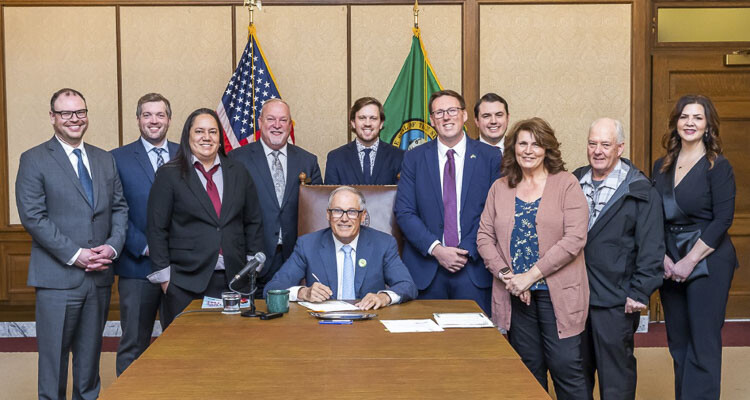
House Bill 1730, which is the freshman lawmaker’s first piece of legislation, will improve the state’s workforce by opening up certain job positions to a larger group of applicants
The governor signed into law a bill from Rep. Kevin Waters on Thursday that will give many of Washington’s smaller businesses a boost in their hiring efforts.
House Bill 1730, which is the freshman lawmaker’s first piece of legislation, will improve the state’s workforce by opening up certain job positions to a larger group of applicants. The legislation allows young adults between the ages of 18 to 21 to be employed in establishments traditionally classified as off-limits to persons under the age of 21, under specific and limited circumstances
“I’m grateful to see this bill become law. I have no doubt it will help our state’s workforce,” said Waters, R-Stevenson. “Many small businesses, especially restaurants and bars, are still having a hard time finding and holding onto good employees. This legislation is also going to open more opportunities for individuals under 21 looking for work. This is a positive step forward for employers and job seekers, and the entire state.”
Because HB 1730 contains an emergency clause it takes effect immediately.
Under the law, it is now legal for anyone at least 18-years-old to perform services unrelated to the sale or service of alcohol to enter and remain on premises, but only to carry out the duties of their employment as a dishwasher, cook, chef, sanitation specialist, or other kitchen staff and only under the following conditions:
- The individual may not perform any services or work in the bar, lounge, or dining area of the licensed premises.
- The individual may not serve food, drinks, or otherwise interact with the patrons of the licensee.
- The individual may never be in possession of or consume alcohol at any time.
- The licensee must ensure that a supervisor, who is at least 21 years of age, is always present where an individual employed under this section is working.
- This section shall not be construed as permitting the sale or distribution of any alcoholic beverages to any person under the age of 21 years.
“It’s great to see this simple bill become law and I’m excited to see the positive effects it will have in easing our workforce shortage,” added Waters.
The 2023 legislative session is scheduled to end on Sunday, April 23.
Information provided by Washington State House Republicans, houserepublicans.wa.gov
Also read:
- Opinion: Were Republican voters just sleeping during the August primary election?
 CCRP Chairman Matt Bumala says 60% of primary no-shows in the 17th and 18th districts were Republicans.
 - High school football: New coach prepares for long-term success at Prairie High School
 James Young-Lewis, a Clark County native who graduated from Evergreen in 2009, became Prairie’s head coach in May after working as an assistant coach across various programs since 2015, joining Prairie’s staff in 2024.
 - Cost to battle 20 wildfires in WA has topped $200M
 Twenty wildfires have cost Washington $207M in one month, more than two-thirds of what DNR spent all last fiscal year.
 - Opinion: WA Cares’ launch showcased care WA Cares did not provide
 Gov. Ferguson showcased a caregiving arrangement at the WA Cares launch that the program had not paid for a single day of.
 - Former State Rep. Liz Pike provides update on husband Neil Cahoon
 Neil Cahoon, a Camas resident, has undergone multiple surgeries including five on Aug. 15 after the Aug. 10 crash near La Center’s Daybreak Airport.
 - Opinion: Portland’s War on Cars Part 4 – A smarter automobile strategy to end gridlock
 O’Toole argues fuel wasted in Portland-area congestion has sextupled since 1982, generating 250,000 tons of extra greenhouse gases annually.
 - $1,000 first prize for Camas Plein Air Art Event honoring Marquita Call on Sept. 26
 Plein air artists compete Sept. 26 in Camas for $1,000 first prize honoring gallery founder Marquita Call.