


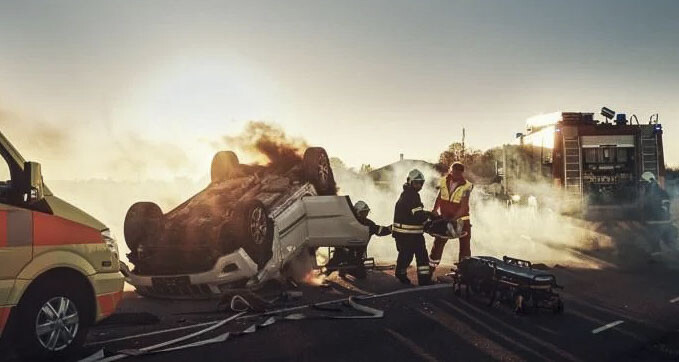
According to the latest data, 709 people were killed in traffic accidents last year, the most since Gov. Jay Inslee’s Results Washington Initiative began tracking those numbers
TJ Martinell
The Center Square Washington
Washington state has a goal of eliminating traffic fatalities by 2030, but for now, state officials are looking for ways to bring them down from what are currently record highs.
According to the latest data, 709 people were killed in traffic accidents last year, the most since Gov. Jay Inslee’s Results Washington Initiative began tracking those numbers.
The figure represents a 45% increase since 2019 when there were 490 fatalities. In 2013, there were 413 fatalities. The most common cause of a traffic fatality was an impaired driver, which was responsible for an estimated 339 deaths last year. A speeding driver was the second most common cause, contributing to 251 deaths.
Recently the Washington Traffic Safety Commission, or WTSC, placed speed trackers at 206 sites around Washington. Of those, 37% of drivers were going at least six miles or more over the speed limit.
“Speed kills,” Gov. Jay Inslee said at a June 28 meeting, adding that there needed to be a way “to get people to be more reasonable drivers in the state of Washington.”
According to WTSC Director Shelly Baldwin, 60% of traffic deaths occur in the eight largest counties, though she said at the June 28 meeting that the problem “reaches all parts of our state.”
“Our vision is a Washington where we all work together to travel safely on our roadways,” she said.
One potential solution the state may implement is the further use of speed cameras. Recent legislation permits local jurisdictions to install speed cameras in more locations, while a bill passed during this year’s legislative session authorizes speed cameras on state highways in work zones.
Baldwin said the speed cameras in cities are a temporary measure for work zones until “the roadway prevents them from driving too fast.”
Inslee indicated at the meeting his desire to see cameras permanently installed on highways such as Interstate 5, stating that residents shouldn’t be concerned about it when there are cameras installed in places like grocery stores and gas stations.
“[We] can’t allow this carnage to continue when we have technology that works and Washingtonians are used to in their lives,” he said.
Other possible solutions examined at the meeting concerned proper driver training for residents who wait until they’re 18 or older to avoid the instruction school requirement. Another was whether to make motorcycle training more thorough in order to obtain an endorsement.
This report was first published by The Center Square Washington.
Also read:
- Opinion: Were Republican voters just sleeping during the August primary election?
 CCRP Chairman Matt Bumala says 60% of primary no-shows in the 17th and 18th districts were Republicans.
 - High school football: New coach prepares for long-term success at Prairie High School
 James Young-Lewis, a Clark County native who graduated from Evergreen in 2009, became Prairie’s head coach in May after working as an assistant coach across various programs since 2015, joining Prairie’s staff in 2024.
 - Cost to battle 20 wildfires in WA has topped $200M
 Twenty wildfires have cost Washington $207M in one month, more than two-thirds of what DNR spent all last fiscal year.
 - Opinion: WA Cares’ launch showcased care WA Cares did not provide
 Gov. Ferguson showcased a caregiving arrangement at the WA Cares launch that the program had not paid for a single day of.
 - Former State Rep. Liz Pike provides update on husband Neil Cahoon
 Neil Cahoon, a Camas resident, has undergone multiple surgeries including five on Aug. 15 after the Aug. 10 crash near La Center’s Daybreak Airport.
 - Opinion: Portland’s War on Cars Part 4 – A smarter automobile strategy to end gridlock
 O’Toole argues fuel wasted in Portland-area congestion has sextupled since 1982, generating 250,000 tons of extra greenhouse gases annually.
 - $1,000 first prize for Camas Plein Air Art Event honoring Marquita Call on Sept. 26
 Plein air artists compete Sept. 26 in Camas for $1,000 first prize honoring gallery founder Marquita Call.