



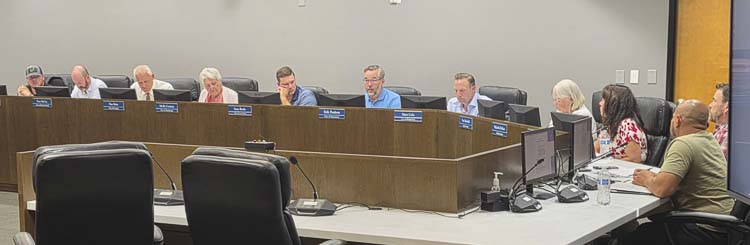
A 3-3-3 format will mean three board members for the city of Vancouver, three for Clark County, and three to represent all of the smaller cities, but it is possible that the committee will have to vote on a 4-3-2 format, giving the smaller cities even less representation
Paul Valencia
Clark County Today
A review committee on Tuesday said it will ask the state to accept its proposal that will lead to one more seat for Clark County on the C-TRAN Board of Directors, and take away a seat from the smaller cities.
The 3-3-3 plan, a compromise, would leave the city of Vancouver with three representatives on the C-TRAN Board, gives three representatives to the Clark County Council, and then has three seats divided between the other cities in the county.
There is a catch: If the state does not accept this proposal, the review committee will meet again in early September, most likely to vote on a 4-3-2 proposal — giving the City a fourth seat, the County a third seat, and then having the rest of the cities share two seats.
This was in response to the Washington State Department of Transportation informing C-TRAN that the C-TRAN board has been out of compliance with state law in regard to representation based on population. WSDOT said the board is currently underrepresented by the city and unincorporated portions of the county, and overrepresented by the smaller cities in the region.
C-TRAN was asked to take action before Oct. 1 in order to continue receiving millions of dollars in grant money.
This led to an informative, and sometimes intense, exchange from the 11 members of the Board Composition Review Committee at a special meeting held Tuesday at C-TRAN headquarters in east Vancouver.
Several members of the board noted that to be in compliance, this panel should vote for the 4-3-2 proposal.
Others pointed out that changing the current structure — three city seats, two County seats, and four seats representing the smaller cities — is a sign that the board is taking action on the state’s request. At the same time, by going to the 3-3-3 instead of a 4-3-2, it aligns closer to C-TRAN’s historic vision to represent all the areas of Clark County, not just the Vancouver urban area.
Wil Fuentes, one of the three Clark County representatives on this review committee, initially argued for the 4-3-2. Taking away Vancouver and the Clark County Urban Growth Area, he said the rest of the area makes up close to 17 percent of the population.
“It’s not even a third, anywhere near close to a third,” Fuentes said. “I don’t think it’s fair (to) reallocate three seats to six jurisdictions that don’t even make up 17 percent of the population.”
Sean Boyle, representing La Center, gave a quick rebuke.
“So should we just make this a Vancouver Transit Zone?” he asked Fuentes.
Tim Hein of Camas gave a historical perspective, noting C-TRAN’s vision from the start of the organization in 1981. All city and county residents would buy in to be part of the larger mission because it was in the best interest of the region. But all areas would have representation.
Now, the review committee is being asked to make changes based on the state saying the board representation must be population based, he said. He asked to go to the 3-3-3 model and provide a rationale to the state as to why that works better for Southwest Washington than simply a numbers game.
“I came here believing 3-3-3 might be a good middle ground for everybody,” said Matt Cole, representing Ridgefield.
Erik Paulsen, representing Vancouver, gave a summary of events, acknowledging that it might seem unfair to the smaller cities, but C-TRAN cannot afford to lose the state’s grant money.
“We have a significant amount of money at stake on the one hand, and we have an issue of equity and fairness on the other. Ultimately, this is what is in conflict,” Paulsen said. “Nobody likes to be told what to do, especially under threat. But the fact of the matter is we are under threat. We are under threat of a significant amount of money.”
He called the motion of a 3-3-3 model “laudable” but also “naive.” While acknowledging the description in the letter from WSDOT was not specific, he believes the state wants C-TRAN to give more seats to the urban areas.
“Between the city of Vancouver and the Clark County UGA, within the service area … that represents 80 percent of the population. … Proportionately speaking, that is actually more, a fraction more, than seven of nine seats. I know that doesn’t feel good for the small cities and other folks in the community … But if the consequence of going with 3-3-3 and (being denied by the state) is to lose out on $12, $13 million a year in funding, that’s an awful big risk to take.”
Fuentes did acknowledge the fears of the smaller cities, including the possibility that Vancouver could have “double representation” in a 4-3-2 format, “which is why the 3-3-3 model kind of makes sense.”
However …
“My concern is we are going to be out of compliance. This agency cannot afford to lose out on several million dollars if the state does not approve our recommendation,” he said.
All 11 members of the review committee were also very aware of the pending deadline. The committee must make its recommendation before the next scheduled C-TRAN Board meeting, on Sept. 9. That way the C-TRAN board can approve that recommendation before the Oct. 1 deadline imposed by the state.
Michelle Belkot, also representing Clark County, proposed adding a special meeting for the review committee if the state denies the 3-3-3 proposal.
Troy McCoy of Battle Ground said he felt “painted in a corner” by the state’s letter, and he feels like he’s “staring down the gun.”
At the same time, he knows what is at stake.
“I do not want to put C-TRAN grant money at risk. Feels like a forced decision has been made for us,” he said.
Molly Coston, representing Washougal, one of the smaller cities, said there needs to be a responsibility to C-TRAN, to not lose funding.
“In that sense, I think we have to vote,” and she paused, almost like she couldn’t believe what she was about to say, “according to the 4-3-2 model.”
She then wondered aloud if the board could make it a 4-3-2 model now to satisfy the state’s demand, then later modify it with the state’s permission to go to a 3-3-3.
“Once you go to one thing, there is no going back. Just like taxes,” Belkot said.
(Unspoken during the committee members’ time to speak, but certainly felt by all, Belkot is on this Review Committee while she is also suing Clark County in order to get her seat back on the C-TRAN Board.)
Matt Little of Clark County asked what is the harm in sending the state the proposal for the 3-3-3 model. Worst case, it is denied, and the review committee can meet again in early September.
Coston agreed: “I think we have to try, to not be totally bullied into their recommendation.”
With that, the members voted to go that route, proposing the 3-3-3 model. That motion passed 10-1, with Paulsen saying no.
Just before that vote, the review board also voted on what it would look like for the smaller cities in the 3-3-3 model, and if it becomes a 4-3-2 format.
Under the 3-3-3 model, Seat 1 would be La Center, Yacolt, Battle Ground, Seat 2 would be Camas, and Seat 3 would be Ridgefield and Washougal. That would come close to each seat representing the same number of people.
Under the 4-3-2 model, Seat 1 would be filled by North County, and Camas and Washougal would share Seat 2. All 11 members agreed on that motion.
The Review Committee scheduled a meeting for Sept. 3, but members noted they could cancel that meeting if the state accepts the 3-3-3 model. If the state denies the 3-3-3 model, the Review Committee will reconvene Sept. 3 to consider its next steps, in time before the next C-TRAN Board meeting on Sept. 9.
Also read:
- Opinion: ‘When are we going to get the full and complete details of the Interstate Bridge Replacement Program’s I-5 Bridge replacement project?’
 IBR team buried key details about light rail ending at waterfront with massive elevator system required.
 - POLL: Do you support extending light rail beyond the waterfront to connect with C-TRAN at Library Square?
 Readers can weigh in on Anne McEnerny-Ogle’s proposal to extend light rail beyond the waterfront to Library Square for improved C-TRAN connections.
 - Opinion: Passing a cyclist – Law, myth and a little patience
 Most drivers can’t legally pass cyclists in-lane due to vehicle width versus road measurements.
 - Vancouver mayor counters IBR’s proposal for the only light rail stop to be at the waterfront
 Vancouver’s mayor wants light rail extended beyond the waterfront to connect with C-TRAN buses at Library Square.
 - Letter: ‘This is the worst thing that ever happened to the region’
 A Hayden Island resident Sam Churchill is criticized in a letter calling the $14 billion Interstate Bridge Replacement project a “boondoggle” that destroys local businesses.
