



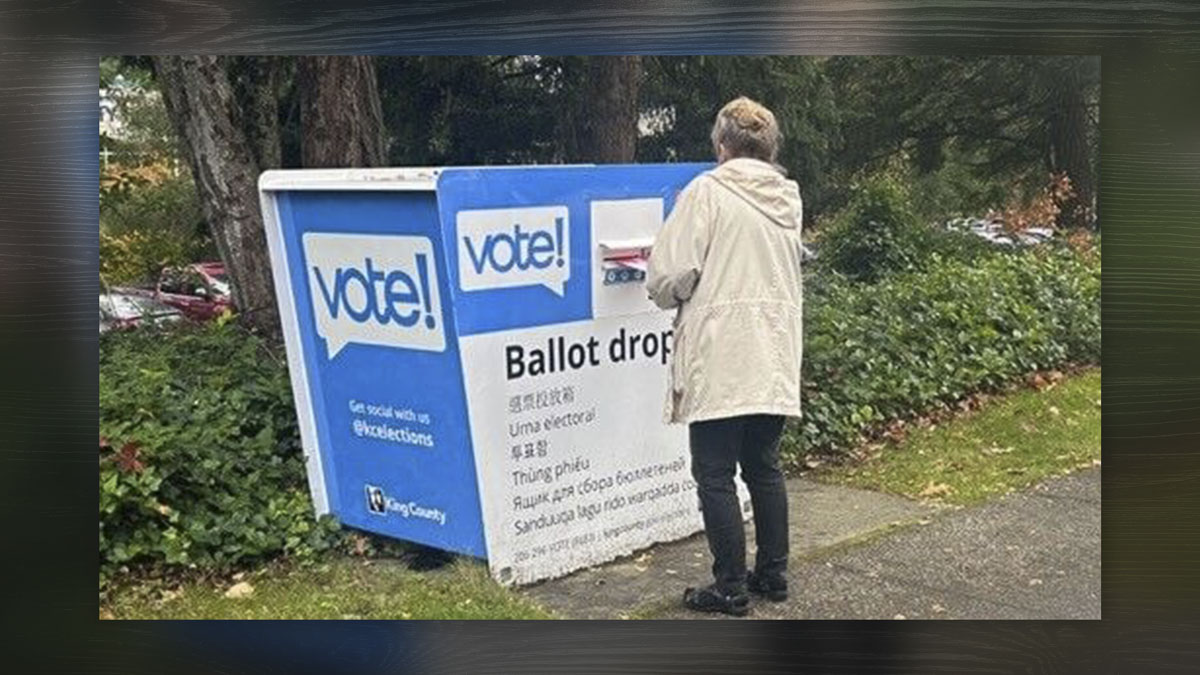
Voters will have the final say in the fall’s general election
Carleen Johnson
The Center Square Washington
Initial returns from Tuesday’s primary election in Washington state show an extremely tight race in the 26th Legislative District, which includes Gig Harbor, Port Orchard and Bremerton.
Rep. Michelle Caldier, R-Gig Harbor, who has served six terms in the state House of Representatives, is running for the state Senate seat against Sen. Deb Krishnadasan, D-Gig Harbor.
Krishnadasan was appointed to the seat in late 2024 to fill the vacancy left by Emily Randall, who was elected to the U.S. House of Representatives.
Of 29,292 votes counted on Tuesday, Caldier (50.04%) leads Krishnadasan (49.74%) by 89 votes.
Both candidates will advance to the Nov. 4 election.
In the 5th Legislative District in east King County, Democrat Victoria Hunt moved from the House to the Senate after Sen. Bill Ramos’s sudden passing at the end of the 2025 legislative session. Hunt is facing Republican candidate Chad Magendanz for the Senate seat in that legislative district.
After initial ballots were counted Tuesday night, Magendanz received 47.02% of the votes tallied, while Victoria Hunt received 52.79%.
Out of the 24,019 ballots tallied so far, Hunt has the edge by 1,387 votes.
Voters will have the final say in the fall’s general election.
Those two contests may be Republicans’ best chance to take back a couple of seats in the state Senate.
Democrats currently hold a 30-19 seat advantage in the Senate, and a 59-39 advantage in the House.
Washington State Republican Party Chair and state Rep. Jim Walsh, R-Aberdeen, told The Center Square that Caldier and Magendanz have the potential to win over some Democrats.
“If a candidate is successful at persuading not just middle voters, but these voters on the other side to come over, they’re pulling votes out of the other side’s base,” Walsh said. “I’m cautiously optimistic that each of them will.”
State Director of Elections Stuart Holmes told The Center Square that voters approve of the top-two primary system.
“The voters like it because they like to be able to select any candidate they want,” Holmes explained. “And regardless of party, the top two will advance to the general election.”
Washington adopted the top-two primary system in 2004 after the passage of Initiative 872. This system replaced the open primary used in Washington state with a top-two nonpartisan blanket primary.
Washington was the first state to conduct a top-two primary election in August 2008.
Holmes said there is a projected turnout of about 30% of voters for the primary.
As of Tuesday night, 822,389 ballots, or 18.5% of the 4.4 million registered voters in Washington, had been processed.
If the 30% turnout pans out, election officials will have nearly half a million additional votes to tally in the coming days as late ballots trickle in.
Ballot returns will be updated daily for the rest of the week.
Election results will be certified on Aug. 19.
This report was first published by The Center Square Washington.

Also read:
- VIDEO: WA diesel hits record $6.53, crushing truckers and school budgets
 With diesel nearing $6.53 per gallon in Washington, trucking businesses and school districts now confront sharply higher fuel expenses affecting budgets and workers.
 - WA’s status solidifies as one of the most expensive places in US
 A new study shows Washington outpaces most states on cost of living, with metrics revealing a sharp rise in daily expenses and major metro areas ranking among the nation’s most expensive.
 - Opinion: Someone explain the Democrat Party to me please
 Lars Larson criticizes Democrat politicians for shutdown threats, Homeland Security funding refusals, and positions on election laws, housing, and gun rights.
 - POLL: Do you agree with requiring board members to follow council direction?
 Disagreement among county councilors centers on whether C-TRAN board members should reflect the council’s collective wishes or act independently, highlighting ongoing concerns about public accountability.
 - High-value WA home listings increase by 65% after income tax passage
 After lawmakers approved an income tax targeting millionaires, listings for homes priced at $2 million or more jumped 65 percent compared to last year, with experts urging caution about interpreting the spike.
