



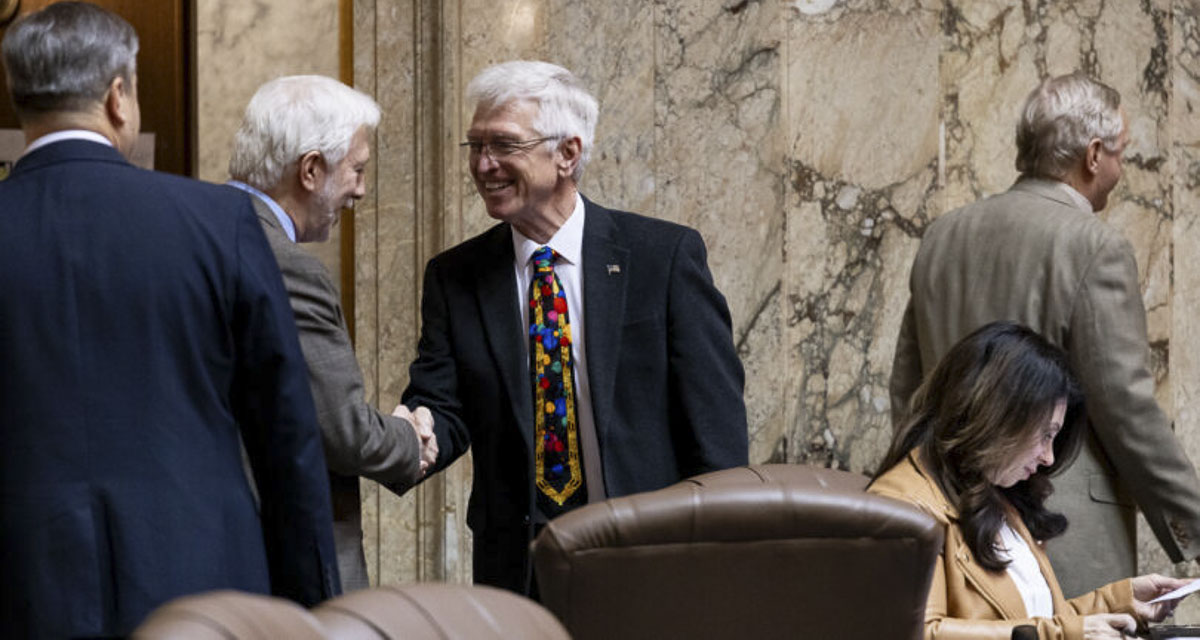
House Bill 2143 would repeal the provision allowing WSDOT to withhold funding when board membership is not allocated strictly by population
Rep. John Ley has introduced legislation aimed at resolving an ongoing dispute between the city of Vancouver and smaller Clark County cities over representation on the C-TRAN Board of Directors.
The conflict stems from a state requirement that transit agency boards be allocated proportionally by population, or risk having funding withheld by the Washington State Department of Transportation (WSDOT). State law also prohibits any single city from holding more than half of a board’s seats to prevent one jurisdiction from dominating decision-making.
“For most of C-TRAN’s history, the Board’s power was evenly divided, with three seats each for the small cities, Clark County, and the City of Vancouver,” said Ley, R-Vancouver. “That structure ensured smaller cities had an equal voice at the table.”
“However, recent changes to this balance have disrupted the community. That could force residents of smaller cities to help fund a light rail extension tied to the Interstate Bridge Replacement Program, which would primarily benefit a small number of people in downtown Vancouver.”
House Bill 2143 would repeal the provision allowing WSDOT to withhold funding when board membership is not allocated strictly by population. The bill would also cap representation for Clark County and the City of Vancouver at three seats each, preserving seats for smaller cities rather than assigning them solely by population.
“The elected leaders of our small cities have taken a firm stand on this issue at the C-TRAN Board level,” noted Ley. “My bill would protect their voice, ensuring those small communities are heard, and their influence remains at a level that has served the community well for nearly 40 years.”
The 2026 legislative session begins on Monday, Jan. 12.
Information provided by the Washington State House Republicans, houserepublicans.wa.gov
Also read:
- VIDEO: WA diesel hits record $6.53, crushing truckers and school budgets
 With diesel nearing $6.53 per gallon in Washington, trucking businesses and school districts now confront sharply higher fuel expenses affecting budgets and workers.
 - Opinion: In plain sight – yielding to pedestrians
 Drivers often fail to see pedestrians due to inattentional blindness, which highlights the need for more focused awareness at intersections and stronger safety practices.
 - Expect delays on SR 14 in Vancouver for guardrail repairs Wednesday
 State Route 14 travelers in Vancouver should plan for morning delays as WSDOT will close two eastbound lanes for guardrail repairs, affecting mileposts 6.0 to 7.0.
 - Overnight closure planned on westbound SR 14 Camas Slough Bridge Tuesday
 WSDOT crews will close westbound SR 14 at Exit 14 in Camas to collect bridge deck samples and plan future repairs; detours will be in effect.
 - Opinion: Stay in your lane – seriously, it’s the law
 Drivers must choose the nearest lane when turning in Washington, and left turns bring added risk. Even with signals, every driver must help prevent crashes by following law.
 wpDiscuz
