


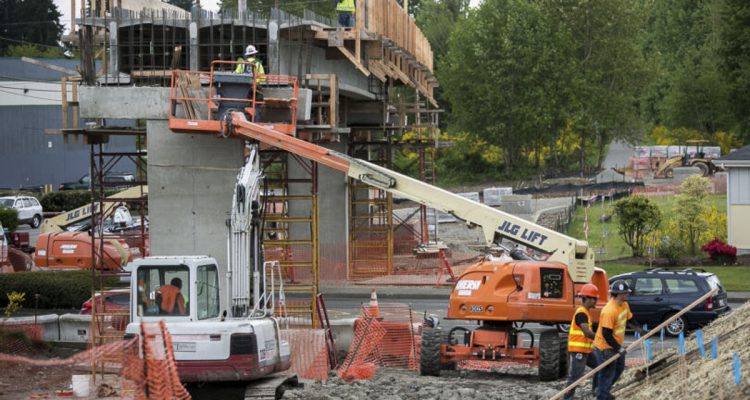
Bill would also exempt certain facility owners from asbestos inspection, management, and reporting requirements for commercial aggregates or asphalt and concrete material
On Tuesday, the House Environment and Energy Committee unanimously passed House Bill 1857 from Rep. John Ley, which would help businesses and labor groups reduce the cost of construction.

The bill would exempt commercial aggregates or asphalt and concrete materials from restrictions pertaining to labeling and the use of naturally occurring asbestos-containing building materials. It would also exempt certain facility owners from asbestos inspection, management, and reporting requirements for commercial aggregates or asphalt and concrete material.
“A well-intended bill passed several years ago to address concerns about asbestos and people’s health had unintended consequences,” said Ley, R-Vancouver, who represents the 18th District. “Certainly, we must monitor construction materials and ensure people are not exposed to asbestos in their homes and other structures. However, asbestos naturally occurs in our rocks and soil and is commonly found in smaller concentrations in commercial aggregates or asphalt and concrete materials.
“These materials are vital to the construction industry, specifically for roads, driveways, and parking lots. However, the standards enacted from the previous policy have created an unnecessary burden. The original policy never intended to include these materials used on our roads. This legislation would exempt these materials from the current standard and boost to the construction industry.”
Asbestos is a naturally occurring mineral fiber found in rock and soil. The Federal Environmental Protection Agency classifies six categories of asbestos mineral fibers: chrysotile, amosite, crocidolite, tremolite, anthophyllite, and actinolite. Asbestos can be used as an insulator or fire retardant in various consumer goods, including building materials, and is also found as a naturally occurring contaminant in deposits of other mineral types used for commercial purposes.
“Our state is facing an affordable housing crisis, and this is one way to reduce manufacturing costs for builders,” noted Ley. “If this bill becomes law, it would lower the cost of every driveway and street poured by removing the cost of testing these materials and the facilities that manufacture them. The construction industry, laborers, and businesses are all in favor of this bill.”
The use of asbestos-containing building materials in new construction or renovations in Washington is prohibited. However, this prohibition does not apply to the use of asbestos-containing building materials in residential construction that are already ordered by a contractor or in the contractor’s possession or if compliance would result in the breach of a contract.
Under HB 1857, commercial aggregates or asphalt and concrete materials would be exempted from the prohibition on manufacturing, wholesaling, or distributing for sale asbestos-containing building materials without labeling them, and on the use of asbestos-containing building materials in new construction or renovations.
Additionally, owners of certain manufacturing facilities would not be required to inspect their facility to determine whether commercial aggregates or asphalt and concrete materials are present. These facilities would also be exempt from the requirement to create an asbestos management plan for commercial aggregates or asphalt and concrete materials, and the regulations regarding the required plan.
“This legislation would exempt commercial aggregates from the current policy because of the costs it imposes on industry and construction,” said Ley. “House Bill 1857 would allow communities to harvest local rocks and provide cheaper aggregate for use in local construction projects. It would also reduce the number of trucks coming from long distances to import the aggregate that would be required if this change were not made. That would reduce traffic and have a positive environmental impact.”
The bill now awaits a vote on the House floor.
Information provided by Washington State House Republicans, houserepublicans.wa.gov

Also read:
- Opinion: Were Republican voters just sleeping during the August primary election?
 CCRP Chairman Matt Bumala says 60% of primary no-shows in the 17th and 18th districts were Republicans.
 - Opinion: WA Cares’ launch showcased care WA Cares did not provide
 Gov. Ferguson showcased a caregiving arrangement at the WA Cares launch that the program had not paid for a single day of.
 - Auditor, auditor candidate address scrutiny over job title
 Greg Kimsey says roughly 40 county employees hold the deputy county auditor designation Kelly used in his campaign.
 - Opinion: Is Mitchell Kelly misleading voters with his ‘deputy auditor’ claim?
 Clark County HR records show no position called “Deputy County Auditor” has ever existed, Anderson argues.
 - Opinion: Democrats rig the ballot to save their income tax
 Churchill argues the ballot disclosure warning voters of education cuts describes revenue never collected and not yet allocated.