


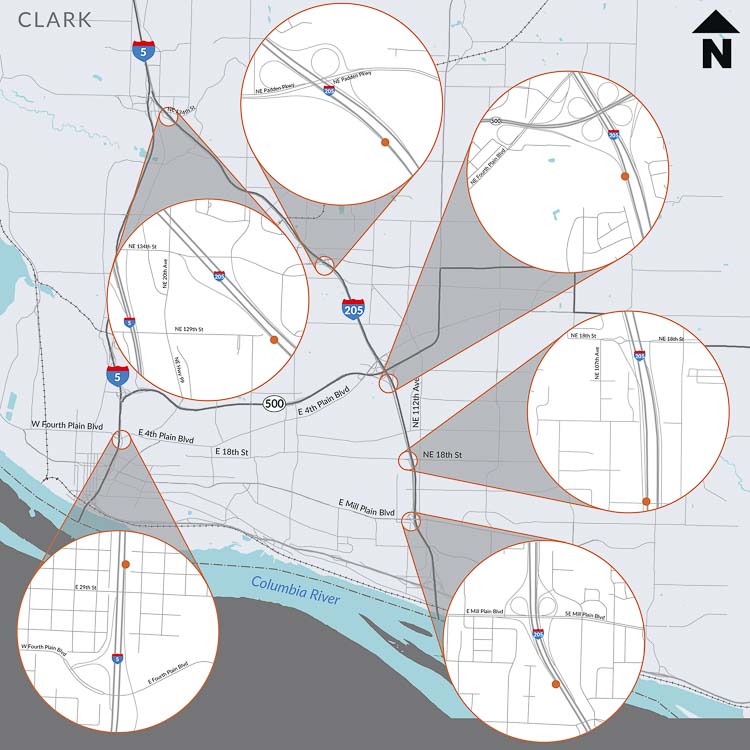
Beginning Tuesday, a WSDOT contractor will turn on the final ramp meter for the I-5/I-205 – Ramp Meter Installation project
VANCOUVER – Travelers on southbound Interstate 205 in Vancouver will soon notice improvements to their travel times.
Beginning Tuesday, Feb. 11, Washington State Department of Transportation contractor, Northeast Electric, LLC., will turn on the final ramp meter for the I-5/I-205 – Ramp Meter Installation project.
This project, which began in July 2023, involved the installation of six ramp meters on on-ramps along Interstate 5 and I-205 throughout Clark County. The final ramp meter in this series, located on the southbound I-205 off-ramp to State Route 500, will be activated on Tuesday, Feb. 11.
What to expect
Ramp meters are traffic signals that adjust to real-time traffic conditions. The meters create gaps between vehicles entering the highway, helping drivers merge more smoothly and keeping traffic moving at highway speeds. Ramp meters also lower the risk of crashes by 30 percent.
How to use ramp meters
Drive up to the white stop line to trigger the ramp meter. If the light is red, stop at the line. When it turns green, accelerate and merge onto the highway. Most ramp meters only let one vehicle enter the highway per green light, with a 4- to 15-second gap between vehicles entering the highway.
Ramp meter data
According to the Southwest Regional Transportation Council’s 2022 Congestion Management Process Summary Report, ramp meters reduced peak travel times on southbound I-5 from Main Street (milepost 3) to Jantzen Beach, Oregon, by 11 minutes.
On-ramp delays
Ramp meters help drivers already on the highway but can cause delays for those merging on. Unlike other states, ramp meters in Washington don’t run at set times. Instead, they adjust based on real-time traffic conditions. WSDOT traffic crews will fine-tune ramp meter operations and monitor traffic at each ramp after they’re turned on. WSDOT’s goal is to balance the needs of both merging drivers and drivers already on the highway.
Also read:
- Opinion: Portland’s War on Cars Part 4 – A smarter automobile strategy to end gridlock
 O’Toole argues fuel wasted in Portland-area congestion has sextupled since 1982, generating 250,000 tons of extra greenhouse gases annually.
 - Opinion: Transit ridership trends are dismal but regional plans are oblivious
 Puget Sound transit passenger-miles fell 31% from 2015 to 2024 despite a half-million-resident population increase.
 - Interstate Bridge Replacement Program seeks qualified firms for bridge replacement contract
 The CRBR project is backed by $5.7 billion from state funds, federal grants, and future tolling.
 - Opinion: Bankrupt – A $3.5 billion Rose Quarter Freeway widening project
 Joe Cortright argues ODOT’s Rose Quarter project has grown from a $450M approval to a $3.5B estimate, with a $2B funding gap.
 - Opinion: Portland’s War on Cars 3 – Ending the war on automobiles
 O’Toole argues Portland should add toll lanes, fix safety hazards, and redesign TriMet routes to end its anti-auto policies.