


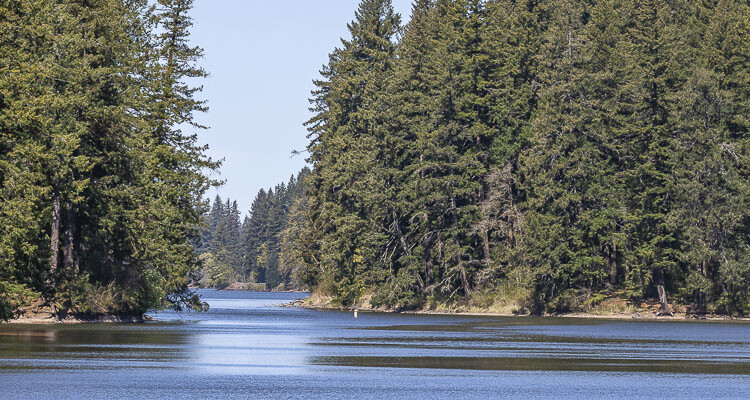
Results from water samples taken on Wednesday revealed cyanotoxins above the threshold level recommended by the Washington Department of Health
VANCOUVER – Clark County Public Health has issued a warning advisory for Lacamas Lake due to elevated levels of cyanotoxins from harmful algae.
Results from water samples taken from Lacamas Lake on Wednesday, July 5 revealed cyanotoxins above the threshold level recommended by the Washington Department of Health. Warning signs are being placed at public access points at the lake.
Cyanotoxins can be harmful to people, especially young children, and deadly for small pets that drink the water. When a warning advisory is in place, health officials recommend:
- No swimming or water skiing.
- No water contact for animals.
- Avoiding areas of scum when using motorized boats, paddle boarding, kayaking or canoeing.
- No drinking lake water.
- Cleaning fish well and discarding organs.
Public Health will continue to monitor Lacamas Lake and, while blooms are present, take weekly water samples to test toxin levels. Signs will be updated as conditions change.
Algal blooms are also present at Vancouver Lake and Round Lake in Camas, but results from water samples collected this week show toxin levels are below state threshold levels. Public Health will continue to monitor Vancouver and Round lakes and take weekly water samples to test toxin levels as long as the blooms are present.
Harmful algal blooms can pose a significant health risk if the cyanobacteria or toxins are ingested, inhaled or contact skin. Inhaled bacteria or toxins could cause wheezing, coughing, chest tightness and shortness of breath. Skin contact could lead to rash, itching, blisters and eye irritation.
If water with cyanotoxins is accidentally swallowed, symptoms could include abdominal pain, diarrhea, vomiting, numbness of the lips, tingling in fingers and toes, and dizziness.
Additional information about harmful algal blooms and current advisories are posted on the Public Health public beach website. To report algal blooms in other bodies of water, visit the Public Health website.
Information provided by Clark Co. WA Communications.
Also read:
- Opinion: Were Republican voters just sleeping during the August primary election?
 CCRP Chairman Matt Bumala says 60% of primary no-shows in the 17th and 18th districts were Republicans.
 - High school football: New coach prepares for long-term success at Prairie High School
 James Young-Lewis, a Clark County native who graduated from Evergreen in 2009, became Prairie’s head coach in May after working as an assistant coach across various programs since 2015, joining Prairie’s staff in 2024.
 - Cost to battle 20 wildfires in WA has topped $200M
 Twenty wildfires have cost Washington $207M in one month, more than two-thirds of what DNR spent all last fiscal year.
 - Opinion: WA Cares’ launch showcased care WA Cares did not provide
 Gov. Ferguson showcased a caregiving arrangement at the WA Cares launch that the program had not paid for a single day of.
 - Former State Rep. Liz Pike provides update on husband Neil Cahoon
 Neil Cahoon, a Camas resident, has undergone multiple surgeries including five on Aug. 15 after the Aug. 10 crash near La Center’s Daybreak Airport.
 - Opinion: Portland’s War on Cars Part 4 – A smarter automobile strategy to end gridlock
 O’Toole argues fuel wasted in Portland-area congestion has sextupled since 1982, generating 250,000 tons of extra greenhouse gases annually.
 - $1,000 first prize for Camas Plein Air Art Event honoring Marquita Call on Sept. 26
 Plein air artists compete Sept. 26 in Camas for $1,000 first prize honoring gallery founder Marquita Call.
 wpDiscuz