


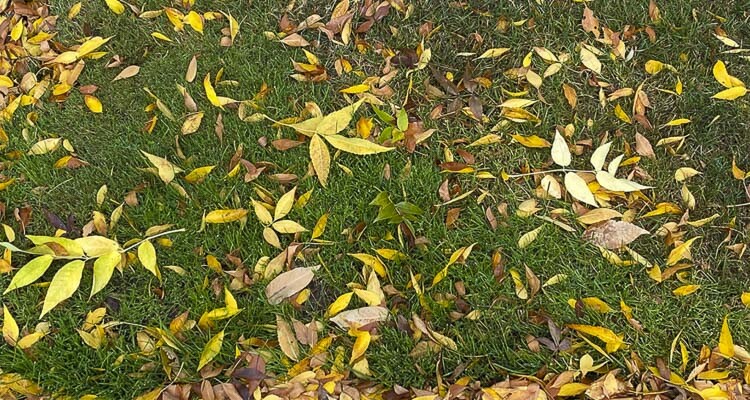
Fallen leaves can clog storm drains and create areas of standing water on roadways, making roads unsafe for drivers, bicyclists and pedestrians
VANCOUVER – As colorful leaves begin to fall from trees, Clark County Public Health is encouraging residents to properly dispose of leaves to keep them out of streets and the landfill.
Leaves should not be raked or blown into streets. Fallen leaves can clog storm drains and create areas of standing water on roadways, making roads unsafe for drivers, bicyclists and pedestrians. Instead, Public Health encourages residents to take advantage of local disposal options that use leaves to create compost.
Leaves are a nutrient-rich, biodegradable material. But each year, millions of pounds of leaves end up in landfills. When organic waste, like leaves, is left to rot in landfills it creates methane, a toxic greenhouse gas.
Rather than sending leaves to the landfill, Public Health asks residents to place leaves in their curbside yard debris or organics cart, or in their own backyard compost. Residents can also dispose of their leaves for free through the Fall Leaf Coupon program provided by Clark County Public Works and the city of Vancouver.
With a Fall Leaf Coupon, residents can drop off up to 5 cubic yards of leaves at one of four designated sites at no charge from Oct. 1 to Dec. 31. Residents can get their coupon by:
- Printing a coupon from www.cityofvancouver.us/leafcoupon, www.clarkgreenneighbors.org/leaves, or www.wcnorthwest.com/leaves
- Clipping a coupon from Waste Connections’ annual recycling newsletter, which will be mailed to all Clark County residences in October.
- Calling Vancouver Solid Waste at (360) 487-7160 or emailing solidwaste@cityofvancouver.us to have a coupon mailed.
- Picking up a coupon from Vancouver City Hall, 415 W. 6th Street, City of Vancouver Utility Services, 2323 General Anderson Road, or Waste Connections Customer Service Office, 12115 NE 99th St. #1830, Vancouver.
The four sites for leaf disposal are H&H Wood Recyclers, McFarlane’s Bark and West Van Materials Recovery Center in Vancouver, and Triangle Resources in Camas. Addresses, business hours and more information can be found on the coupon. Coupons in Español, Русский and Tiếng Việt are also available.
The coupons are for residential use only and cannot be redeemed by businesses. Branches and other yard debris are not eligible for free disposal. Loads should be covered during transport, and all bags of leaves will need to be emptied at the disposal site by the resident.
To learn more about backyard composting and for a schedule of free community workshops, visit the Clark County Composter Recycler website.
To report clogged drains and street flooding on roads in unincorporated Clark County, visit the Clark County Public Works website.
Information provided by Clark Co. WA Communications.
Also read:
- Opinion: Were Republican voters just sleeping during the August primary election?
 CCRP Chairman Matt Bumala says 60% of primary no-shows in the 17th and 18th districts were Republicans.
 - High school football: New coach prepares for long-term success at Prairie High School
 James Young-Lewis, a Clark County native who graduated from Evergreen in 2009, became Prairie’s head coach in May after working as an assistant coach across various programs since 2015, joining Prairie’s staff in 2024.
 - Cost to battle 20 wildfires in WA has topped $200M
 Twenty wildfires have cost Washington $207M in one month, more than two-thirds of what DNR spent all last fiscal year.
 - Opinion: WA Cares’ launch showcased care WA Cares did not provide
 Gov. Ferguson showcased a caregiving arrangement at the WA Cares launch that the program had not paid for a single day of.
 - Former State Rep. Liz Pike provides update on husband Neil Cahoon
 Neil Cahoon, a Camas resident, has undergone multiple surgeries including five on Aug. 15 after the Aug. 10 crash near La Center’s Daybreak Airport.
 - Opinion: Portland’s War on Cars Part 4 – A smarter automobile strategy to end gridlock
 O’Toole argues fuel wasted in Portland-area congestion has sextupled since 1982, generating 250,000 tons of extra greenhouse gases annually.
 - $1,000 first prize for Camas Plein Air Art Event honoring Marquita Call on Sept. 26
 Plein air artists compete Sept. 26 in Camas for $1,000 first prize honoring gallery founder Marquita Call.