



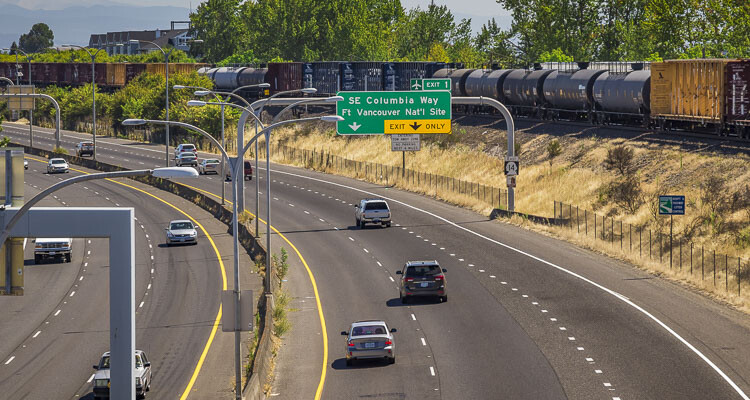
The projected revenue drop for the 10-year outlook fell $633 million compared to projections made just six months ago
Timothy Schumann
The Center Square Washington
Washington transportation funding is facing a revenue decline worth hundreds of millions of dollars, according to the most recent fiscal projections presented to the Washington State Transportation Commission.
Deputy Director Carl See shared details of the lowered revenue expectations, showing a theme of figures in red. In his overview, the projected revenue drop for the ten year outlook fell $633 million compared to projections made just 6 months ago in November of 2022.
According to See, the downward revisions are “largely being driven by lower motor vehicle fuel tax revenues.” This could be explained by increased electric vehicle adoption, which has caused some members of the state Legislature to advocate for a road usage tax based on miles driven, as opposed to a fuel tax.
It’s not just the long term numbers that are on the downswing, numbers for the upcoming two bienniums are also in the red.
In the current 2021-2023 biennium, transportation revenues totaled a projected $6.59 billion, with 52% of that coming from $3.39 billion in motor vehicle fuel taxes. Motor fuel revenue forecasts for the 2021-2023 and 2023-2025 biennium dropped $48.8 million and $135.1 million respectively.
Totaling 27%, or $1.78 billion, “Licenses, Permits, and Fees” also declined. The category was down $8.85 million and $1.38 million for the 2021-2023 and 2023-2025 bienniums respectively.
With almost 80% of revenues accounted for in those two categories, revenue numbers begin to fall off sharply.
Clustered in a group around 5% each of total revenues are Tolls, Ferries, and Driver Fees, coming in at $392 million, $349 million, and $329 million respectively. Closing out the revenue sources were the miscellaneous “other” category for $225 million, and the Vehicle Sales Tax at $127 million.
That final and smallest slice of the pie was one of the few bright spots revised upward in this revised forecast of transportation revenues. The Vehicle Sales Tax portion of the forecast was increased by 0.51% and 0.66% for the 2021-2023 and 2023-2025 bienniums respectively, totaling around $1.5 million over the 4 year period.
The 2023-2025 biennium general fund bore the brunt of this reduction in revenue forecasts decreasing by $407.1 million. However, It should be noted that while this number seems large, it is only 0.6% of the total budget for the two year period.
A worrying trend in the report saw every one of the last four revenue projections revised downwards, with the ten year forecast covering 2022-2031 dropping from a high of $37 billion in June of 2022 down to just over $36 billion in March of 2023.
The report ended on a brighter note, showcasing General Fund revenue which comes from a variety of sources including “retail sales and use, property, business and occupation, real estate, public utility, cigarette and tobacco taxes, and insurance premiums.”
For the 2021-2023 biennium the actual collections numbers for that general fund were higher than forecast in November of 2022, increasing by $198.6 million.
This report was first published by The Center Square Washington.
Also read:
- Opinion: What is the cost of a bridge?
 John Ley argues the I-5 Bridge replacement’s soaring cost stems from costly extras like light rail, noting other states deliver larger, toll-free bridges for much less.
 - Letter: Vancouver Mayor Anne McEnerny-Ogle makes several serious and incorrect engineering statements
 Bob Ortblad critiques engineering claims by Vancouver Mayor Anne McEnerny-Ogle, highlighting cost and safety advantages of an immersed tunnel for the I-5 crossing.
 - Washington’s studded tire deadline is March 31
 Drivers must remove studded tires by March 31 or face a $137 fine, with WSDOT urging early action due to busy service centers and no planned deadline extension.
 - VIDEO: WA diesel hits record $6.53, crushing truckers and school budgets
 With diesel nearing $6.53 per gallon in Washington, trucking businesses and school districts now confront sharply higher fuel expenses affecting budgets and workers.
 - Opinion: In plain sight – yielding to pedestrians
 Drivers often fail to see pedestrians due to inattentional blindness, which highlights the need for more focused awareness at intersections and stronger safety practices.
