


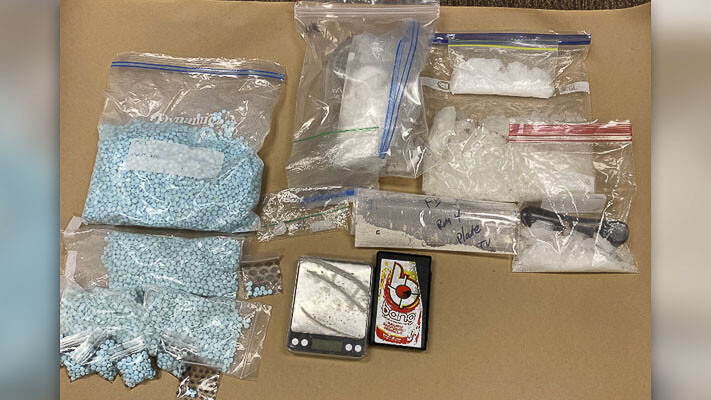
In Washington, the Supreme Court struck down the state’s main drug possession crime, which meant there was no state law making simple drug possession a crime unless the legislature passed one, which it did with ESB 5476
Logan Washburn
The Center Square
As neighboring Washington deals with its own drug law overhaul, Portland Mayor Ted Wheeler has proposed measures to ban hard drug use in public.
“We’ll be passing a ‘time, place and manner’ type restriction that makes it clear it is not legal to use those kinds of drugs openly anywhere in the city of Portland,” he said to KATU. “You cannot openly use drugs in the city of Portland any more than you can pop open a beer and walk down the street.”
He plans to share more about this plan Thursday, but he told the Portland Metro Chamber at its annual meeting that he plans to regulate open-air drug use. Wheeler compared the restrictions to those on public drinking.
“It is legal for people to own alcohol, they can legally carry alcohol containers down the street or transport them in their car, but people can’t legally use them openly in public,” he said. “We’re intending to do the exact same thing with drugs.”
Wheeler said his plan does not contradict Measure 110, passed in 2020, which decriminalized the personal possession of certain amounts of hard drugs like heroin, cocaine and methamphetamines.
“Measure 110 legalizes personal possession of hard drugs, but it does not speak to the actual use in public of those drugs,” Wheeler said to KATU. “This will help us get a handle on the open drug use.”
Measure 110 allows officers to refer individuals to treatment and fine them up to $100 for possessing hard drugs. Part of Portland’s Central City Recovery Plan is to increase patrol visibility and citation issuance for drug-related crimes.
Portland’s fatal overdoses in mid-May had increased 46% since that time last year, according to the Willamette Week. The city saw 158 fatal overdoses in 2022. The state has seen a 210% increase in fentanyl-related deaths since 2020, according to Axios.
The Clackamas County Commission, in the Portland Metro Area, recently passed a measure to ask voters if they support directing state lawmakers to modify or repeal Measure 110, according to KGW.
In State v. Blake, the Washington Supreme Court struck down the state’s main drug possession crime. This meant there was no state law making simple drug possession a crime unless the legislature passed one, which it did with ESB 5476, according to the ACLU.
The bill, however, expires July 1. But Washington’s legislature passed ESB 5536 in May’s special session, making the intentional possession or public use of certain amounts of illegal drugs a modified gross misdemeanor. It made the crime punishable by up to six months in jail for the first two offenses and by up to a year after that.
This report was first published by The Center Square.
Also read:
- Opinion: Workers need their wages more than the state’s paid-leave program does
 Washington’s paid-leave payroll tax stands at 1.13% and is projected to hit its 1.2% cap by 2027, with some lawmakers eyeing a 2% rate.
 - Opinion: Fatal flaws of Socialism – The knowledge problem
 Cargill argues no government, committee, or computer can possess the dispersed knowledge that markets coordinate through prices.
 - Battle Ground Public Schools seeks citizen advisory committee members
 Battle Ground Public Schools invites parents and residents to join its Citizens Advisory Committee, with open meetings Sept. 10 and Oct. 8.
 - Ridgefield Main Street unveils new Greely Building photo panels
 Large-scale photo panels on the Greely Building showcase Ridgefield’s wildlife refuge, Chinookan Plankhouse, and dragon boat traditions.
 - Vancouver Police investigate fatal collision
 A 74-year-old man in a motorized wheelchair died after a pickup truck struck him in a Vancouver intersection Wednesday evening.
 - Opinion: ‘It may be time for McCleary 2.0’
 Dick Rylander examines the Battle Ground School District’s proposed $116,830,000 three-year EP&O levy heading to the November 2026 ballot.
 - Washington Policy Center tax expert warns that new income tax will affect everyone
 Ryan Frost argues Washington’s new 9.9% income tax has a $1M deduction that a simple legislative majority could remove.