




Signage will alert drivers when the shoulder lane is open to traffic, giving westbound travelers four lanes from 164th Ave westbound to I-205
Paul Valencia
ClarkCountyToday.com
The signs lit up, the construction barrels were picked up, and after two years of construction, the Vancouver-Portland metro area opened its first part-time shoulder lane.
Public officials and invited guests gathered at the Washington State Department of Transportation Southwest Region headquarters in Vancouver on Thursday to press a few buttons, to turn on the signs located a few miles away on State Route 14.
And now, there is a 1.5-mile stretch, westbound from 164th Ave. to northbound Interstate-205, that will allow for transit and other authorized vehicles to use at any time and give another lane for the public during peak traffic times.
“It is exciting to stand here with all of our partners who made this project happen,” said Carley Francis, WSDOT region administrator.
She thanked the city of Vancouver, elected officials, C-TRAN, and Rotschy Inc., for working together to complete the project.
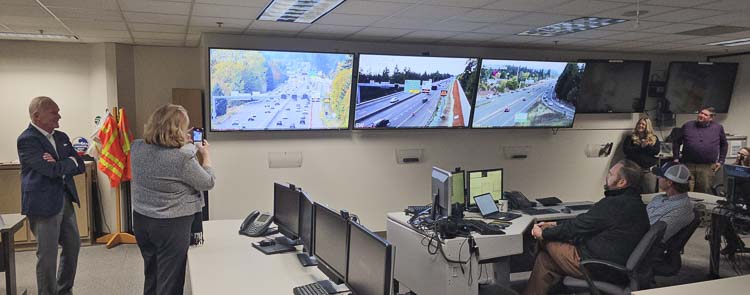
That section of SR 14 now has three lanes of traffic in each direction, with the added bonus of an extra lane westbound when needed.
“When activated, the new part-time shoulder lane effectively expands our capacity from three to four lanes during heavy traffic, without the cost of adding a fourth westbound travel lane,” Francis said.
“It’s really going to make a difference … for everyone in Southwest Washington,” said Paul Harris, Washington state representative from the 17th district.
Harris drove both directions of the improved area earlier Thursday, to get a look at both sides of the highway. He was looking forward to driving it again when the part-time shoulder lane was open.
Electronic signs will inform the public when the part-time lane is open for travel.
A green arrow and “Open” will be displayed when it is open. A red “X” and “Closed” are displayed when it is not open. And a yellow arrow with “CAUTION” or “CLOSED AHEAD” will be displayed if there is debris in the lane or an emergency ahead.
“This is going to help tremendously. Thank you for working with us,” Vancouver Mayor Anne McEnerny-Ogle told the members from WSDOT. “Thank you for understanding our needs.”
The first bus-on-shoulder program in the region was tested along this route years ago.
Today, authorized transit can use the shoulder at any time to access both northbound and southbound I-205.
“It will help us keep things moving,” said Leann Caver, CEO of C-TRAN. “Thank you for helping us move along and not feel like we’re sitting, not getting anywhere.”
Additional improvements, according to WSDOT, include stormwater facilities, a noise wall, traffic cameras, and guardrails. The $28 million project was part of the state’s 2015 Connecting Washington transportation funding package.
“Using innovative traffic management tools that dynamically adjust to traffic levels, this completed SR 14 project removes chokepoints, increases traffic flow, and shortens commute times along this heavily traveled roadway,” Francis said.
Also read:
- VIDEO: WA diesel hits record $6.53, crushing truckers and school budgets
 With diesel nearing $6.53 per gallon in Washington, trucking businesses and school districts now confront sharply higher fuel expenses affecting budgets and workers.
 - Opinion: In plain sight – yielding to pedestrians
 Drivers often fail to see pedestrians due to inattentional blindness, which highlights the need for more focused awareness at intersections and stronger safety practices.
 - Expect delays on SR 14 in Vancouver for guardrail repairs Wednesday
 State Route 14 travelers in Vancouver should plan for morning delays as WSDOT will close two eastbound lanes for guardrail repairs, affecting mileposts 6.0 to 7.0.
 - Overnight closure planned on westbound SR 14 Camas Slough Bridge Tuesday
 WSDOT crews will close westbound SR 14 at Exit 14 in Camas to collect bridge deck samples and plan future repairs; detours will be in effect.
 - Opinion: Stay in your lane – seriously, it’s the law
 Drivers must choose the nearest lane when turning in Washington, and left turns bring added risk. Even with signals, every driver must help prevent crashes by following law.
 wpDiscuz
