



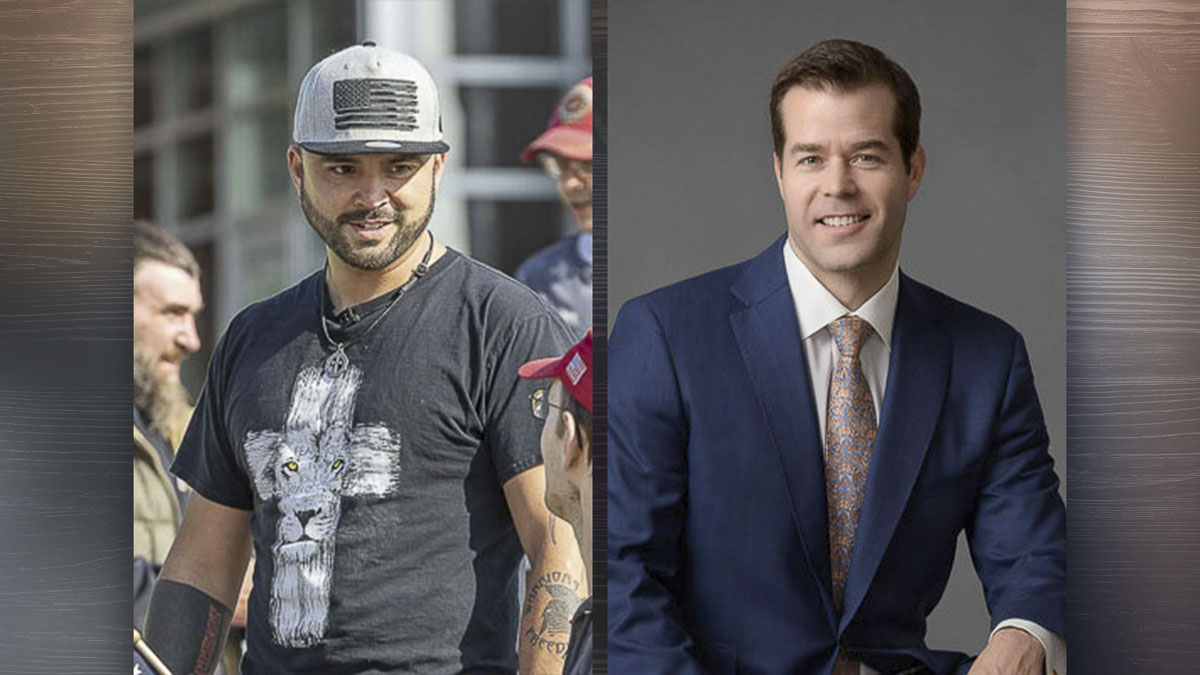
Ninth Circuit revives claims against prosecutor who personally swore to warrant affidavit containing alleged false statements
 See Grok’s analysis of this story
PORTLAND, OREGON – On Thursday (Jan. 29), the United States Court of Appeals for the Ninth Circuit issued a published decision holding that a prosecutor may be sued for personally submitting alleged false statements to obtain an arrest warrant and criminal charges against Joey Gibson and Russel Schultz.
The Court of Appeals decision reverses the district court’s dismissal of claims against Deputy District Attorney Brad Kalbaugh, based on claims he “presented knowingly false testimony to obtain an arrest warrant,” and holds that such conduct is not protected by prosecutorial immunity. (P. 28).
The criminal charges were first brought against Gibson in 2019, after he conducted and live streamed a public protest outside a Portland area Antifa hangout commonly known as the Cider Riot bar. During that protest, Gibson called on community members to take lawful steps to stop Antifa from engaging in criminal activity in the Portland area. Soon afterward, prosecutors filed baseless charges and sought a secret arrest warrant to take Gibson into custody. The warrant application was signed by Deputy District Attorney Brad Kalbaugh, who personally swore to the statements offered to establish probable cause and obtain the warrant.
The court wrote “No reasonable prosecutor in Kalbaugh’s shoes would have believed that his alleged conduct did not violate the Fourth Amendment; the act’s “‘unlawfulness [was] apparent.’” (p.33).
The Ninth Circuit emphasized that “absolute immunity does not apply . . . when a prosecutor acts as a complaining witness in support of a warrant application,” and that a prosecutor becomes a complaining witness when he “certif[ies] that the facts alleged within an affidavit are true.” The court rejected arguments seeking to immunize warrant affidavit submissions and explained that “neither federal nor state law made it necessary for [Kalbaugh, as the prosecutor,] to make that certification,” adding, “It was Kalbaugh’s choice to file his own affidavits, it was his signature on the affidavits, and it was his assertion of probable cause.”
The court held that the law has been clearly established for decades. “We have held since at least 1991 that a state actor who presents knowingly false testimony in support of a probable cause determination for an arrest warrant, where the warrant would not have issued without the false statements, violates the Fourth Amendment.” The court further stated, “No reasonable prosecutor in Kalbaugh’s shoes would have believed that his alleged conduct did not violate the Fourth Amendment; the act’s ‘unlawfulness [was] apparent.’”
Gibson and Schultz maintain they were targeted and charged for political reasons, and that the warrant process was infected by falsehoods used to manufacture probable cause. The case now returns to the district court for further proceedings consistent with the Ninth Circuit’s ruling.
Statement from D. Angus Lee, counsel for Joseph Gibson and Russel Schultz:
“Today’s decision is an important victory for accountability and basic constitutional truth. Prosecutors cannot personally swear to facts to secure an arrest warrant, and then claim immunity when those sworn facts are false. The Ninth Circuit said it plainly: knowingly false statements used to obtain a warrant violate the Fourth Amendment, and ‘the act’s unlawfulness was apparent.’ We intend to pursue these claims aggressively and prove what happened here.”
“Today the Ninth Circuit confirmed that prosecutors cannot hide behind immunity when they personally act as a complaining witness to obtain an arrest warrant. The court held that ‘absolute immunity does not apply . . . when a prosecutor acts as a complaining witness in support of a warrant application,’ and reiterated that ‘a state actor who presents knowingly false testimony’ to secure a warrant, where the warrant would not have issued without the false statements, ‘violates the Fourth Amendment.’ The court also stated, ‘No reasonable prosecutor’ could believe that conduct was lawful. This is an important victory, and we have every intention of pursuing our claims against the prosecutor for submitting false information to secure politically motivated charges against two innocent men.”
Statement from Multnomah County District Attorney’s Office
A spokesperson from the Multnomah County District Attorney’s Office issued the following statement Thursday.
“This is a procedural case that is prone to misunderstanding. A person filing a lawsuit can allege any fact they want in their complaint. At the motion to dismiss stage, the court must assume that all facts in the complaint are true. The plaintiff in this case alleged that former DDA Kalbaugh knowingly made false statements in an arrest warrant application. The Multnomah County District Attorney’s office believes this allegation to be false and has every confidence that former DDA Kalbaugh will prevail on the merits if plaintiffs seek to refile their claim. Neither the District Court nor the Ninth Circuit has found that DDA Kalbaugh knowingly made false statements. Today’s decision only states that, if plaintiffs wish to pursue this matter, they can attempt to prove their allegations. We firmly believe they will not be able to do so, because that is not what happened in this case.’’
Case: Gibson et al. v. City of Portland et al., Ninth Circuit No. 24-1663.
Next steps: Plaintiffs will proceed on remand, including amending pleadings as required and pursuing discovery regarding the warrant submissions and decision making that led to the arrests.

This independent analysis was created with Grok, an AI model from xAI. It is not written or edited by ClarkCountyToday.com and is provided to help readers evaluate the article’s sourcing and context.
Quick summary
The Ninth Circuit Court of Appeals revived civil claims against former Multnomah County Deputy District Attorney Brad Kalbaugh, finding that allegations he submitted knowingly false statements in a warrant affidavit to secure an arrest warrant and charges—stemming from a 2019 protest involving Joey Gibson and Russel Schultz—are not shielded by prosecutorial immunity. The court ruled that when a prosecutor acts as a “complaining witness” in a warrant application, immunity does not apply to alleged Fourth Amendment violations based on false statements.
What Grok notices
- Quotes key passages from the Ninth Circuit opinion, including the holding that knowingly false statements in warrant applications can violate the Fourth Amendment and are not protected by immunity when a prosecutor functions as the affiant/complaining witness.
- Provides background on the underlying incident (the 2019 Cider Riot protest) and explains how that event led to the warrant, arrests, and the subsequent civil lawsuit.
- Includes statements from both sides—plaintiffs’ attorney Angus Lee and the Multnomah County District Attorney’s Office—giving readers competing views on the decision and the allegations.
- Summarizes the procedural outcome: the appellate court reversed the district court’s dismissal and sent the case back (remanded) for further proceedings.
- Notes next steps such as amended pleadings and discovery, indicating that the revived claims will now move into evidence-gathering and further litigation stages.
Questions worth asking
- How might this ruling change how prosecutors approach warrant affidavits when they personally certify facts rather than relying solely on investigators?
- Could the decision affect how courts evaluate claims of political motivation in protest-related charging decisions, and what evidence would be relevant?
- On remand, what evidentiary standards and legal tests will apply to prove “knowing” falsehoods or material omissions in the affidavit?
- How do other federal circuits draw the line between prosecutorial advocacy (often immune) and “complaining witness” conduct in warrant applications?
- What broader implications could the decision have for civil-rights litigation involving arrests in politically charged demonstrations?
Research this topic more
- U.S. Court of Appeals for the Ninth Circuit – opinions and case documents
- Multnomah County District Attorney’s Office – statements and policy information
- Washington State Bar Association – professional and ethics resources
- ACLU of Oregon – civil rights litigation and protest-related resources
- U.S. Department of Justice Civil Rights Division – guidance and resources
Also read:
- Letter: In defense of Joe Kent, a war hero
 Ozzie Gonzalez shares a firsthand account of his time working for Joe Kent, emphasizing Kent’s military background and principled stance on foreign policy controversies.
 - Opinion: ‘Washington’s majority party is panicking’
 Nancy Churchill argues that controversial state policies, including new taxes, law enforcement changes, and agency power grabs, are generating a wave of backlash in communities across Washington.
 - Letter: ‘Now we have Engineer Bob telling us the I-5 Bridge needs replacing because it is built on shifting sand with wooden structures’
 Amboy resident Thomas Schenk critiques Democrat leadership, tax policies, and the addition of light rail to the I-5 Bridge, while urging Republican voters to participate more in midterm elections.
 - Clark County Baseball presents Baseballism Kickoff this week with action all over the region
 Thirty-six teams from across the Northwest, including two state champs, are competing in free high school baseball tournaments at local turf fields in Vancouver, Camas, and Ridgefield.
 - The I-5 Bridge is vulnerable to collapse, but apparently not that vulnerable
 State leaders and Vancouver’s mayor warn about bridge safety, but insist it’s safe enough for daily use as they focus on moving forward with a costly replacement including light rail—despite decades of public resistance.
 - Vancouver Police seek assistance from the public to locate hit and run driver
 A woman was injured in a crosswalk by a van whose driver briefly helped before fleeing; Vancouver Police ask for help locating the suspect and vehicle.
 - Vancouver City Council to host community forum on belonging March 23
 Residents are invited to join Vancouver City Council’s community forum to discuss personal experiences, barriers, and new ideas for improving local sense of belonging.
 wpDiscuz
