


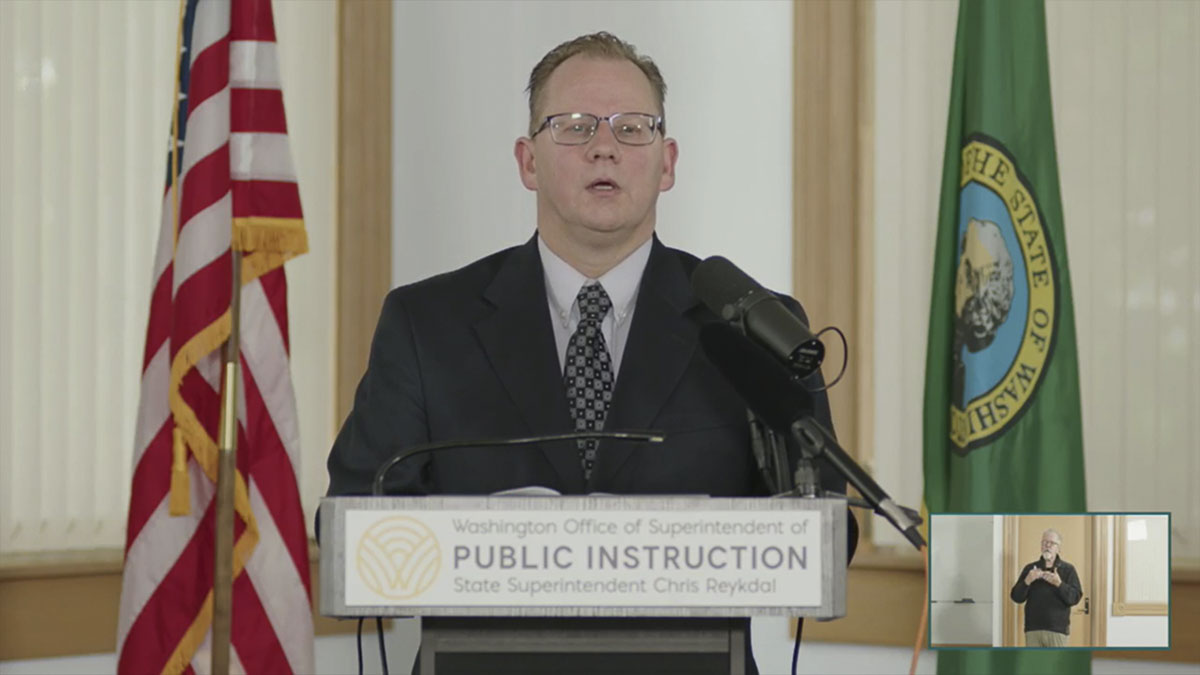
In a Monday press conference, State Superintendent of Public Instruction Chris Reykdal said the state is underfunding education by $4 billion dollars per year
Carleen Johnson
The Center Square Washington
State Superintendent of Public Instruction Chris Reykdal says Washington’s public schools need a major influx of taxpayer dollars in the next few years to close the K-12 funding gap.
In a Monday press conference, Reykdal said the state is underfunding education by $4 billion dollars per year and he is asking lawmakers to fill some of that gap in the next legislative session.
“I don’t accept no as an answer, and I don’t accept people who say that’s too much money we can’t do it,” said Reykdal.
On special education, he is seeking $1 billion. That breaks down to $300 million next fiscal year and $700 million the following budget cycle.
The number of students with individualized education programs, or IEP’s, has continued to climb each year. An IEP is a document describing the specific special education services a student will receive, which can include everything from helping students with ADHD to those with severe disabilities.
Student transportation is another area where Reykdal argues the state is not providing adequate funding. He is asking for $152.5 million in the next budget “to provide reliable transportation to and from school for special passengers, including special education students, homeless students, and students in foster care.”
“Our data is really clear; those are the students most at risk of getting behind in school and more likely to drop out,” said Reydal. “We have our dropout rate down to the lowest level we’ve ever seen but to make progress on that last 10 or 11% it’s going to be critical to invest in things that make a difference, like getting them to school, feeding them, and making sure they have supports.”
Reykdal said schools need more social workers and he’s asking lawmakers to approve $52 million in the next budget and $56 million in the following budget to hire additional social workers.
“Our numbers are pretty sad,” said Reykdal. “For example, it takes 7,200 middle schoolers to generate one social worker, so we’re going to have to make progress on this.”
He is pushing for $695 million to increase pay and hire more paraeducators, health services workers, clerical professionals and IT technicians.
“It’s $1.6 billion in the following two years. That’s extremely ambitious and we should do it,” said Reykdal.
Some of the money would pay to train paraeducators who are already on the job, to earn teaching credentials.
“Our paraeducators have already made a commitment in working with our students every single day and they are the best opportunity we have to grow out teacher ranks,” said Reykdal.
Reykdal’s challenger in the race for Superintendent of Public Instruction is Peninsula School District board member David Olson, who told The Center Square he appreciates Reykdal’s attempt to get more money for education but disagrees with the approach.
“All we really need is for the state legislature to keep its promises and they could just go back to lottery and marijuana money,” said Olson.
When the Legislature first approved a state lottery during the economic recession of 1982, the money was never specifically earmarked for education. Profits were directed to the state general fund — an account that pays for the largest part of the state budget, K-12 schools, and other government programs.
Voters and lawmakers have tweaked that formula over the years and currently most lottery revenues– after payouts-go toward college scholarships and preschool programs instead of K-12 schools.
As for revenue from marijuana sales, public education does receive a small fraction of profits, amounting to just over a half million dollars in 2022.
Funding for materials, supplies, and operating costs, or what is referred to as MSOC, is not keeping pace with inflation. Reykdal wants $350.7 million in the next two-year budget cycle to deal with a nearly 9.5% cost increase.
Olson also took issue with Reykdal’s plan to have the state cover the cost of getting paraeducators credentialed to be teachers.
“Teachers all over the state tell me they need more paraeducators. If we pay to promote all those paraeducators to be teachers, how is that helping solve the problem?”
Olson told The Center Square he supports paying paraeducators more money, but said the funding model today doesn’t work.
He explained a district may need 400 paraeducators, but state funding may only cover 100, so local levy dollars are used to make up the difference.
For rural districts unable to pass local levies, they may be unable to pay for additional staff they need.
Olson also questioned the timing of Reykdal’s budget proposal.
“Sending a lame duck governor a budget a month before the election is just performative,” said Olson who pointed out that with a new governor taking office and several legislative races on the ballot, those who will make budgetary decisions could be new faces.
This report was first published by The Center Square Washington.
Also read:
- Opinion: Were Republican voters just sleeping during the August primary election?
 CCRP Chairman Matt Bumala says 60% of primary no-shows in the 17th and 18th districts were Republicans.
 - High school football: New coach prepares for long-term success at Prairie High School
 James Young-Lewis, a Clark County native who graduated from Evergreen in 2009, became Prairie’s head coach in May after working as an assistant coach across various programs since 2015, joining Prairie’s staff in 2024.
 - Cost to battle 20 wildfires in WA has topped $200M
 Twenty wildfires have cost Washington $207M in one month, more than two-thirds of what DNR spent all last fiscal year.
 - Opinion: WA Cares’ launch showcased care WA Cares did not provide
 Gov. Ferguson showcased a caregiving arrangement at the WA Cares launch that the program had not paid for a single day of.
 - Former State Rep. Liz Pike provides update on husband Neil Cahoon
 Neil Cahoon, a Camas resident, has undergone multiple surgeries including five on Aug. 15 after the Aug. 10 crash near La Center’s Daybreak Airport.
 - Opinion: Portland’s War on Cars Part 4 – A smarter automobile strategy to end gridlock
 O’Toole argues fuel wasted in Portland-area congestion has sextupled since 1982, generating 250,000 tons of extra greenhouse gases annually.
 - $1,000 first prize for Camas Plein Air Art Event honoring Marquita Call on Sept. 26
 Plein air artists compete Sept. 26 in Camas for $1,000 first prize honoring gallery founder Marquita Call.