



Last year the Legislature passed a capital-gains tax which was immediately challenged in the courts as unconstitutional
Lawrence Wilson
The Center Square
Washington lawmakers have advised the Department of Revenue that its proposed rule concerning the state’s capital gains tax should be labeled as advisory only pending the state Supreme Court’s ruling on the law’s constitutionality.
Last year the Legislature passed a capital-gains tax, RCW 82.87, which was immediately challenged in the courts as unconstitutional. Douglas County Superior Court Judge Brian Huber agreed, ruling on March 1 that the tax is properly considered both a graduated tax and a property tax.
Douglas ruled that, as a property tax, the law violates the state constitution which requires that property taxes be uniform. The law is not uniform, Douglas ruled, because it does not apply to amounts less than $250,000.
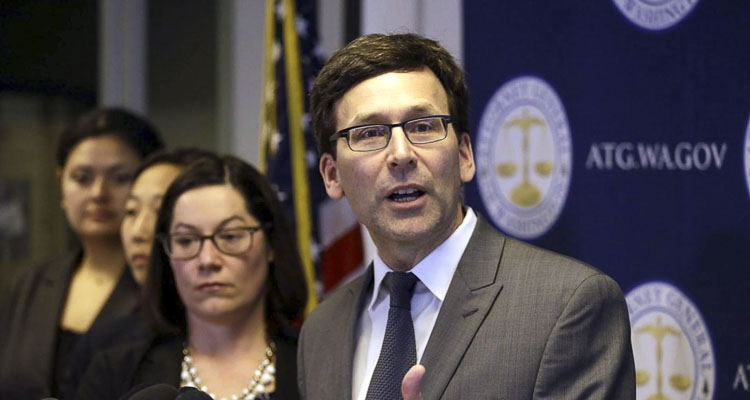
Washington Attorney General Bob Ferguson asked the state Supreme Court to take the case on direct appeal, which it did. A hearing is set for Jan. 26.
Meanwhile, the DOR continued to work on an administrative rule for collecting the tax, even though collection was prohibited by the Superior Court’s ruling that the tax is unconstitutional.
That prompted a letter of protest from the Citizen Action Defense Fund, a local government watchdog nonprofit, demanding the agency stop its rule making activities related to implementing the capital gains income tax.
“It is black letter law that statutes declared unconstitutional are deemed void ‘from the beginning’ or ab initio — they have no legal effect whatsoever and the law treats them as if they never existed,” CADF Executive Director Jackson Maynard wrote in the Oct. 5 letter, addressed to John Ryser, DOR acting director.
Then on Nov. 3 Attorney General Bob Ferguson asked the Supreme Court to stay the lower court’s ruling with respect to tax collecting, calling the decision “incorrect, and is at the very least debatable.” He argued that “It would be profoundly irresponsible for the Department to fail to prepare to collect the tax in April 2023 as directed by statute.”
To clarify the situation, the Joint Administrative Rules Review Committee of the Washington State Legislature wrote to Ryser requesting that “the Department amend the proposed rule to include language that the rule serves as guidance and only applies if the capital gains tax authorized under chapter 82.87 RCW is ruled constitutional and valid by the Washington Supreme Court.”
Wording to that effect is now displayed on the DOR webpage pertaining to RCW 82.87.
Meanwhile, a source familiar with the matter has confirmed to The Center Square that the state Supreme Court will consider Ferguson’s motion to stay the lower court ruling on Nov. 29.
If the Supreme Court grants Ferguson’s motion, the revenue department will be allowed to proceed with collecting the capital gains tax in April 2023 even if no final ruling on the constitutionality of the law is handed down before then.
The Center Square Washington first published this report. Brett Davis contributed to this report.
Also read:
- Opinion: ‘Stay close, stay informed, stay the course’
 Anna Miller calls on residents to join Clark County Republican Women’s dinner, urging perseverance and unity as local government faces turbulent times.
 - Overnight closure planned on westbound SR 14 Camas Slough Bridge Tuesday
 WSDOT crews will close westbound SR 14 at Exit 14 in Camas to collect bridge deck samples and plan future repairs; detours will be in effect.
 - OII completes investigation of Clark County Sheriff’s Office use of deadly force
 Marc Fogle died after a fatal struggle with Deputy Bryson Layton following a DUI crash; prosecutors will decide on charges after review of OII’s findings.
 - Video: Can accelerated home construction replace need for WA income tax?
 A new report suggests boosting housing production by 20,000 units yearly could bring in over $600 million in revenue, offsetting a portion of proposed income tax revenue.
 - WA Gov. Ferguson to meet with NBA commissioner as hopes rise for Sonics’ return
 The meeting this week comes before a vote that could clear the way for the league’s expansion to Seattle Jake Goldstein-StreetWashington State Standard Washington Gov. Bob Ferguson on Thursday previewed an upcoming meeting with NBA Commissioner Adam Silver ahead of a planned vote on league expansion that could bring men’s professional basketball back to Seattle. …
 - Opinion: Will the income tax cause a drop in charitable giving?
 High-income households leaving Washington after new tax may redirect donations, possibly shrinking local nonprofits’ funding despite the intended deduction benefit.
 - Spring car care tips to get your vehicle road-trip ready
 April is Car Care Month, a timely reminder for drivers to check their tires, batteries, wipers, and air filters before spring and summer travel begins.
