



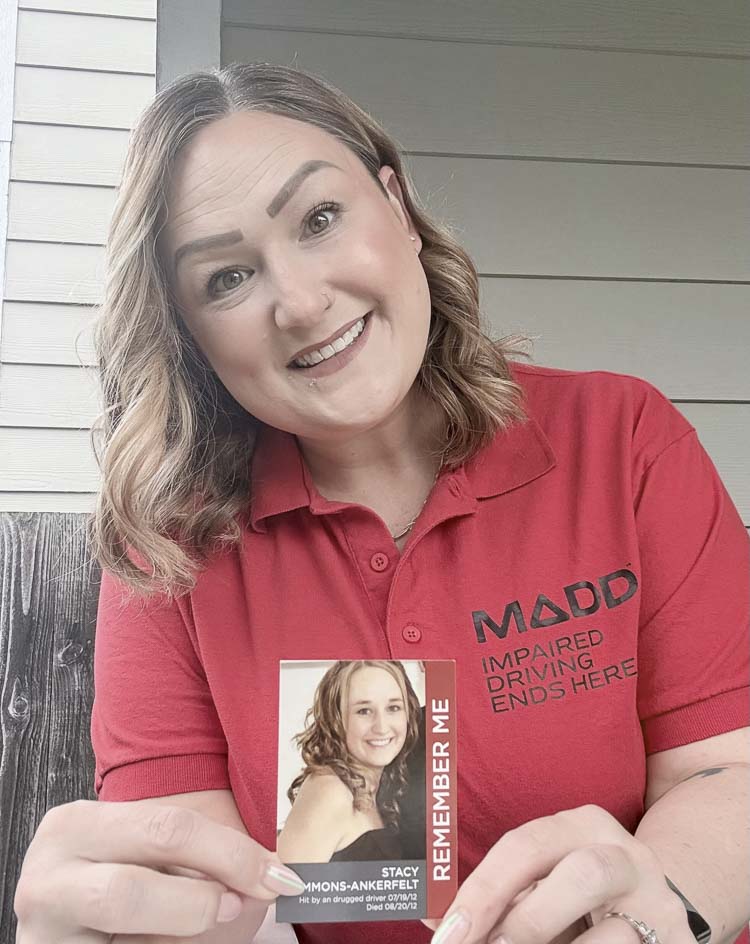
Mothers Against Drunk Driving is lobbying politicians to lower the legal BAC level to 0.05, in hopes of joining Utah and more than 100 countries worldwide that have seen the move as a successful act of education and prevention
Paul Valencia
Clark County Today
They initially answered this call to action to honor a loved one.
It turns out, they are answering this call to action for your loved ones, too.
Mothers Against Drunk Driving, along with their partners and volunteers, are hoping this will be the year the Washington State Legislature will pass a law that would lower the legal blood alcohol content (BAC) from 0.08 to 0.05.
“This is more of an education and prevention bill,” said Ashley Bonus, a court monitoring specialist for MADD.
Bonus testified in memory of her sister, who was killed by a drunk driver in 2012.
“It’s not going to result in more arrests. It’s not going to result in more people going to jail. It’s not going to affect the hospitality industry,” Bonus said. “It’s just going to educate people that impairment starts sooner, and hopefully it saves lives.”
MADD has data to back that up after Utah became the first state in the union to lower the legal limit to 0.05 in 2018. Bonus added that more than 100 countries are at 0.05, as well.
“Lowering this BAC is going to result in an 11 percent decrease in alcohol related traffic fatalities. That’s big. We have a lot of innocent people dying on our roads,” Bonus said. “We know how to prevent this. We know how to fix it. Why aren’t we doing it?”
Scott Lockard and his family also know the pain of losing a loved one to the selfish act of driving drunk.
“It’s such a preventable crime. This is something that people are electing to get behind a wheel when they shouldn’t, people who have total disregard for other people on the road.”

Scott’s daughter Mia Camille Tanner Lockard, a 2024 graduate of Washougal High School, was killed by a drunk-driver going the wrong way on Interstate 5 in Pierce County last year. Mia was in her first year of college.
“It’s tough. We’re working on healing. I’ve talked to a lot of parents who have lost kids. It’s something you don’t ever get over,” Lockard said. “As time goes on, you learn to deal with it in different ways. It’s always with you.”
Lockard had to get involved.
“The main thing was trying to turn our grief into action,” he said.
He reached out to MADD.
“They’ve been wonderful to work with, so supportive, so helpful,” Lockard said. “Knowing that there is that support there, at any point. It’s really helpful for families that are hurting.”
It was through MADD that he first heard of the attempts to lower the legal BAC limit.
For Bonus, this is the fourth year in a row she has lobbied for 0.05 in Washington.
“If anyone could feel my heartache for one minute, I’m sure this would pass in every state, no questions asked,” Bonus said.
Going to 0.05, she said, would help raise awareness.
“Impairment starts much earlier on people than they assume,” Bonus said.
The hope, MADD says, is that a lower legal limit will inspire those who drink to plan ahead accordingly. Call a taxi. Order a ride-share. Designate a sober driver in the group. In Utah, fatal crashes involving impaired drivers are down since its law went into effect, Bonus said.
Bonus said her sister, Stacy Gammons-Ankerfelt, who lived in Auburn, Wa., “radiated positivity, kindness, and love.”
She was 28 years old when she was struck by a drunk driver right in front of her home, just before getting into her own car. The drunk driver was going 50 miles per hour in a residential area. Stacy was dragged a block down her street. She suffered a traumatic brain injury, and died 32 days after the crime.
The drunk driver served five years of an eight-year sentence and has since reoffended.
“It’s a ripple effect to what happened to us. It’s never one life. It’s never one person affected. It shreds through families,” Bonus said.
In fact, Stacy’s husband never got over the loss of his wife. His life spiraled, and he committed suicide.
Bonus said it is important to share that part of the story.
Again, it’s never just one person who is affected.
This year, Ashley Bonus, her and Stacy’s mom, and Ashley’s 16-year-old son testified before the legislature. Ashley’s son was just 2 years old when his aunt died.
Young family members, Bonus said, are robbed of the life they should have known.
“He’s had to hear his whole life how wonderful this woman was and he has nothing,” Bonus said. “He just wishes he had extra time with her.”
Before going before the legislature during this current session, Bonus also shared her story in Clark County in December. She was in Vancouver to honor local law enforcement officials who specialize in DUI enforcement.
According to Target Zero, the statewide campaign with a mission to have zero traffic-related deaths on Washington roads by 2030, 52 percent of fatal crashes in Clark County since 2015 have involved an impaired driver.
Some facts and figures cited by MADD as well as the Washington Traffic Safety Commission,
- 0.05 BAC saves lives throughout the world by educating drivers on the danger of alcohol-impaired driving (and providing deterrence for those who need it)
- The average reduction in fatalities internationally is 11% when .05 is implemented
- Drivers are 4-6 times more likely to be in a fatal crash with a BAC between 0.05-0.079
- The ability to drive safely declines 25-55% at 0.05. Impairment affects judgement, vision, coordination, speed control, and reaction to unexpected events
- An average male will exceed 0.05 after four standard drinks in two hours and average female after three drinks (on an empty stomach)
- .05 doesn’t result in more arrests or harm business.
- 2 out of 3 people will be impacted by drunk driving in their lifetime.
- In states and countries that have reduced their BAC limits, they find that fewer people drive under the influence of alcohol, and the level of alcohol among people who drive is reduced.
Bonus hopes this is the year Washington politicians follow MADD’s lead.
“It’s hard to not get your hopes up. It is so personal to me,” Bonus said.
Her battle is not just to honor her sister, but for all the lives that can be saved with prevention and education.
“I fight hard because I want to help other families. No law will bring my sister back,” Bonus said.
“I come back every year stronger. I take offense to any fatality on our roadways.”
Also read:
- ‘Our new normal’: WA confronts another year of drought
 Casey Sixkiller says every watershed in Washington has dropped below 75% of normal water supply.
 - Schools expect minimal impact with Title IX pacts rescinded
 Federal officials rescinded agreements with six school districts, saying previous administrations misapplied Title IX protections.
 - Area Agency on Aging & Disabilities in Southwest Washington announces the Senior Farmers Market Nutrition Program
 AAADSW opens applications for $80 benefit cards to help eligible seniors buy fresh produce at farmers markets.
 - Free in-person workshops promote composting and sustainable living
 Clark County’s free workshops teach residents worm composting, green cleaning, and smart recycling through April and May.
 - Keeping afloat: A bittersweet chronicle of two women who endured the sinking of the Titanic
 Local historian Peri Muchich shares the story of Pacific Northwest Titanic survivor Anna Warren at Sunday’s museum event.
 - Letter: ‘This is the worst thing that ever happened to the region’
 A Hayden Island resident Sam Churchill is criticized in a letter calling the $14 billion Interstate Bridge Replacement project a “boondoggle” that destroys local businesses.
 - Washougal ramps up efforts to support small businesses
 Washougal launches Gateway to Success Series with free workshops starting April 15 at Best Western Plus Convention Center.
 wpDiscuz
