


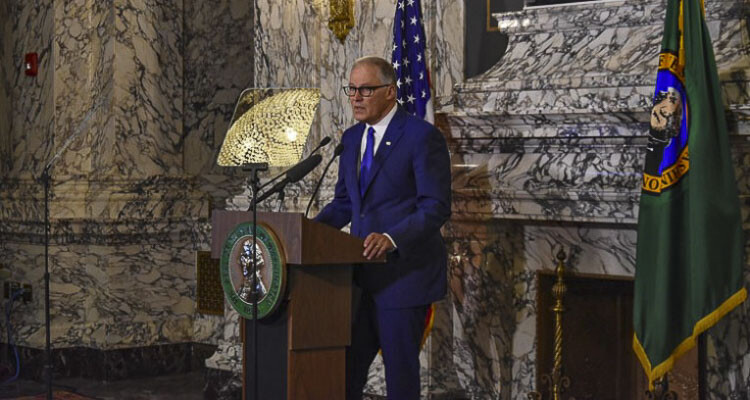
Federal law prohibits the use of federal funds to pay for abortions except in cases of rape, incest or to save the life of the pregnant woman
Lawrence Wilson
The Center Square Washington
Gov. Jay Inslee’s proposed budget for the upcoming biennium includes $15 million in taxpayer money to be spent on providing abortion services and training for abortion providers.
Inslee’s proposed budget for 2023-2035, released Wednesday, will be submitted to the Legislature but is not binding on lawmakers.
The proposal calls for $70.4 billion in government spending. Of that amount, nearly $1.2 billion is allocated for the Department of Health.
Included in the DOH distribution is “$7,407,000 of the general fund — state appropriation for fiscal year 2024 and $7,603,000 of the general fund — state appropriation for fiscal year 2025 is provided solely to provide reimbursement for abortion services to providers of abortion care, to provide funding for travel costs for abortion care, including but not limited to childcare and meals, and to provide grants to public four year higher education institutions that offer advanced degree programs in nursing, medicine, and pharmacy to develop and offer abortion care training.”
Although more than half the state’s proposed DOH budget, 50.74%, is provided by federal appropriations, the provision for abortion services and training would be paid directly by Washington taxpayers, if the proposal were to pass the Legislature.
Federal law prohibits the use of federal funds to pay for abortions except in cases of rape, incest or to save the life of the pregnant woman.
The governor characterized the budget as prioritizing housing, homelessness and behavioral health in Wednesday’s statement accompanying its release.
State Sen. Lynda Wilson, R-Vancouver, ranking member of the Washington Senate’s Ways and Means Committee, criticized the proposed budget as ineffective and focused on the wrong priorities, though she did not mention the abortion provision.
“The governor’s support for behavioral health is appropriate, at least on the surface, but that will do nothing in the short term to deal with the record number of murders and fatal drug overdoses in our state, or help hire law-enforcement officers to fight crime in our communities,” Wilson said in a statement.
State Senate Ways and Means Chair Sen. Christine Rolfes, D-Bainbridge Island, did not reply to a request for comment.
This report was first published by The Center Square Washington.
Also read:
- Opinion: Were Republican voters just sleeping during the August primary election?
 CCRP Chairman Matt Bumala says 60% of primary no-shows in the 17th and 18th districts were Republicans.
 - High school football: New coach prepares for long-term success at Prairie High School
 James Young-Lewis, a Clark County native who graduated from Evergreen in 2009, became Prairie’s head coach in May after working as an assistant coach across various programs since 2015, joining Prairie’s staff in 2024.
 - Cost to battle 20 wildfires in WA has topped $200M
 Twenty wildfires have cost Washington $207M in one month, more than two-thirds of what DNR spent all last fiscal year.
 - Opinion: WA Cares’ launch showcased care WA Cares did not provide
 Gov. Ferguson showcased a caregiving arrangement at the WA Cares launch that the program had not paid for a single day of.
 - Former State Rep. Liz Pike provides update on husband Neil Cahoon
 Neil Cahoon, a Camas resident, has undergone multiple surgeries including five on Aug. 15 after the Aug. 10 crash near La Center’s Daybreak Airport.
 - Opinion: Portland’s War on Cars Part 4 – A smarter automobile strategy to end gridlock
 O’Toole argues fuel wasted in Portland-area congestion has sextupled since 1982, generating 250,000 tons of extra greenhouse gases annually.
 - $1,000 first prize for Camas Plein Air Art Event honoring Marquita Call on Sept. 26
 Plein air artists compete Sept. 26 in Camas for $1,000 first prize honoring gallery founder Marquita Call.
 wpDiscuz