



As of the most recent report by the Department of Ecology, in the fiscal year 2024 almost half of all CCA revenue spent originated from an account designated specifically for transit related projects
TJ Martinell
The Center Square Washington
Washington drivers may be funding transit when they fill up their vehicles at the gas pump due not only to how carbon auctions under the Climate Commitment Act could be indirectly raising gas prices, but how CCA money has been appropriated by the state Legislature.
As of the most recent report by the Department of Ecology, in the fiscal year 2024 almost half of all CCA revenue spent originated from an account designated specifically for transit related projects.
One source of debate over a proposed RUC program is whether or not the revenue should be restricted to state highway projects in the same way as gas tax revenue. Some have advocated maintaining that restriction on any RUC money, while others believe it should be flexible enough to fund other transportation areas such as transit.
Under the CCA, Ecology holds quarterly carbon auctions in which emitters subject to the law must purchase carbon allowances; according to Ecology, those auctions have generated more than $2 billion in revenue so far.
Organizations like the Washington Policy Center and the Washington Farm Bureau have argued that the carbon auctions have caused gas prices to increase as a result. A former economist for the Washington State Department of Transportation claimed in 2023 that he was told by higher ups to falsify the impact of the CCA on gas prices and filed a lawsuit as a result.
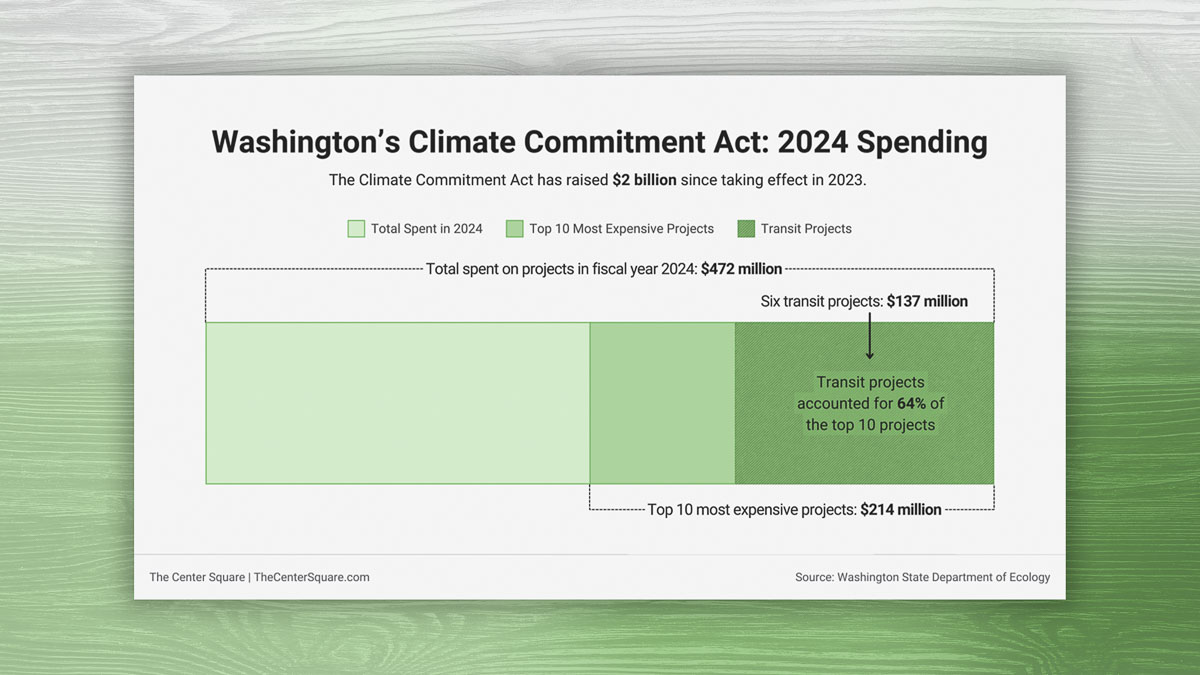
Meanwhile, an analysis by The Center Square of CCA projects funded in the fiscal year 2024 found that of the top 10 most expensive projects, six of them were transit related. The most expensive CCA funded project during that time frame was also for transit; the $66 million project was to “support ongoing operations costs to maintain and provide bus service” in Seattle.
In total, $137 million or 64% of the $214 million spent on the top 10 most expensive projects were for transit projects. That $137 million represents 30% of the $472 million in total CCA spending for the fiscal year 2024.
CCA revenue is deposited into three accounts, two of which have sub accounts, respectively. The revenue is held in those accounts until the money is appropriated by the state Legislature.
Of those four subaccounts, money spent from the Climate Transit Programs Account on 115 projects constituted $213 million or 45% of all CCA project spending in the 2024 fiscal year.
According to Ecology, spending from that subaccount focuses on the following:
- Transit support grants
- Tribal transit mobility grants
- Transit coordination grants
- Special needs transit grants
- Bus and bus facility grant programs
- Green transit grants
- Transportation demand management grants
- Other transit projects identified in an omnibus transportation appropriations act
The Center Square recently reported that although the CCA’s primary objective is to reduce carbon emissions, almost 90% of total project spending in the 2024 fiscal year involved no emission reductions, and those that did reduced total state emissions by .3% “over time.”
Of the top 10 most expensive projects, only two were reported to reduce emissions. Of those two projects, only one reported actual emission reduction; that $9.7 million project converted three Jumbo Mark II ferry vessels to hybrid-electric, reducing emissions by 6,510 metric tons.
This report was first published by The Center Square Washington.
Also read:
- Opinion: Half the road, full stop – Understanding pedestrian right-of-way
 Doug Dahl explains how Washington’s law requires drivers to stop when a pedestrian is within one lane of their half of the road, not just when directly in front.
 - Opinion: What is the cost of a bridge?
 John Ley argues the I-5 Bridge replacement’s soaring cost stems from costly extras like light rail, noting other states deliver larger, toll-free bridges for much less.
 - Letter: Vancouver Mayor Anne McEnerny-Ogle makes several serious and incorrect engineering statements
 Bob Ortblad critiques engineering claims by Vancouver Mayor Anne McEnerny-Ogle, highlighting cost and safety advantages of an immersed tunnel for the I-5 crossing.
 - Washington’s studded tire deadline is March 31
 Drivers must remove studded tires by March 31 or face a $137 fine, with WSDOT urging early action due to busy service centers and no planned deadline extension.
 - VIDEO: WA diesel hits record $6.53, crushing truckers and school budgets
 With diesel nearing $6.53 per gallon in Washington, trucking businesses and school districts now confront sharply higher fuel expenses affecting budgets and workers.
