




While Ecology is touting the investments as reducing 9 million metric tons of carbon over the past two fiscal years, some critics are questioning the true cost per ton for some of the projects
TJ Martinell
The Center Square Washington
Funding electrifying the Washington State Ferries system continues to dominate total Climate Commitment Act project spending, according to a new Department of Ecology report for fiscal year 2025.
While Ecology is touting the investments as reducing 9 million metric tons of carbon over the past two fiscal years, some critics are questioning the true cost per ton for some of the projects.
CCA revenue generated from quarterly carbon auctions is deposited into three main accounts, with two of those accounts having two subaccounts each. More than half of that spending came from the Climate Commitment Account; according to Ecology’s CCA spending dashboard, the projects funded by that account reduced carbon by 7.8 million tons.
Meanwhile, only $89 million came from Carbon Reduction Account, with the projects reducing 433,460 metric tons of carbon, while just .1% of CCA spending originated from a subaccount intended for air quality related projects; that percentage matches previous spending from that account reported by The Center Square earlier this year.
According to Ecology’s latest report, Washington State Ferries received $599 million for its System Electrification Program, which represents more than half of total spending during the fiscal year. While the House Transportation Committee Chair Jake Fey, D-Seattle, has recently expressed doubts as to further electrification of the system, WSF is aiming for a zero-emission fleet by 2050.
The CCA money for that program will help the agency purchase 16 new hybrid ferries to be charged at 16 terminals. WSF recently converted the M/V Wenatchee, which returned to service in July, at the cost of $133 million. Earlier this year, Gov. Bob Ferguson announced that a bid to construct three new 160-vehicle hybrid ferries had been awarded to Florida-based Eastern Shipbuilding Group, at the cost of more than $700 million.
Although Ecology claims that the cost for carbon reduction through these projects overall was $40 per ton, Washington Policy Center Vice President of Research Todd Myers has questioned the calculations.
In a series of X posts, he cited several examples, such as a $4.1 million project with the city of Ellensburg’s Public Works Department “to administer a program that provides rebates and incentives to low and moderate-income households and small businesses to purchase and install high-efficiency electric equipment and appliances.”
According to Ecology’s report, the project reduced carbon by 3.5 million metric tons, more than a third of all carbon reduced over the past two years, with $1 spent for every metric ton of carbon reduced.
“There is no way a town of 22,000 people emits the same amount of CO2 – FROM ELECTRICITY ALONE – as 15% of all gas and diesel vehicles in the state,” Myers wrote, adding that “now, the 3.5 million is over several years, but this is an absurd amount.”
Projects with the same description funded in King County and Walla Walla County reported a cost of $163 per metric ton reduced. The King County project received $487,305 and reduced carbon by 7,945 metric tons, while the Walla Walla County project got $753,343 in funding and recued 1,229 metric tons of carbon.
Ecology Climate Pollution Reduction Program Communications Manager Caroline Halter wrote in an email to The Center Square that “emissions reductions vary by the scope of the project, equipment used, and other unique factors, like the characteristics of the homes and buildings. Calculating emissions reductions requires first calculating the “business-as-usual” scenario, which is going to be different for each project depending on its unique factors. For example, for home electrification and efficiency projects, the business-as-usual scenario will vary by the characteristics of the homes and buildings, the previous equipment they used, and the type of new equipment that was installed.”
According to Ecology’s report, for the fiscal year 2025 the agency approved four new calculators for estimating emissions reduction reporting, while the Carbon Management & Emissions Tool, also known as COMET-Planner, estimates emissions reductions from land use changes in riparian and agricultural lands.
Halter wrote in an email to The Center Square that “agencies calculate emissions reductions over the lifetime of the project using calculators that have been approved for use by Ecology. Calculators are tailored to the type of project. For example, calculating emissions reductions from industrial equipment for recycling waste heat in industrial facilities requires a different tool than calculating emissions reductions from transportation investments or land conservation. We’re continuing to refine and develop the suite of approved tools.”
This report was first published by The Center Square Washington.
Also read:
- Opinion: California’s $20 fast food minimum wage creates less jobs and lower income
 Study data show California fast food workers now face fewer shifts, higher menu prices, and widespread automation after the $20 wage hike.
 - Gov. Ferguson signs law to undo WA estate tax increase enacted last year
 Washington rolls back its estate tax hike, restoring previous rates and prompting uncertainty around $340 million in expected revenue for education.
 - Vancouver house fire displaces residents
 Crews from Vancouver Fire Department stopped a living room blaze from spreading, but five residents were forced out due to lingering smoke.
 - VIDEO: Vote-by-mail rules in WA at risk in SCOTUS election law case
 More than 127,000 Washington ballots postmarked by Election Day but received after could be disqualified under a possible Supreme Court ruling, prompting debate from both parties.
 - Rounding out debate, Gov. Ferguson signs bill addressing retailers’ penny problem
 A new Washington law lets merchants round cash purchases to the nearest 5 cents, aiming to manage change as shortages of pennies affect both businesses and customers.
 - Opinion: State is rightly emphasizing experience and skills, not degrees
 Elizabeth New explains how a new state policy removes unnecessary advanced degree requirements, supporting skills-based employment and broadening opportunities for capable workers.
 - Opinion: The wealth migration is real – which states are benefiting?
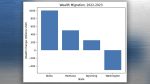 IRS data shows Idaho, Montana, and Wyoming attracted significant wealth from new residents, while Washington state saw a loss of $500 million as its new capital gains tax took effect.
