

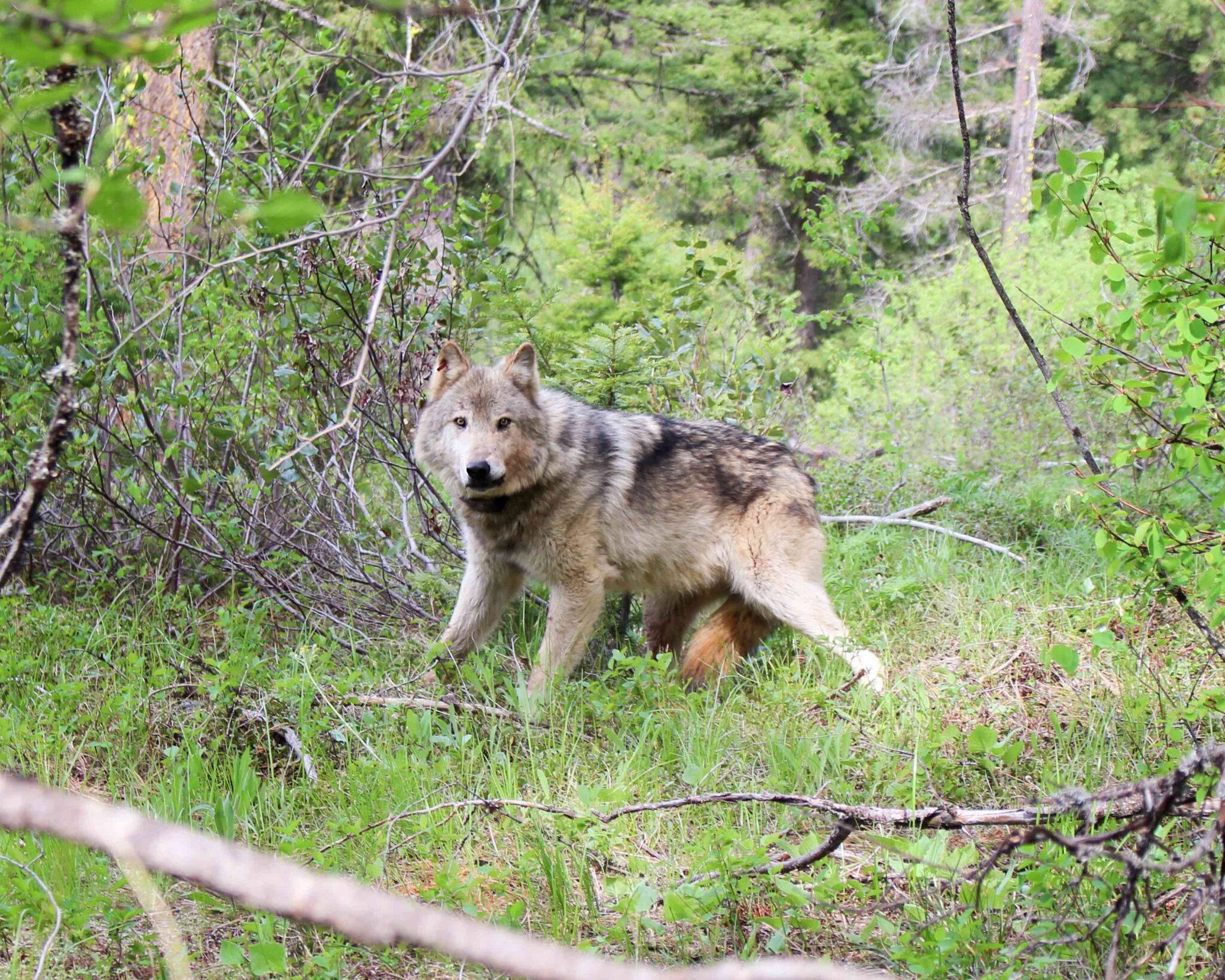
Washington’s gray wolf population is at its highest count since the state began monitoring in 2008.
State and tribal officials counted a minimum of 270 wolves and 49 packs, including 23 breeding pairs at the end 2025, according to a new report from the Washington Department of Fish and Wildlife. The numbers are estimates from last winter’s surveying and include lone wolves.
It marks a 17.4% increase from 2024, when the tally was 230 wolves and 43 packs. That year marked the first decline since counting began. In 2023, the state recorded 254 wolves and 42 packs.
“The growth is pretty consistent in what we’ve seen in our recolonizing population throughout recovery,” said Trent Roussin, a wolf biologist for the Washington Department of Fish and Wildlife.
The state groups wolves into three recovery regions: Eastern Washington, the North Cascades, and the Southern Cascades and Northwest Coast.
The increase was fueled in part by six new or reestablished packs. In northeast Washington, three packs were reestablished. Officials recorded two new packs in the North Cascades and one new pack on the Confederated Tribes of the Colville Reservation.
There were no known wolf packs in the Southern Cascades and Northwest Coast region by the end of 2025, according to the report.
“Regaining lost footing is essential but these numbers don’t mean wolves are recovered,” said Amaroq Weiss, a senior wolf advocate at the Center for Biological Diversity. “The southern Cascades and North Coast boast some of the best wolf habitat in the state but still have no wolf packs or breeding pairs.”
To get there from their current habitat, wolves would have to cross I-90 or the Columbia Basin, which they can and they have, said Gabriel Spence, wolf biologist for Fish and Wildlife.
“We have had high mortality – human-caused mortality – on wolves in the South Cascades,” said Spence. “That mortality can really slow any population growth.”
At least 28 wolves died last year, according to the report. Six were killed due to livestock conflict. Of those, four were lethally removed by the state.
Twelve wolves were legally hunted by tribal members on the Colville Reservation. Three wolves died due to alleged poaching with one case referred to a prosecuting office and the other two under active investigation.
Killing a wolf without authorization can carry penalties of up to a year in jail or a $5,000 fine under state law.
One wolf that died during a Department of Fish and Wildlife capture operation was determined to have had a congenital heart defect. Two died of natural causes and one died of unknown causes, the report states.
Under state law, the wolves are classified as endangered throughout the state. That won’t change until at least four successful breeding pairs inhabit western Washington, where none were found, and other pairs continue to survive in the two additional recovery regions of the state.
Wolves and ranchers
For ranchers, an increasing number of wolves means more risk for their livestock. Because the wolves are classified as endangered under state law, ranchers are not allowed to kill them.
The state compensates ranchers when a wolf kills their livestock, but even then “it’s not enough,” said Chelsea Hajny, executive vice-president of the Washington Cattlemen’s Association.
Attacks on livestock in 2025 decreased by 50% from the year before, according to the report. Five of the 49 packs last year were involved in at least one confirmed or probable livestock injury or mortality.
But ranchers don’t always report depredations when they happen, said Hajny, calling the reported number “skewed.”
“Ranchers are facing a real crisis,” Hanjy said.
It’s not just the loss of a cow, she said. Wolves that inhabit ranches stress cattle to the point where they are not able to breed or successfully carry a calf.
“We need more action and more ability to take matters into our own hands,” she added.
Range riders would be a solution, Hanjy said, referring to those contracted by the state to monitor land and report wolf activity to ranchers, but “there’s simply not enough of them.”
This report was first published by the Washington State Standard.



Comments
Loading comments…