


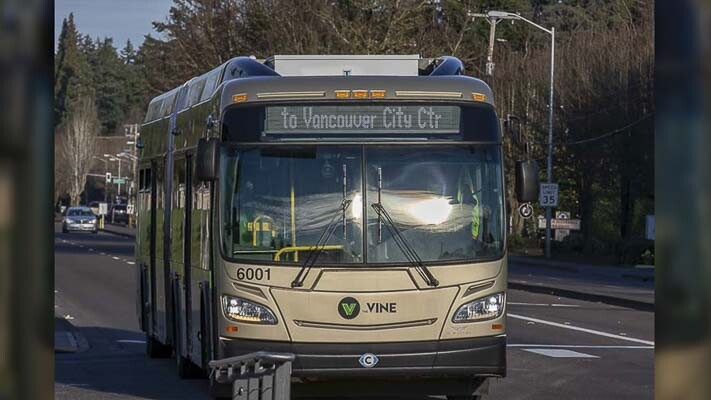
The Vine on Mill Plain is the second branch of The Vine, C-TRAN’s bus rapid transit system
VANCOUVER — C-TRAN will hold a grand opening celebration on Saturday (Sept. 30), to mark the opening of The Vine on Mill Plain. The event will take place at the new Mill Plain Transit Center, 601 S.E. 184th Ave., located adjacent to Clark College’s Columbia Tech Center campus in east Vancouver.
Speakers will include FTA Administrator Nuria Fernandez, C-TRAN CEO Shawn M. Donaghy, Vancouver Mayor and C-TRAN Board Member Anne McEnerny-Ogle, Clark College President Dr. Karin Edwards and others.
The event is open to the public.
EVENT DETAILS: THE VINE ON MILL PLAIN GRAND OPENING
- Saturday, September 30, 1 p.m. to 3 p.m.
- Mill Plain Transit Center
- 601 S.E. 184th Ave.., Vancouver
- Parking is available in the lot immediately south of the transit center. Shuttles will also be running between Turtle Place (7th and Washington Street in downtown Vancouver) and Mill Plain Transit Center for the duration of the event.
BACKGROUND
The Vine on Mill Plain is the second branch of The Vine, C-TRAN’s bus rapid transit system. The new line will primarily serve Mill Plain Boulevard between downtown Vancouver and the new Mill Plain Transit Center in east Vancouver — a 10-mile corridor.
Bus rapid transit, or BRT, is designed to bring faster, more reliable transit service to Mill Plain, one of C-TRAN’s busiest corridors. Larger vehicles, enhanced stations with real-time information displays and other features will also improve the experience for riders and allow for future growth. The system will look and feel similar to The Vine on Fourth Plain, which became the first BRT system in the region when it opened in 2017.
The Mill Plain line includes 37 new stations along the Mill Plain corridor, plus the new Mill Plain Transit Center on the east end of the alignment near 184th Avenue. On the west end, the Mill Plain service will share the existing Turtle Place station in downtown Vancouver now used by The Vine on Fourth Plain. The Vine on Mill Plain will replace C-TRAN’s Route 37, which now serves the Mill Plain corridor.
Construction officially began with a groundbreaking ceremony in 2021. Service officially begins Sunday, October 1 — bringing the project to completion ahead of schedule and under budget.
C-TRAN is the regional public transportation provider for Clark County. It offers Local bus service within its Clark County service area, plus Regional and Express bus service to Portland. C-TRAN also provides on-demand service with The Current, operating in Camas/Washougal, Ridgefield/La Center, WSU Vancouver/Salmon Creek, Rose Village, and the Port of Vancouver. For more information on C-TRAN please visit C-TRAN’s website at www.c-tran.com, or call Customer Service at (360) 695-0123.
Also read:
- Opinion: Were Republican voters just sleeping during the August primary election?
 CCRP Chairman Matt Bumala says 60% of primary no-shows in the 17th and 18th districts were Republicans.
 - High school football: New coach prepares for long-term success at Prairie High School
 James Young-Lewis, a Clark County native who graduated from Evergreen in 2009, became Prairie’s head coach in May after working as an assistant coach across various programs since 2015, joining Prairie’s staff in 2024.
 - Cost to battle 20 wildfires in WA has topped $200M
 Twenty wildfires have cost Washington $207M in one month, more than two-thirds of what DNR spent all last fiscal year.
 - Opinion: WA Cares’ launch showcased care WA Cares did not provide
 Gov. Ferguson showcased a caregiving arrangement at the WA Cares launch that the program had not paid for a single day of.
 - Former State Rep. Liz Pike provides update on husband Neil Cahoon
 Neil Cahoon, a Camas resident, has undergone multiple surgeries including five on Aug. 15 after the Aug. 10 crash near La Center’s Daybreak Airport.
 - Opinion: Portland’s War on Cars Part 4 – A smarter automobile strategy to end gridlock
 O’Toole argues fuel wasted in Portland-area congestion has sextupled since 1982, generating 250,000 tons of extra greenhouse gases annually.
 - $1,000 first prize for Camas Plein Air Art Event honoring Marquita Call on Sept. 26
 Plein air artists compete Sept. 26 in Camas for $1,000 first prize honoring gallery founder Marquita Call.