
On Jan. 29, the legislation passed the House on a 92-4 vote. It passed the Senate on a 48-1 vote on Feb. 6
Brett Davis
The Center Square Washington
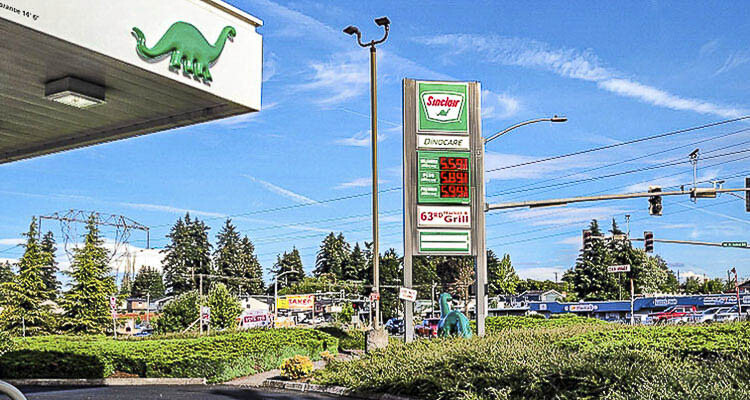
Washington state Gov. Jay Inslee on Wednesday morning signed into law a bill that tightens fuel tax enforcement and closes revenue gaps.
“This is our first bill of the session,” the governor said at the Olympia signing ceremony for Engrossed House Bill 1964, which targets a specific loophole – that is, the fuel tax is included in the price of gasoline paid by the person filling up. “It passed in an overwhelmingly bipartisan vote, which is always a good way to start things off.”
On Jan. 29, the legislation passed the House on a 92-4 vote. It passed the Senate on a 48-1 vote on Feb. 6.
EHB 1964 empowers the Department of Licensing to track and investigate any potential fuel tax and registration violations via the creation of a dedicated “fuel tax discovery team.”
“This bill requires DOL to establish a team that will investigate fuel tax violators and provides them with the authority to assess civil violations,” Inslee said. “Fuel tax reports submitted to DOL will be exempt from public disclosure to protect taxpayer information.”
The governor made a point of noting this is not a tax hike.
“This does not increase any tax; it just makes sure that people are abiding with [what] almost all Washingtonians do, which is to pay their taxes as appropriate,” Inslee said.
Rep. Bill Ramos, D-Issaquah, the primary sponsor of HB 1964, addressed some of the confusion regarding the collection of fuel taxes during floor remarks on House passage of the legislation last month.
“People don’t realize how our fuel taxes are collected,” he said at the time. “Most people think we pay them at the pump individually, but in truth, they’re collected further up the chain. And the folks picking up fuel from the refineries, they’re responsible for paying those. They’re incorporated into the price of fuel and everybody does pay at the pump, but it is incorporated into the price, not collected there.”
According to the legislation’s fiscal note, EHB 1964 is expected to bring in approximately $16 million per biennium.
The fiscal note also estimates operating expenses of $1.63 million for the current 2023-25 biennium and $2.24 million each for the 2025-27 and 2027-29 biennia.
This report was first published by The Center Square Washington.
Also read:
- Opinion: Were Republican voters just sleeping during the August primary election?
 CCRP Chairman Matt Bumala says 60% of primary no-shows in the 17th and 18th districts were Republicans.
 - High school football: New coach prepares for long-term success at Prairie High School
 James Young-Lewis, a Clark County native who graduated from Evergreen in 2009, became Prairie’s head coach in May after working as an assistant coach across various programs since 2015, joining Prairie’s staff in 2024.
 - Cost to battle 20 wildfires in WA has topped $200M
 Twenty wildfires have cost Washington $207M in one month, more than two-thirds of what DNR spent all last fiscal year.
 - Opinion: WA Cares’ launch showcased care WA Cares did not provide
 Gov. Ferguson showcased a caregiving arrangement at the WA Cares launch that the program had not paid for a single day of.
 - Former State Rep. Liz Pike provides update on husband Neil Cahoon
 Neil Cahoon, a Camas resident, has undergone multiple surgeries including five on Aug. 15 after the Aug. 10 crash near La Center’s Daybreak Airport.
 - Opinion: Portland’s War on Cars Part 4 – A smarter automobile strategy to end gridlock
 O’Toole argues fuel wasted in Portland-area congestion has sextupled since 1982, generating 250,000 tons of extra greenhouse gases annually.
 - $1,000 first prize for Camas Plein Air Art Event honoring Marquita Call on Sept. 26
 Plein air artists compete Sept. 26 in Camas for $1,000 first prize honoring gallery founder Marquita Call.
 wpDiscuz