



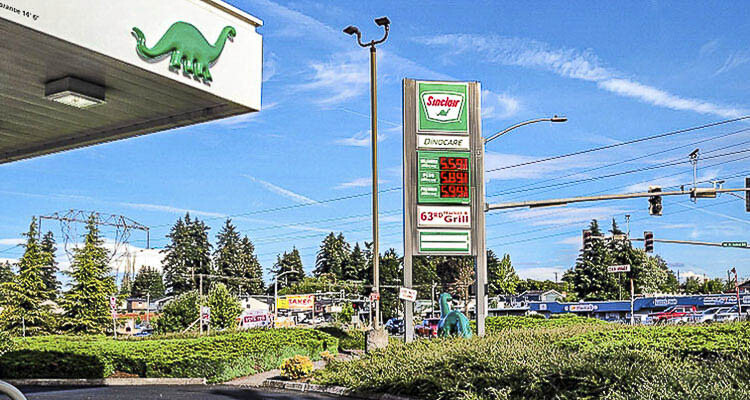
On Jan. 29, the legislation passed the House on a 92-4 vote. It passed the Senate on a 48-1 vote on Feb. 6
Brett Davis
The Center Square Washington
Washington state Gov. Jay Inslee on Wednesday morning signed into law a bill that tightens fuel tax enforcement and closes revenue gaps.
“This is our first bill of the session,” the governor said at the Olympia signing ceremony for Engrossed House Bill 1964, which targets a specific loophole – that is, the fuel tax is included in the price of gasoline paid by the person filling up. “It passed in an overwhelmingly bipartisan vote, which is always a good way to start things off.”
On Jan. 29, the legislation passed the House on a 92-4 vote. It passed the Senate on a 48-1 vote on Feb. 6.
EHB 1964 empowers the Department of Licensing to track and investigate any potential fuel tax and registration violations via the creation of a dedicated “fuel tax discovery team.”
“This bill requires DOL to establish a team that will investigate fuel tax violators and provides them with the authority to assess civil violations,” Inslee said. “Fuel tax reports submitted to DOL will be exempt from public disclosure to protect taxpayer information.”
The governor made a point of noting this is not a tax hike.
“This does not increase any tax; it just makes sure that people are abiding with [what] almost all Washingtonians do, which is to pay their taxes as appropriate,” Inslee said.
Rep. Bill Ramos, D-Issaquah, the primary sponsor of HB 1964, addressed some of the confusion regarding the collection of fuel taxes during floor remarks on House passage of the legislation last month.
“People don’t realize how our fuel taxes are collected,” he said at the time. “Most people think we pay them at the pump individually, but in truth, they’re collected further up the chain. And the folks picking up fuel from the refineries, they’re responsible for paying those. They’re incorporated into the price of fuel and everybody does pay at the pump, but it is incorporated into the price, not collected there.”
According to the legislation’s fiscal note, EHB 1964 is expected to bring in approximately $16 million per biennium.
The fiscal note also estimates operating expenses of $1.63 million for the current 2023-25 biennium and $2.24 million each for the 2025-27 and 2027-29 biennia.
This report was first published by The Center Square Washington.
Also read:
- Plenty of NBA connections expected in town Sunday for Vancouver Bears game
 Former NBA stars Gary Payton and Robert Pack will coach opposite each other when the SuperHawks visit the undefeated Vancouver Bears in a marquee USBL matchup.
 - 18th District lawmakers to host town hall meeting on Saturday, March 28, in Battle Ground
 Stephanie McClintock and John Ley will meet with Battle Ground constituents to answer questions, review the new income tax, and discuss the effects of the $80 billion budget.
 - State’s umpire-in-chief goes on recruiting trip in his final season as a baseball umpire
 Tim Stevens is spending his last season traveling to every Washington umpire association, working to address the shortage of officials and encourage young people to join the ranks.
 - POLL: After hearing state leaders describe the I-5 Bridge as vulnerable in an earthquake, what is your reaction?
 State and local leaders describe the I-5 Bridge as structurally at risk but recommend drivers continue crossing it while complex replacement plans unfold.
 - Opinion: Historical state income tax and another massive operating budget highlight the end of the 2026 legislative session
 Rep. John Ley details the passage of a state income tax, an expanding $80 billion budget, and new Clark County infrastructure funding following the 2026 legislative session.
 - VIDEO: Legal challenges certain as Gov. Ferguson prepares to sign new income tax
 Senate Minority Leader John Braun and other legislators expect legal challenges and initiative efforts to follow Gov. Ferguson’s signature on Washington’s new income tax law affecting high earners and businesses.
 - Vancouver Fire Department honors firefighters, community members at annual awards ceremony
 Acts of bravery, including river rescues and life-saving interventions by both residents and first responders, were recognized at the Vancouver Fire Department’s annual awards ceremony.
 wpDiscuz
