



The interview panel for new state employees must undergo anti-bias training and the job candidate will be subject to questions regarding anti-racism and DEI
TJ Martinell
The Center Square Washington
As some states, such as Texas, have enacted laws banning the funding of Diversity, Equity, and Inclusion, or DEI, Washington state is implementing such training for all state agency employees and leadership.
Despite the recent firing of the state’s first director of the Office of Equity, the office continues its work under a Pro-Equity Anti-Racism, or PEAR, Plan & Playbook developed as part of a 2022 executive order by Gov. Jay Inslee. That work coincides with existing efforts by the State Equity, Diversity, and Inclusion Committee that manages the required training centered around concepts such as Critical Race Theory and institutional privilege.
State agencies like the Washington Utilities and Transportation Commission have a PEAR team that consults with an external advisory group to help them implement individual agency plans and strategies to, in the words of UTC, “promote equitable access to opportunities and resources to reduce disparities and improve outcomes statewide across state government.”
As demonstrated at a recent meeting of the UTC PEAR External Advisory Group, the groups adhere to “ground rules” developed by the DEI Council that require participants to do the following:
- Understand your privilege, the space you occupy, and the power dynamic you bring to this space
- Acknowledge that systemic racism and other forms of oppression exist, and that history informs current law and policy
- Actively recognize, interrupt, and dismantled white supremacy
- Accept that no action is equity neutral
“Privilege” is defined by a “privilege matrix” found on state agency websites classifying groups as either “dominant” or “marginalized.”
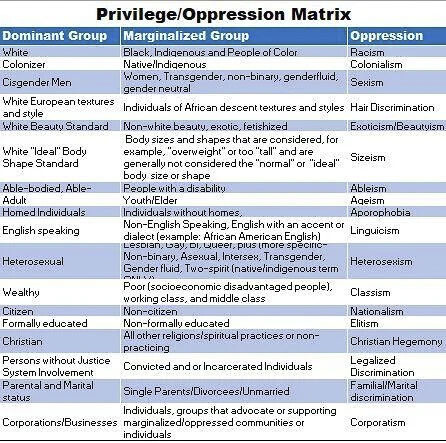
Groups considered “dominant” include those who fall under the following labels:
- Persons “without justice System involvement”
- “Homed”
- White
- Men
- English speaking
- U.S. citizen
- Healthy weight
- Christian
- Formally educated
- Married
- Heterosexual
Those labeled as “marginalized” include people who fit the following description:
- Non-white
- Homeless
- Overweight
- Convicted of a crime
- Divorced
- Disabled
- “Intersexual”
- “All other religions/spiritual practices” than Christianity
DEI’s work also includes racial equity and “competency training” for state agency employees and leadership. The Council defines “cultural competencies” as:
A congruent set of knowledge, skills, abilities, and behaviors that enable individuals to work effectively in cross-cultural situations. It promotes respect and understanding of diverse cultures and social groups, and an appreciation of each individual’s unique attributes. Cultural competencies enable employees to respond to others in a manner that demonstrates an effort to understand subtle differences such as communication style, problem-solving, values, and conflict resolution styles.
According to the UTC advisory group meeting, the UTC commissioners have already participated in the following:
- “Trauma informed management training”
- A group reading of the books “White Fragility” and “The Sum of Us: What Racism Costs Everyone and How We Can Prosper Together
Regarding the UTC commissioner training, UTC Director of Consumer Protection and Communication Anna Gill said, “there was certainly discomfort. These are hard topics for people. There was definitely some challenges when we were really talking about white fragility. We experienced a little bit of white fragility. We really worked through it and people are really engaged and learning. You get comfortable being uncomfortable.”
State employees are required to undergo DEI training, including watching a documentary titled “Who We Are: A Chronicle of Racism in America” and participating in other activities intended to provide “awareness of how racial inequalities show up in every system and workplace in Washington,” according to a slideshow presentation from the UTC advisory group meeting.
The interview panel for new state employees must undergo anti-bias training and the job candidate will be subject to questions regarding anti-racism and DEI.
This report was first published by The Center Square Washington.
Also read:
- High-value WA home listings increase by 65% after income tax passage
 After lawmakers approved an income tax targeting millionaires, listings for homes priced at $2 million or more jumped 65 percent compared to last year, with experts urging caution about interpreting the spike.
 - 18th District lawmakers to host town hall meeting on Saturday, March 28, in Battle Ground
 Stephanie McClintock and John Ley will meet with Battle Ground constituents to answer questions, review the new income tax, and discuss the effects of the $80 billion budget.
 - Opinion: In plain sight – yielding to pedestrians
 Drivers often fail to see pedestrians due to inattentional blindness, which highlights the need for more focused awareness at intersections and stronger safety practices.
 - NBA vote clears way for expansion to Seattle
 The NBA Board of Governors has voted to explore adding teams in Seattle and Las Vegas, moving Seattle closer than ever to hosting pro basketball again.
 - Opinion: The legislature has committed $2.4 billion to recurring pension increases since 2018
 Six legislative COLAs have raised public employer costs by $2.38 billion since 2018, driving up unfunded pension liabilities and increasing burdens on county and city budgets.
 - Opinion: ‘Just because they got away with it doesn’t mean they weren’t wrong’
 A Skamania County deputy’s report found violations of county rules and the Open Public Meetings Act, but no prosecutor acted on the findings.
 - More drama at Clark County Council in regard to its representatives on the C-TRAN Board
 Councilors debated whether C-TRAN board representatives must follow group mandates, with Michelle Belkot refusing to commit to new voting rules and Glen Yung opposing her nomination.
