




While some elected and appointed state officials have highlighted the impacts of President Donald Trump’s One Big Beautiful Bill Act on Medicaid funding for the combined operating budget, one lawmaker says it’s a distraction from how the state actually got to this point
TJ Martinell
The Center Square Washington
Washington state is currently forecast to run out of money by 2027 and experience a fiscal deficit by 2028 despite the largest tax increase in state history this session, in addition to record revenue levels.
While some elected and appointed state officials have highlighted the impacts of President Donald Trump’s One Big Beautiful Bill Act on Medicaid funding for the combined operating budget, one lawmaker says it’s a distraction from how the state actually got to this point.
“The BBB (Big Beautiful Bill) is giving them the ability to say, ‘This is all federal, this is so unfair,’” Sen. Ron Muzzall, R-Oak Harbor, told The Center Square.
Muzzall is the ranking minority member of the Senate Health & Long-Term Care Committee. At the committee’s recent meeting, Gov. Bob Ferguson’s Senior Health Policy Advisor Caitlin Safford opined that the state was “in the worst budget crisis we’ve ever had.”
However, Muzzall said that within the context of federal Medicaid funding reductions, talking about a budget crisis is “transferring the responsibility to a bill from the feds that won’t take effect until 2027.”
He said the emphasis on federal Medicaid spending reduction “is incredibly frustrating, this hyperbole. We are in a budget problem in the state of Washington, but it is all our responsibility. The Legislature put us in this position by not putting away money and spending too much.”
“It has been said … this last one [legislative session] was the worst ever. I think this next one could be worse yet. We don’t have the reserves that we should have.”
The Center Square recently reported that Washington’s combined state and federal spending in the operating budget has increased by more than 116% since the 2013-15 biennium. Much of that increase has been due to Medicaid spending along with long-term care, which now composes half of the state Department of Social and Health Services’ budget. Among the new Medicaid spending by the state has been an expansion program to offer illegal aliens free health care, at the cost of $150 million over the current biennium.
The Big Beautiful Bill makes changes to those who qualify for Medicaid enrollment. While critics have argued it could remove hundreds of thousands of current recipients in the state, others have argued that these people were added on who shouldn’t qualify.
With regard to the state’s budget crisis, Muzzall says the federal bill’s passage is nothing new.
“We knew that this end of the 2025 legislative cutoff date,” he said. “This is nothing new to anybody who’s been involved in this process.”
While Ferguson has called the Big Beautiful Bill a “big betrayal of a bill,” Muzzall said Ferguson signed the current state operating budget in April “knowing full well what it was going to cost Medicaid and the state of Washington and now the healthcare system.”
The Center Square reached out to Ferguson’s office for comment on Muzzall’s remarks regarding the Big Beautiful Bill and the governor signing the state’s operating budget, but did not receive a response.
Editor’s note: This is part of an ongoing series examining increases in Washington state spending over several years and determining what taxpayers’ money is being used for by state elected officials.

Also read:
- White House govt. Funding request for 2027 cuts $73 billion
 President Trump’s budget seeks to boost defense funding while cutting $73 billion from agencies like the EPA, NASA, and Agriculture, prompting sharp criticism from Democratic leaders.
 - Heywood asks WA Supreme Court to allow referendum effort on income tax
 Brian Heywood is petitioning the state Supreme Court after the Secretary of State rejected a referendum to repeal Washington’s new 9.9% tax on income over $1 million.
 - VIDEO: Families at center of WA transgender sports debate face-to-face with OSPI
 Two Washington high school students and their parents met with Superintendent Chris Reykdal to discuss concerns about sports policies after one student faced an investigation for harassment.
 - As Washington lawmakers punt on school cellphone ban, some want more action
 At Robert Eagle Staff Middle School, all-day phone removal led to fewer conflicts and more student engagement, but some parents and lawmakers argue a ban should not be imposed statewide.
 - POLL: Do you agree with giving a state commission the power to remove an elected sheriff?
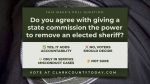 A new poll asks if a state commission—not voters—should have the power to remove an elected sheriff, following concerns raised by Clark County Sheriff John Horch.
