



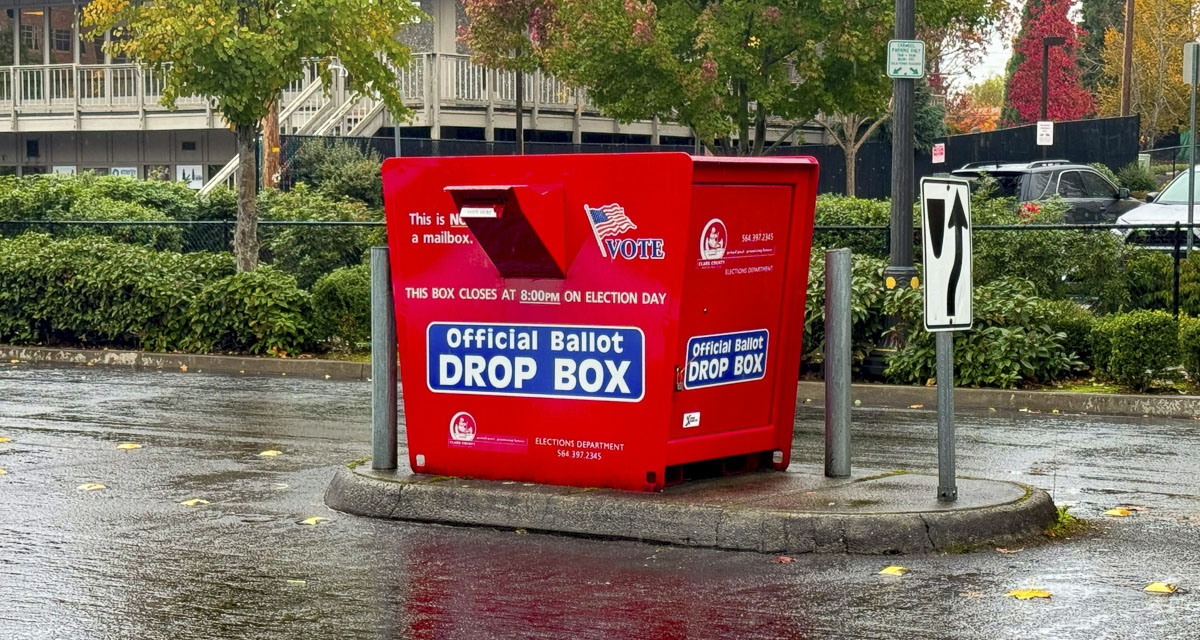
While the case is out of Mississippi, it could disrupt how elections are conducted in Washington and other vote-by-mail states
Jake Goldstein-Street
Washington State Standard
The U.S. Supreme Court on Monday took up a Republican-backed challenge to counting mail-in ballots received after Election Day.
Depending how the justices rule, the case could be consequential for Washington and other states that vote by mail.
It stems from a lawsuit against a Mississippi state law allowing mail-in ballots received within five business days after Election Day to still be counted. Roughly 30 states have similar laws, with varying grace periods.
The decision could also have ramifications for next year’s high-stakes midterms, which will decide whether Republicans maintain control of both the U.S. House and Senate. The court will likely hear arguments and rule by mid-2026.
Washington is one of a handful of states that conduct elections by mail and ballot drop boxes. The state accepts mail-in ballots up until the day before certification, which is 21 days after the election, as long as they are postmarked by Election Day.
Ballots for this month’s elections in Washington are still being counted, and the results of some close races have flipped and narrowed during the past week.
A federal judge in Mississippi upheld the state’s law, ruling the state’s statute isn’t preempted by federal law, which says Election Day is the Tuesday after the first Monday in November.
But a federal appeals panel sided with the law’s challengers, the Republican National Committee and the state’s Republican and Libertarian parties. The appeals judges cited the U.S. Constitution’s clause that gives states the power to regulate elections, but also noted that clause says “Congress may at any time by Law make or alter such Regulations.”
President Donald Trump, in his first term, appointed the three judges who issued that decision.
The legal question now is whether “election day” is when voters cast their ballots, or also when they must be received. The appeals court decided that ballots aren’t cast until election officials get them.
While the ruling doesn’t apply in Washington, if the Supreme Court upheld it, the ballot-counting system here would also be thrown into question.
Mississippi officials appealed to the Supreme Court to protect their five-day grace period. The state’s attorney general, a Republican, wrote in a brief to the high court that the appeals decision “would require scrapping election laws in most States.”
“The stakes are high: ballots cast by — but received after — election day can swing close races and change the course of the country,” Attorney General Lynn Fitch wrote.
The law’s opponents say these measures “deprive the electorate of a clear nationwide deadline that ‘puts all voters on the same footing.’”
In the 2024 general election, Washington election officials received nearly 120,000 valid ballots after Election Day that were postmarked on time.
Washington Attorney General Nick Brown, a Democrat, along with colleagues in other states, filed a friend-of-the-court brief urging the Supreme Court to side with Mississippi. They note the appeals court decision “jeopardizes the ability of military service members and their families stationed abroad to have their timely cast ballots counted.”
Asked for comment on the case Monday, Brown’s office referred to the earlier brief. Secretary of State Steve Hobbs, also a Democrat, didn’t immediately respond to a request for comment.
President Donald Trump has repeatedly attacked mail-in voting.
In a March executive order, for example, he urged U.S. Attorney General Pam Bondi to stop states from counting absentee or mail-in ballots received after Election Day in federal elections.
Brown and Oregon Attorney General Dan Rayfield sued the Trump administration over the order. That case is pending in federal court in Seattle.
Washington state’s Republican Party also wants to see a return to in-person voting, with same-day vote counts.
The Supreme Court is already grappling with other litigation focused on mail-in ballots.
Last month, they heard arguments in the case of an Illinois congressman who sued over a law in his state counting ballots received up to 14 days after Election Day. That case deals with the more procedural issue of the standard plaintiffs must meet to be allowed to sue over an election law.
This report was first published by The Center Square Washington.

Also read:
- VIDEO: Rejected – WA SOS will not process referendum to repeal income tax law
 State officials stopped Let’s Go Washington’s referendum to overturn the new tax, citing constitutional limits. Legal and political battles, including a Supreme Court challenge, are expected next.
 - Southwest Washington lawmakers to hold a series of town hall meetings throughout the 17th Legislative District
 Sen. Paul Harris, Rep. Kevin Waters, and Rep. David Stuebe will answer questions and discuss the state’s expanded operating budget and newly passed income tax at five April town halls.
 - Project 42: It is an income tax, not a millionaire’s tax
 Project 42 co-founder Dann Mead Smith urged Clark County residents to organize against the new income tax law, emphasizing it can be expanded to reach more than just millionaires.
 - VIDEO: WA income tax signed into law with legal challenge right behind
 A 9.9% income tax affecting high earners in Washington faces swift legal opposition and a proposed citizen initiative seeking repeal.
 - Income tax signed in Washington with a legal challenge close behind
 A new law will tax households earning over $1 million, with funds aimed at expanding credits for lower-income residents. Lawsuits and challenges are already underway.
