



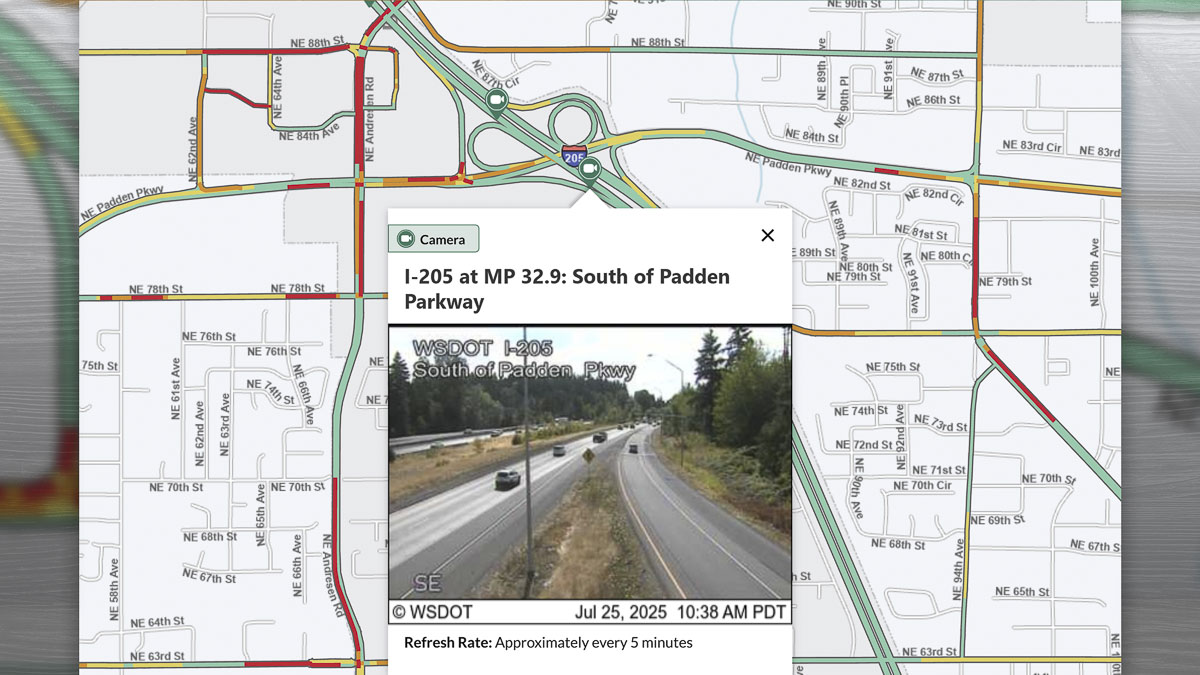
Beginning Monday, July 28, the Washington State Department of Transportation maintenance crews will remove brush and clear danger trees alongside I-205 in Vancouver
CLARK – Travelers who use Interstate 205 in Clark County should expect delays.
Beginning Monday, July 28, the Washington State Department of Transportation maintenance crews will remove brush and clear danger trees alongside I-205 in Vancouver. This work improves visibility, lowers the risk of fires, and keeps plants from growing onto the road.
What to expect
Monday, July 28 and Tuesday, July 29:
- The on-ramp from Northeast Padden Parkway to northbound I-205 (milepost 33) will close each day from 8 a.m. to 3 p.m.
- Travelers wanting to get onto northbound I-205 will need to use a different route.
For everyone’s safety, please slow down, stay focused and expect delays when traveling through the work zone.
Know before you go
People can receive real-time travel information via the WSDOT mobile app, or by visiting our real-time travel map.
Also read:
- Opinion: Half the road, full stop – Understanding pedestrian right-of-way
 Doug Dahl explains how Washington’s law requires drivers to stop when a pedestrian is within one lane of their half of the road, not just when directly in front.
 - Opinion: What is the cost of a bridge?
 John Ley argues the I-5 Bridge replacement’s soaring cost stems from costly extras like light rail, noting other states deliver larger, toll-free bridges for much less.
 - Letter: Vancouver Mayor Anne McEnerny-Ogle makes several serious and incorrect engineering statements
 Bob Ortblad critiques engineering claims by Vancouver Mayor Anne McEnerny-Ogle, highlighting cost and safety advantages of an immersed tunnel for the I-5 crossing.
 - Washington’s studded tire deadline is March 31
 Drivers must remove studded tires by March 31 or face a $137 fine, with WSDOT urging early action due to busy service centers and no planned deadline extension.
 - VIDEO: WA diesel hits record $6.53, crushing truckers and school budgets
 With diesel nearing $6.53 per gallon in Washington, trucking businesses and school districts now confront sharply higher fuel expenses affecting budgets and workers.
 wpDiscuz
