



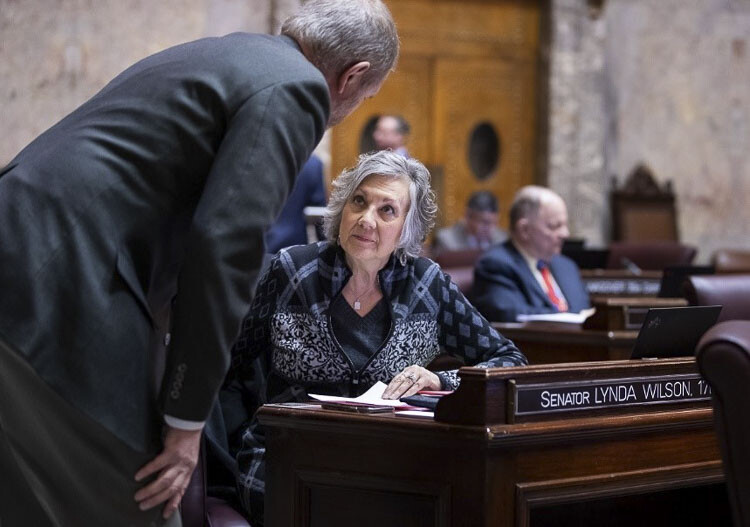
Sen. Lynda Wilson offers an assessment of new state revenue forecast
State government’s first revenue forecast for 2023 shows a drop of more than a billion dollars over the four-year budget outlook, and Sen. Lynda Wilson, Republican budget leader, says the decline should serve as a reality check for legislative budget writers about to unveil spending proposals for 2023-25.
The prediction from Washington’s non-partisan chief economist has anticipated revenue falling $483 million for the upcoming 2023-25 biennium and $541 million for the following two-year cycle, for a total of $1.024 billion – offsetting most of the $1.4 billion gain in the final quarterly forecast for 2022. The forecast was adopted by the state’s Economic and Revenue Forecast Council, which Wilson now chairs, at its meeting this afternoon.
Wilson, R-Vancouver, offered this assessment:
“No one who has been paying attention should be surprised by this downturn. Economic activity in our state showed signs of slowing last fall, and as our chief economist reported today, the same interest-rate increases that are causing trouble in the banking industry are depressing construction activity and home buying and other major consumer purchases. That’s on top of the continuing crisis of affordability in our state, which has people paying high costs for gas, heat, food and housing.
“On the plus side, state government is still in a sound budget position. Between our robust rainy-day fund and other money in reserve, there is more than enough to cover all of state government’s required expenses. The surplus should still be around $4.5 billion even after factoring in the higher costs of maintaining state services and programs for the next two years. There is zero justification for new taxes of any kind, and I am heartened by that, especially since other tax increases approved in past years are still looming.
“All that said, it would be a very good idea to take a more cautious approach to spending in the upcoming operating budget. State agencies have grown used to big spending from the majority Democrats in the past half-dozen years. That rate of growth simply can’t continue if we are to remain in a sound budget position and be prepared for an extended economic downturn. Let’s keep expenditures under control now rather than set the stage for a future shortfall that would either threaten services or fall on taxpayers.
“Now that the latest revenue numbers are in hand we will see operating-budget proposals emerge from both chambers in the coming days. They need to put average Washington families first, not government.”
Information provided by Senate Republican Caucus.
Also read:
- Fiscal fallout: $375 million bond debt indirectly funding operating budget
 Shifting $375 million from a loan fund impacts local infrastructure as Washington state covers operating costs with bond debt, prompting concern among officials and advocacy groups.
 - Lawsuit aims to block new eligibility requirements for WA sheriffs
 Four sheriffs are suing over a state law that sets new eligibility rules, arguing it undermines voter authority by allowing removal for certification issues.
 - Opinion: The growing gap between public voice and political power
 Todd Myers describes how large-scale protest and sign-ins often fail to sway state leaders, and argues authentic influence is most likely found through local action.
 - City of Battle Ground seeks applicants for Salary Commission vacancy
 Battle Ground seeks a resident to join its independent Salary Commission, which reviews compensation and health benefits for local elected officials through 2027.
 - Opinion: Who is winning the race for affordable power?
 Hydroelectric power keeps Washington competitive, but new laws and carbon pricing are driving up electricity costs for residents each year.
 - Vancouver Fire Department assists with Columbia River Marina fire response
 Vancouver Fire Department joined Clark-Cowlitz and Scappoose crews to help fight a vessel and dock fire at Goble Marina, assisting in river operations where one boat sank and another was partially submerged.
 - White House govt. Funding request for 2027 cuts $73 billion
 President Trump’s budget seeks to boost defense funding while cutting $73 billion from agencies like the EPA, NASA, and Agriculture, prompting sharp criticism from Democratic leaders.
