



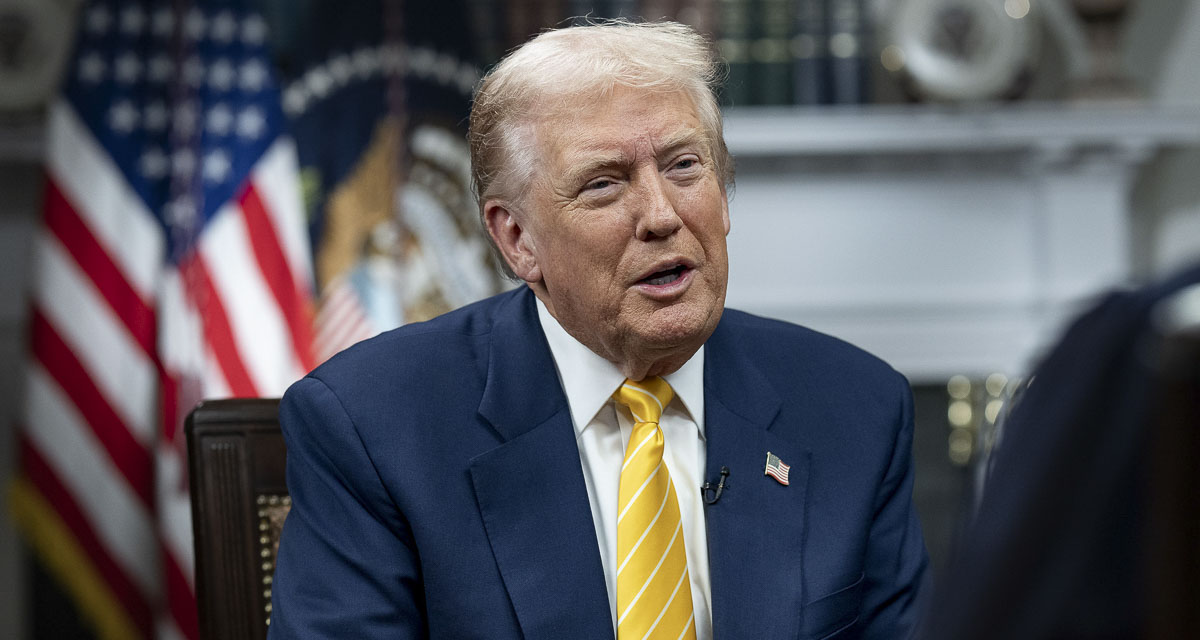
President Donald Trump came back into office emboldened by a decisive 2024 election victory and empowered by Republican majorities in both chambers of Congress
Jennifer Shutt
Washington State Standard
 See Grok’s analysis of this story
This year produced a seemingly endless array of history-making events and nearly constant change to immigration policy, tariffs, the Education Department and federal health care programs.
President Donald Trump came back into office emboldened by a decisive 2024 election victory and empowered by Republican majorities in both chambers of Congress. The unified GOP government enacted major tax cuts and domestic spending law in July, but hit a roadblock in late September when the federal government shut down for a record-breaking six weeks.
Here’s a look back at some of the biggest news stories from Washington, D.C.
January
The U.S. House began the year reelecting Louisiana Republican Mike Johnson as speaker and pushing through a series of GOP-favored bills focused on immigration and transgender student athletes.
Senate Majority Leader John Thune, R-S.D., officially took over the role from Mitch McConnell, R-Ky., pledging to protect the legislative filibuster, the 60-vote procedural hurdle that requires at least some bipartisanship for major legislation to advance. Meanwhile, several committees began the confirmation process for Trump’s nominees.
Just days ahead of his second inauguration, a judge sentenced Trump in the New York hush money case for paying off an adult film star in the leadup to the 2016 election.
Trump, who moved his inauguration indoors amid arctic weather, marked the first day of his second term by signing a series of executive orders addressing immigration and birthright citizenship, as well as climate change and LGBTQ rights. He also pardoned 1,500 people who were convicted of various crimes related to the Jan. 6. 2021, attack on the U.S. Capitol.
Just before the end of the month, Trump signed the first bill approved by the Republican-controlled Congress, the Laken Riley Act. And he announced plans to implement tariffs on Canada, Mexico and China, the start of one of his signature economic policies.
February
Lawsuits against Trump’s actions began piling up within weeks as Democratic attorneys general, immigrant rights organizations and civil liberties groups accused the administration of overstepping its authority.
Trump and other administration officials sought to reduce the size and scope of the federal government by firing thousands of probationary workers and called on the heads of all federal agencies to submit reorganization plans by mid-March. He also fired 20 immigration judges.
Republicans in Congress started working through the several complicated steps of the budget reconciliation process that would eventually lead to the “big, beautiful bill.”
March
Trump’s efforts to dismantle the Department of Education began advancing shortly after the Senate voted to confirm Linda McMahon as secretary. In one of her first acts leading the department, she wrote in a memo its “final mission” would be to “to send education back to the states and empower all parents to choose an excellent education for their children.”
Trump signed an executive order later in the month directing McMahon to “take all necessary steps to facilitate the closure” of the Education Department, though much of that authority rests with Congress.
Supreme Court Chief Justice John G. Roberts issued a rare public statement defending the judicial branch against criticism from Trump.
The Republican chairman of the Senate Armed Services Committee asked the Defense Department inspector general to look into the use of the Signal messaging app by high-ranking officials to discuss an imminent bombing in Yemen. A journalist at The Atlantic was inadvertently added to the chat and later published a series of articles about the experience.
April
The Trump administration admitted in court filings that officials mistakenly deported Kilmar Abrego Garcia of Maryland to a notorious mega-prison in El Salvador.
The Supreme Court became more involved in the national debate about Trump’s policies toward immigrants, first ruling that the administration didn’t need to bring Abrego Garcia back before reversing course and ruling officials must “facilitate” his return to the United States.
El Salvador President Nayib Bukele, sitting alongside Trump in the Oval Office, later said he wouldn’t send Abrego Garcia back.
Separately, Trump’s tariff policies were the focus of a Senate hearing. Republicans in Congress settled on an outline for their “big, beautiful bill” and later began advancing different parts of that package out of House committees.
Health and Human Services Secretary Robert F. Kennedy Jr. said he would refocus autism research funding on environmental factors. And Trump signed a series of executive orders addressing education policy.
May
The Supreme Court ruled that a ban on transgender people serving in the military could remain in place while the case continued at a lower level, that the Trump administration violated due process rights when it tried to deport some Venezuelans under the Alien Enemies Act of 1798, that the administration could end temporary protected status for 350,000 Venezuelans, and that the Trump administration could proceed with deportations for 500,000 people from Cuba, Haiti, Nicaragua and Venezuela who had been granted temporary protected status.
Republicans in the House voted to approve a 1,116-page package that combined 11 bills into what would eventually become the “big, beautiful bill,” sending the measure to the Senate.
Former President Joe Biden was diagnosed with “a more aggressive form” of prostate cancer.
June
Trump doubled tariffs on steel and aluminum, from 25% to 50%, saying during a trip to a U.S. Steel plant in Pennsylvania that he would increase them even further if he thought it would be necessary to “secure the steel industry in the United States.” The nonpartisan Congressional Budget Office reported later in the month that his tariff policies would reduce the country’s deficit but likely slow the economy.
Immigration continued to be a central part of the news cycle with Abrego Garcia returning to the U.S., California Democratic Sen. Alex Padilla being forcibly removed and handcuffed while attempting to ask Homeland Security Secretary Kristi Noem a question during a press conference in Los Angeles and the Supreme Court weighing in on lower courts issuing nationwide injunctions.
Trump said the U.S. military had bombed “three key nuclear facilities” in Iran before calling for peace.
July
The Senate approved the final, much reworked version of the “big, beautiful bill,” sending it back to the House, which voted along party lines to clear the sweeping tax and health care package for Trump, who signed it on the Fourth of July.
The legislation included several policy goals for the GOP, including on Medicaid, immigration and deportations and a national private school voucher program. The Congressional Budget Office expects the law will increase the federal deficit by $3.394 trillion during the next decade and lead 10 million people to lose access to health insurance.
The Supreme Court ruled the Trump administration could continue with its plans for mass layoffs and downsizing at the Education Department.
Trump was diagnosed with chronic venous insufficiency, a “benign and common” condition for people over the age of 70, according to U.S. Navy Capt. Sean Barbabella, the president’s physician.
Senators from both parties expressed frustration that Department of Agriculture officials didn’t consult with Congress before proposing to move thousands of jobs out of the Washington, D.C., area.
Trump announced a deal with European Union leaders that would result in a 15% tariff on most goods coming into the U.S. from those 27 countries.
August
Trump started off the month instituting a 15% tariff on goods brought into the U.S. from about three dozen countries, though he raised that amount for several nations, including 18% on products from Nicaragua, 30% on imports from South Africa and 50% on goods from Brazil.
A New York State appeals court ruled the $465 million civil penalty against Trump in the case where he was found liable for financial fraud for inflating the worth of some of his real estate holdings was excessive.
Republican and Democratic state legislatures, urged on by the president and members of Congress, sought to begin the November 2026 midterm elections early by redrawing maps for U.S. House seats to give their party a baked-in advantage.
Federal Reserve governor Lisa Cook sued Trump after he attempted to fire her, arguing in court documents his actions were an “unprecedented and illegal attempt” that would erode the board’s independence.
September
A federal appeals court ruled that Trump did need to pay an $83 million penalty for defaming writer E. Jean Carroll.
The Supreme Court ruled that federal immigration agents could racially profile Latinos in Southern California as a lawsuit over the issue continued through the federal courts.
Former Centers for Disease Control and Prevention Director Susan Monarez testified before a Senate committee that she was fired from that role after less than a month because she refused to pre-approve vaccine recommendations.
Trump and several other high-ranking Republicans spoke at the memorial service for conservative political activist Charlie Kirk, who was assassinated during an event at Utah Valley University.
Kirk’s death was one of several instances of political violence this year that also included the killing of Minnesota House Speaker Melissa Hortman and her husband, the arson at the official home of Pennsylvania Gov. Josh Shapiro and the shooting at the CDC’s headquarters in Atlanta.
A group of U.S. investors reached an agreement to take over TikTok, the immensely popular social media app, avoiding the need for it to go offline in the United States.
October
Congress failed to approve the dozen full-year government funding bills before the start of the new fiscal year, leaving an opening for a government shutdown. Democrats tried to bring attention to health care costs and other issues throughout the weeks-long debacle.
The funding stalemate impacted nearly every corner of the federal government, including pay for federal employees like air traffic controllers, food aid for lower-income families, Head Start and public lands.
The No Kings day protests highlighted some Americans’ discontent with Trump and Republican policies a little more than a year before the 2026 midterm elections will measure that frustration at the ballot box.
Trump demolished the East Wing of the White House to make way for construction of a ballroom that will be nearly double the size of the 55,000-square-foot residence and workplace.
November
The shutdown stalemate ended after Senate Majority Leader Thune promised Democrats a vote on a health care bill of their choosing before the end of the year.
The funding bill approved by Congress and signed by Trump included three full-year funding bills but a stopgap for the rest of government, setting up the possibility of a partial government shutdown beginning in February if lawmakers don’t broker a deal before then.
The final days of the shutdown included a tug-of-war between the judicial branch and the Trump administration over whether they needed to pay full benefits for the 42 million people enrolled in the Supplemental Nutrition Assistance Program, or SNAP.
The Supreme Court heard oral arguments in the case that will determine whether Trump overstepped when he instituted tariffs using the International Emergency Economic Powers Act.
Separately, the justices allowed the Trump administration to continue issuing male or female passports based on a person’s assigned sex at birth.
Congress approved a bill forcing the Trump administration to release the Epstein files.
A gunman opened fired on two National Guard members from West Virginia who were just blocks from the White House. U.S. Army Spc. Sarah Beckstrom, 20, died the next day as a result of her injuries.
December
The man charged with shooting the two National Guard members pleaded not guilty during an arraignment hearing and was denied bond in the case, which was later moved to federal court as prosecutors contemplated whether to seek the death penalty.
The Trump administration moved to limit legal immigration and pressed for mass deportations, raising concerns about the shooter, an Afghan national who worked alongside allied troops and was granted asylum in the United States.
Separately, the FBI charged a 30-year-old Virginia man with placing pipe bombs outside the Democratic National Committee and the Republican National Committee offices ahead of the 2021 attack on the U.S. Capitol.
A federal judge ordered immigration officials to release Abrego Garcia.
The House and Senate were unable to come up with a bipartisan agreement to avoid a spike in health insurance premiums for the 22 million Americans enrolled in the Affordable Care Act marketplace who have benefited from an enhanced tax credit created during the coronavirus pandemic to make coverage less expensive. But a discharge petition in the House will force a floor vote early in the new year to extend the subsidies for three more years.
The Department of Justice released tens of thousands of documents linked to the investigation into deceased sex offender Jeffrey Epstein before announcing officials had received a million more pages that will be published in the coming weeks.
This report was first published by the Washington State Standard.

This independent analysis was created with Grok, an AI model from xAI. It is not written or edited by ClarkCountyToday.com and is provided to help readers evaluate the article’s sourcing and context.
Quick summary
The article gives a month‑by‑month recap of major 2025 events in Washington, D.C., during President Trump’s second term with Republican majorities in Congress, covering mass deportation initiatives, broad tariff actions, efforts to wind down the U.S. Department of Education, a record six‑week federal government shutdown, sweeping tax and health‑care legislation, and multiple court challenges to these policies.
What Grok notices
- Uses a chronological structure that walks through 2025 month by month, tying specific executive orders, major bills, and Supreme Court rulings to each period.
- Describes headline initiatives such as mass deportations, wide‑ranging tariffs, efforts to close or significantly shrink the Department of Education, a prolonged government shutdown, and a “big, beautiful” tax and domestic‑spending bill.
- Notes some projected impacts, including Congressional Budget Office estimates of higher deficits and reduced health‑coverage levels under the new laws.
- Highlights that many actions triggered immediate legal challenges, with courts continuing to define the limits of executive authority on immigration, trade, and agency changes.
- Draws on Washington State Standard reporting and focuses on the national effects of unified Republican control, rather than on state‑by‑state implementation details.
Questions worth asking
- How have extensive new tariffs affected consumer prices, supply chains, and manufacturing and agricultural employment in different regions?
- What long‑term consequences could follow from reducing or dismantling parts of the Department of Education, particularly for federal student‑aid programs and civil‑rights enforcement in schools?
- In practical terms, how did the six‑week shutdown change access to federal services and influence quarterly economic growth?
- As courts rule on challenges to deportation policies, tariffs, and agency restructuring, how are they defining the boundaries of presidential and congressional authority?
- Which political and economic priorities shaped the contents of the year’s major tax and domestic‑spending package, and how do those choices compare with earlier tax‑cut efforts?
Research this topic more
- White House – executive orders, policy fact sheets, and archived announcements
- Congressional Budget Office – cost estimates and economic analyses of 2025 legislation
- U.S. Supreme Court – dockets and opinions for key cases on immigration, trade, and executive power
- Federal Register – official notices on tariffs, regulatory changes, and agency reorganization
- GovTrack – bill texts, vote records, and timelines for the major tax and spending packages

Also read:
- VIDEO: Rejected – WA SOS will not process referendum to repeal income tax law
 State officials stopped Let’s Go Washington’s referendum to overturn the new tax, citing constitutional limits. Legal and political battles, including a Supreme Court challenge, are expected next.
 - Southwest Washington lawmakers to hold a series of town hall meetings throughout the 17th Legislative District
 Sen. Paul Harris, Rep. Kevin Waters, and Rep. David Stuebe will answer questions and discuss the state’s expanded operating budget and newly passed income tax at five April town halls.
 - Project 42: It is an income tax, not a millionaire’s tax
 Project 42 co-founder Dann Mead Smith urged Clark County residents to organize against the new income tax law, emphasizing it can be expanded to reach more than just millionaires.
 - VIDEO: WA income tax signed into law with legal challenge right behind
 A 9.9% income tax affecting high earners in Washington faces swift legal opposition and a proposed citizen initiative seeking repeal.
 - Income tax signed in Washington with a legal challenge close behind
 A new law will tax households earning over $1 million, with funds aimed at expanding credits for lower-income residents. Lawsuits and challenges are already underway.
