



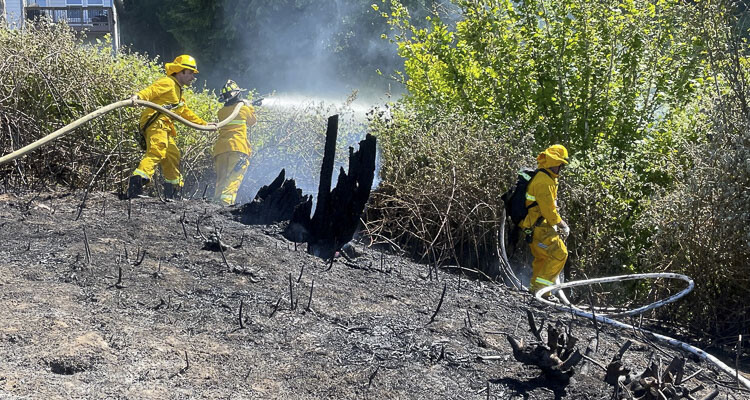
The Fire Marshal also is rescinding all burning permits issued prior to the ban
VANCOUVER – Starting at 12:01 a.m. Thursday (June 8), all land clearing and residential burning in Clark County will be banned until further notice.
The Fire Marshal also is rescinding all burning permits issued prior to the ban. Permits can be reissued or extended when the ban is lifted. The burning restrictions do not apply to federally managed lands.
“Due to recent fires and out of abundance of caution open burning in Clark County will be closed until Sept. 30,” said Clark County Fire Marshal Dan Young. “Recreational fires will still be allowed.”
To have predictable and consistent burn bans, Clark County implements a policy to ban outdoor burning from July 15 through Sept. 30 each year. Designating this period was based on years of information about fuel conditions. However, under certain conditions, a ban can begin sooner or end later.
Recreational campfires on forest lands are allowed only in improved fire pits in designated campgrounds, such as commercial campgrounds and local, county and state parks. On private land, recreational fires are permitted when built according to the following regulations:
Recreational fires must be in a metal-, stone- or masonry-lined fire pit such as those in improved campgrounds or available at home and garden stores.
Size may not exceed 3 feet in diameter by 2 feet in height.
Fires must be at least 25 feet from a structure or other combustible material and have at least 20 feet of clearance from overhead fuels such as tree limbs, patio covers or carports.
Fires must be attended at all times by a responsible person at least 16 years old who has the ability and tools to extinguish the fire. Tools include a shovel and either five gallons of water or a connected and charged water hose.
Portable outdoor fireplaces, also known as patio fireplaces, designed to burn solid wood should not be operated within 15 feet of a structure or combustible material and must always be used in accordance with the manufacturer’s instructions.
Completely extinguish recreational fires by covering them with water or moist soil and stirring with a shovel until all parts are cool to the touch.
Self-contained camp stoves are a safe and easy alternative to campfires.
For more information, please contact the Fire Marshal’s Office at (564) 397-2186 or visit the county’s website at www.clark.wa.gov/development/fire/burning.html.
Information provided by Clark Co. WA Communications.
Also read:
- VIDEO: Decertified WA sheriffs can now be ousted under controversial new law
 A new Washington law lets an unelected board remove elected sheriffs or police chiefs for misconduct that costs them state certification, raising concerns about free speech and political consequences.
 - Inmate with pending charges in Clark County escapes Western State Hospital
 Joshua Dylan Rice, a Clark County inmate facing robbery and assault charges, escaped Western State Hospital and may have ties to Salmon Creek and North Bend, Oregon.
 - With more state financial stress on horizon, Ferguson signs WA budget
 Washington’s latest $79.4 billion state budget taps rainy day funds, reduces child care provider payments, and defers big tax collections, setting up a deficit in 2028.
 - Gov. Ferguson signs controversial law tightening standards for WA sheriffs
 Sheriffs must now meet strict standards or risk removal, with local officials appointing replacements instead of voter recall, amid ongoing debate over constitutionality.
 - Opinion: Stalin would be proud – Clark County Socialists gathered for ‘No Kings’
 Reform Clark County’s Rob Anderson criticizes local and national groups for organizing protests that featured Auditor Greg Kimsey as a keynote, raising concerns about public trust and political partisanship.
 - Higher payroll taxes may hit workers as eligibility rules broaden
 Elizabeth New argues the state’s paid family leave system drains paychecks from lower-income workers and gives more to frequent and high-income users, urging repeal or major reform.
 - Clark County Sheriff’s Office completes extradition in homicide case
 Dariel Nunez-Montero was transferred from Kentucky to the Clark County Jail and is being held as the investigation into the death of Courtney Clinton moves forward.
