




Clark County Council votes 4-1 to for a small increase to the sales tax, with Michelle Belkot voting no because there is no definitive plan as to what to do with the $6.5 million the increase will raise annually
Paul Valencia
Clark County Today
 See Grok’s analysis of this story
The Clark County Council on Tuesday approved an increase in the sales tax that could go for affordable housing, but with no plan yet on just how to spend the revenue.
Before the vote, County Manager Kathleen Otto noted that if approved, the 0.1-percent increase to the sales tax (10 cents for every $100) would start on the first day of the second quarter of 2026. The increase would raise roughly $6.5 million annually.
Clark County Councilor Michelle Belkot had concerns.
“I was wondering how this money is going to be tracked and allocated,” Belkot said.
That would be up to the council’s discretion, Otto replied.
“Council hasn’t made that final decision on how to spend this,” Otto said.
Belkot said it should be explained before “we” impose this, referring to the pending vote. Belkot noted that the council already imposed higher taxes on Clark County residents last year.
“I would be in favor of a work session related to this before we go forward,” she said.
Her colleagues on the council disagreed. County Chair Sue Marshall, and councilors Glen Yung, Wil Fuentes, and Matt Little voted in favor of the sales tax increase.
“I do agree that we pass it now. We are experiencing a housing crisis,” Yung said. “The sooner that we’re able to invest in ways that we can help start to reverse that and help people be able to stay in their homes is critical.
“I trust that we are going to have a good solid policy development on this in the coming months.”
Belkot was not in a trusting mood.
“To me that’s like putting the cart before the horse,” Belkot said. “We have no explanation of how to explain this to our taxpayers, but yet we are going to impose this? … That doesn’t make any sense to me. … I won’t be supporting this.”
Otto noted there was a time element to this week’s vote. By voting to approve now, the tax could start being collected beginning the second quarter of this year. By waiting, it would delay the implementation of the tax.
The city of Vancouver has had a similar tax for years. This new tax would be for residents of unincorporated Clark County.
Fuentes stated he was supportive of passing it now, with so many in the county struggling.
“Six-and-a-half million dollars is not a lot of money but it will help us address some of the issues with the lack of affordable housing,” Fuentes said.
But again, where will the money go, and how will it be used?
The wording on the agenda for Tuesday’s meeting allows for more than just affordable housing:
“Request approval of a resolution to impose a councilmanic 0.1 percent sales and use tax for housing and related services as authorized by RCW 82.14.530, including the construction and acquisition of affordable housing, constructing mental and behavioral health-related facilities, and funding the operations and maintenance costs of new units of affordable housing and facilities where housing-related programs are provided, or newly constructed evaluation and treatment centers.”
Sue Marshall said it is simple.
“It’s easy enough to explain to the public that this fund will go toward building affordable housing,” she said.
Belkot still wants more specifics because as of this week, there is no plan. Plus, it is clear that the funds raised by this increase could be used for more than just affordable housing, according to RCW 82.14.530.
Marshall is confident she knows how the funds will be used.
“For me, as I look at this funding, it’s to build affordable housing,” Marshall said. “It’s build, build, build.”

This independent analysis was created with Grok, an AI model from xAI. It is not written or edited by ClarkCountyToday.com and is provided to help readers evaluate the article’s sourcing and context.
Quick summary
The Clark County Council voted 4–1 to impose a 0.1% sales‑tax increase starting April 1, 2026, projected to raise about $6.5 million per year for affordable housing and related services in unincorporated areas. Councilor Michelle Belkot voted no, citing concern that the county approved the tax without a specific spending plan in place.
What Grok notices
- Quotes council members and County Manager Kathleen Otto on why the tax was adopted now, including urgency arguments and references to allowable uses under RCW 82.14.530, giving readers direct access to the debate.
- Clarifies that the revenue can support more than housing construction, including related services and facilities (such as behavioral‑health or mental‑health uses), depending on county policy choices.
- Places the decision in local context by noting that the City of Vancouver already has a similar tax, and that the county’s measure applies to unincorporated areas.
- Highlights the main disagreement: supporters emphasize immediate funding for a housing crisis, while Belkot emphasizes transparency and wanting a defined allocation plan before imposing a new tax.
- Points readers toward next steps—council work sessions, implementation details, and policy development—where the county would likely finalize priorities and accountability measures.
Questions worth asking
- How will the county prioritize the new revenue among affordable‑housing construction, operations and services, and potential behavioral‑health or mental‑health facility support?
- What accountability measures—such as performance metrics, annual reporting, audits, or advisory boards—will be used to show how the estimated $6.5 million per year is spent and what outcomes it produces in unincorporated areas?
- If the council had delayed the tax until a detailed plan was finalized, how would that have affected first‑year revenue and project timelines compared with potential gains in public trust?
- How does a 0.1% sales‑tax increase compare, in distribution and burden, to other local funding mechanisms for housing (fees, levies, bonds, or targeted excise taxes)?
- What data on housing shortages, homelessness trends, or service demand did the council rely on when deciding to act before finalizing specific allocations?
Research this topic more
- Clark County Council – resolutions, meeting agendas, and materials related to the housing sales‑tax vote
- Washington State Legislature – RCW 82.14.530 text and authorized uses for the local housing sales tax
- Washington Department of Revenue – local sales‑tax rate tables and implementation guidance
- Clark County Community Services – current housing, homelessness, and behavioral‑health programs and needs assessments
- Association of Washington Cities – overviews of local‑option housing taxes and best‑practice accountability approaches

Also read:
- Washington governor talks potential return of SuperSonics with NBA commissioner
 Gov. Bob Ferguson spoke with NBA Commissioner Adam Silver about the possibility of bringing the Seattle SuperSonics back as the league weighs future expansion decisions.
 - Opinion: The income tax proposal has arrived
 Ryan Frost of the Washington Policy Center argues that a proposed Washington income tax creates a new revenue stream rather than delivering tax reform or relief.
 - Is it time to lower the legal limit for blood alcohol content to 0.05 in the state of Washington?
 Mothers Against Drunk Driving and families affected by impaired driving are urging Washington lawmakers to lower the legal BAC limit to 0.05, citing prevention data and personal testimony from Clark County residents.
 - Expert in homebuilding has several tips on how to make housing affordable
 Veteran homebuilder Tracy Doriot shares his perspective on why regulations, taxes, labor shortages, and permitting delays are driving housing costs higher in Clark County and across Washington.
 - POLL: If a sub-district is created, what area should it include?
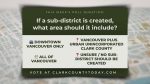 Clark County residents are asked where a potential C-TRAN sub-district should be drawn if voters are asked to fund light rail operations and maintenance costs.

Take from the working and give to the not working
Thumbs up! Wish CCT would return the “+” and “-” options.
Fixed!
Agreed.
I just submitted a budget with a revised 3% across-the-board increase through 2027. No allocation plan, no estimates, just a vague sense that I might get an idea someday. Can’t wait to see what the boss says.
As Belkot seems to say: get a plan, build an estimate, and then make an intelligent decision. Radical, I know but the knee jerking of this council has to stop
OMG… how true! how true! Belkot seems to be the only one living in reality, on this issue.
Trust us… just give us the money… we’ll figure out later where it goes and how we’ll present it to taxpayers as having been sent. NOT!
Un-fugging-believable !!!
I would like to know what the Vancouver City Council thinks the price is for “Affordable Housing” with another tax on the citizens! Is it $1000.00, $1500.00, $2000.00, $2500.00 etc. Where is the accountably of where the money has gone so far for housing for the homeless? So far, the council keeps adding taxes, but are making more citizens homeless, by taxing the folks out of their homes now, to create more homeless! I know that I couldn’t afford their version of “Affordable Housing”!
As my Grandmother would say, many years ago, “when in doubt..don’t “. A simple philosophy that works.
Crooks = Anyone who voted to increase tax on US citizens. You are now part of the largest organized crime network in the world. Your credibility, integrity and common sense are gone. Good intentions are no longer any excuse. Get your emotional broken ideas out of our government. Facts have proven it over and over and socialism does not work. No more sugar coating it, you’re a crook. I have been lending to home buyers in Clark County for over 30 yrs. Everything the government gets involved with becomes more expensive. The government needs to get out of the way and quit competing with the private sector.
https://youtu.be/RfFYqybyHOM The 24 min mark proves the affordable housing efforts are a total waste of taxpayers money and everyone’s time.