



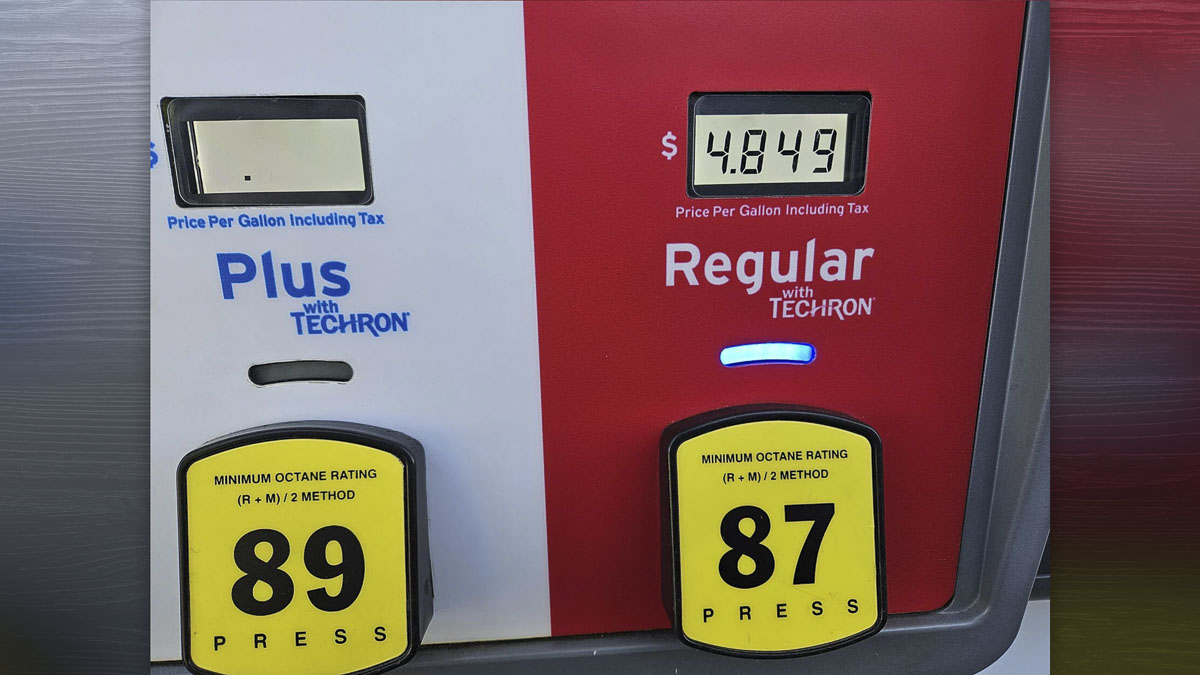
The new gas tax increased the price by 6 cents per gallon, bringing the state’s per-gallon tax rate from 49.4 cents to 55.4 cents
Brett Davis
The Center Square Washington
While gas prices in Washington state fluctuate, they have increased overall compared to last year, with drivers enduring some of the highest fuel costs in the nation.
According to AAA, the average price of standard, or regular grade, gas in Washington is $4.39 per gallon as of Friday morning, up slightly from last week’s $4.388. However, prices have increased substantially compared to last year, when gas was $4.243.
Only California and Hawaii have higher gas prices than Washington.
The national average for a gallon of regular gas is $3.151.
Several factors impact the price of gas in the Evergreen State, including increases in state gas and diesel taxes effective July 1.
The new gas tax increased the price by 6 cents per gallon, bringing the state’s per-gallon tax rate from 49.4 cents to 55.4 cents. To adjust for inflation, per-gallon gas prices will rise 2% every year.
The diesel tax went up 3 cents per gallon at the beginning of July. Diesel will increase by 3 cents more in two years; then in 2028, it will increase by 2% a gallon each year. Factoring in future increases and inflationary adjustments translates into a 9-cent climb from 49.4 cents per gallon to 58.4 cents per gallon.
State lawmakers faced a projected $1 billion shortfall in the two-year transportation budget and an $8 billion gap over the next six years. The deficit was largely attributed to rising construction costs and a decline in gas tax revenue due to increased fuel efficiency and the rise of electric vehicles.
The gas tax increase, along with other revenue measures, is expected to generate approximately $3.2 billion over the next six years, with the gas tax specifically bringing in $1.4 billion over that period.
Also impacting the price at the pump in Washington is the state’s cap-and-trade program, established by the Climate Commitment Act in January 2023 and run by the Washington State Department of Ecology. The program has generated approximately $3.2 billion so far. The money goes to projects that reduce greenhouse gas emissions and promote clean energy initiatives.
Larry Behrens, communications director with the energy advocacy organization Power The Future, didn’t hesitate to express his opinion on Washington’s energy policies related to gas prices.
“While gas prices have dropped across the country over the past year, they’ve actually gone up in Washington state,” he emailed The Center Square on Thursday. “It’s a clear sign of energy mismanagement, especially when Washington drivers are now paying over $4.38 a gallon – more than $1 above the national average. At this point, Washington seems determined to compete with California for the title of most incompetent energy policy in America.”
Andrew Wineke, Washington State Department of Ecology deputy communications director, has a different perspective.
“According to U.S. Energy Information Administration data, gas prices in Washington are about 6 cents a gallon cheaper today than they were a month ago, 60 cents lower than they were in 2023, and 73 cents lower than they were in 2022,” he said in a Thursday email to The Center Square. “That’s despite the 6-cent increase in the gas tax that took effect July 1.”
He added, “Adjusted for inflation, today’s prices are also lower than the equivalent price in 2021.”
Wineke pointed out that Washington often experiences higher gas prices than the national average due to a combination of factors unique to the state and region.
“Gas prices in the Northwest often don’t track national trends because the region is not connected to the rest of the country via pipelines, meaning that nearly all of the fuels used in Washington and Oregon come from the five oil refineries located along Puget Sound,” he explained. “You can see this in Oregon’s fuel prices, which are also higher today than they were in 2024, but lower than they were in 2023 or 2022.”
This report was first published by The Center Square Washington.
Also read:
- Opinion: Inviting courts into health care policy discussion
 Elizabeth New (Hovde) warns that Senate Joint Resolution 8206 could invite lawsuits by placing vague health care mandates into Washington’s Constitution.
 - Opinion: 24 States In. Washington Out? $732 Million Lost?
 Vicki Murray argues Washington risks forfeiting $732 million in federal education funding if state leaders do not opt into the federal tax-credit scholarship program.
 - C-TRAN offering free service on Transit Equity Day, Feb. 4
 C-TRAN will offer free service across its entire system on February 4 in observance of Transit Equity Day, honoring the legacy of Rosa Parks.
 - City of Battle Ground prepares for 75th Anniversary Celebration
 The City of Battle Ground is marking the 75th anniversary of its incorporation with a year-long series of community activities and celebrations planned throughout 2026.
 - Opinion: Nationwide strike in support of illegals and opposing the rule of law?
 Lars Larson argues that a reported nationwide strike reflects opposition to immigration enforcement and the rule of law, criticizing political leaders and media coverage.
 - POLL: Should councilors serving on boards be required to vote the way the full council decides?
 A new poll asks whether Clark County councilors serving on boards should be required to vote in line with the full council’s position or retain independent judgment.
 - Ninth Circuit revives claims against prosecutor who personally swore to warrant affidavit containing alleged false statements
 The Ninth Circuit ruled that prosecutorial immunity does not apply when a prosecutor personally swears to alleged false statements used to obtain an arrest warrant.

It’s 100% related to Inslee’s/voter upheld cap and trade “tax” that adds $0.50 gallon to the price. If you want to call that flawed energy policy then go for it but it’s nothing more than a cash grab to fund green projects that at end of the day will do absolutely nothing when it comes to changing the trajectory of climate change. Where are the metrics from Ecology on the difference it’s making other than money spent and raised?
Voters had the opportunity to deep six that but failed.
Ecology blaming WA “unique ” positioning when it comes to refineries is hogwash.
All one needs to do is simply do a cost comparison of gas prices in the Spokane area and directly across the state line in Idaho. $4.10 vs $3.30. Idaho’s gas tax is $0.35 compared to Washington’s $0.55. Simple math. I have no issue paying the higher WA gas tax for transportation projects and maintenance but Inslee’s green tax is a different matter.