



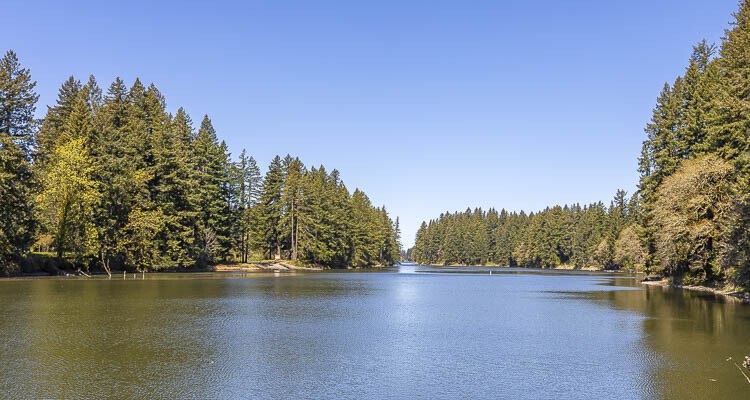
The Lacamas watershed is on Washington state’s list of polluted waters, for high bacteria levels, warm water temperatures, high pH, and low dissolved oxygen levels
VANCOUVER – Clark County and city of Camas representatives recently kicked off a process to enter into an interlocal agreement to cooperatively work to improve water quality in the Lacamas watershed. Staff plan to have a final agreement to present to city and county councils for approval shortly after the new year. Implementation of actions to address water quality issues will begin in spring 2024.
“Goals for measurable improvement in watershed and lake health must be set and action immediately taken,” said Clark County Councilor Gary Medvigy.
The Lacamas watershed is on Washington state’s list of polluted waters, for high bacteria levels, warm water temperatures, high pH, and low dissolved oxygen levels. Each summer, toxic algae blooms close the lake for recreation and water contact.
The drafting of the interlocal agreement follows a recent gathering of local agencies and nonprofits to identify ways to collaborate to reduce toxic algal blooms in Lacamas lakes. Over 100 representatives of federal, state and local agencies came together for the Lacamas Watershed Symposium on Oct. 25, hosted by the county’s Clean Water Commission. The nine-member volunteer community advisory group hosted the symposium to establish a shared understanding of the science and data driving management decisions in the watershed, identify focus areas for future action and investment, inspire a call to action and coordination between stakeholders, and confirm shared responsibility for actions to protect and restore clean water.
While the Lake Management Plan for Lacamas, Round and Fallen Leaf lakes was completed by the city of Camas, over 80% of the watershed that drains into the lakes is in unincorporated Clark County. “Strong collaboration will be necessary as we work to develop a sustained program with Clark County, the Department of Ecology and others, with the overall goal of improving water quality for all those who enjoy our lakes,” said Camas Mayor Steve Hogan.
To solidify the collaboration needed to successfully improve water quality in the lakes, Clark County Council voted to enter an interlocal agreement with the city of Camas to outline how the agencies will work together to address water quality issues and implement improvement strategies.
With the goal of reducing toxic algae blooms and improving water quality to support recreation, wildlife and ecological services, agencies have been creating a foundation for action in addition to the interlocal agreement, including:
- Clark County’s investment of over $750,000 annually on activities in the watershed including stormwater facility maintenance and inspections, capital projects and stream monitoring.
- Camas’ Lake Management Plan, which used water quality monitoring and sampling data to create and release a draft report which identifies actions to improve water quality in the lakes (engagecamas.com/lacamas-lake-management-plan).
- The Washington Department of Ecology has been conducting a detailed study of pollution levels and sources in the watershed and will publish a detailed Lacamas Source Assessment report in December, including recommendations for focusing pollution reduction efforts along Lacamas Creek. Preliminary results indicate high nutrient pollution levels in tributaries including China Ditch, Lower Fifth Plain Creek, Spring Branch Creek, Lower Lacamas Creek and Dwyer Creek.
- Clark Conservation District’s Poop Smart program, supporting landowners with septic system inspections and maintenance, and assisting livestock owners with manure best management practices (poopsmartclark.org).
The county has served as a partner in both the Department of Ecology’s watershed study and the city of Camas’ Lake Management Plan by providing technical input and monitoring resources.
Coming together at the symposium, agencies and organizations shared information about these efforts and identified ways to work together to amplify results and address lake water quality issues with short-term and long-term actions. The forthcoming interlocal agreement will outline shared responsibilities during the implementation of recommended actions.
A recording of the symposium’s presentations and copies of the presentation slides are available at clark.wa.gov/public-works/clean-water-commission. When the interlocal agreement is presented to the Clark County council, it will be posted at clark.wa.gov/councilors/clark-county-council-meetings.
For information about road and park projects, closures, opportunities for community input, and more, residents can follow Public Works on X (formerly known as Twitter), Facebook and Instagram and view information on Nextdoor.
Go to clark.wa.gov/public-works/news to read this information in another language. Click the button in the top right of the page that says “Change language” next to a globe icon and choose your preferred language.
Information provided by Clark Co. WA Communications.
Also read:
- State Representatives McClintock and Ley answer questions at town hall in Battle Ground
 Residents voiced rising concerns about property taxes, school funding debates, the impact of new income tax legislation, and major costs tied to the Interstate Bridge plan.
 - As Washington gets an income tax, the fight to overturn it begins
 Opponents are organizing lawsuits and potential ballot measures to challenge the new 9.9% income tax on Washington households earning over $1 million.
 - Battle Ground Police arrest suspect in fatal 2025 crash
 Laboratory results from a blood sample collected in 2025 provided probable cause for police to arrest Michael T. Smith, more than a year after the Battle Ground crash.
 - Vancouver Police seeking missing person
 Vancouver Police are searching for 62-year-old Carrie Ann Winters, who was last known to be near Frenchman’s Bar in west Vancouver. She has distinctive tattoos.
 - VIDEO: WA diesel hits record $6.53, crushing truckers and school budgets
 With diesel nearing $6.53 per gallon in Washington, trucking businesses and school districts now confront sharply higher fuel expenses affecting budgets and workers.
 - WA’s status solidifies as one of the most expensive places in US
 A new study shows Washington outpaces most states on cost of living, with metrics revealing a sharp rise in daily expenses and major metro areas ranking among the nation’s most expensive.
 - Opinion: Someone explain the Democrat Party to me please
 Lars Larson criticizes Democrat politicians for shutdown threats, Homeland Security funding refusals, and positions on election laws, housing, and gun rights.
