


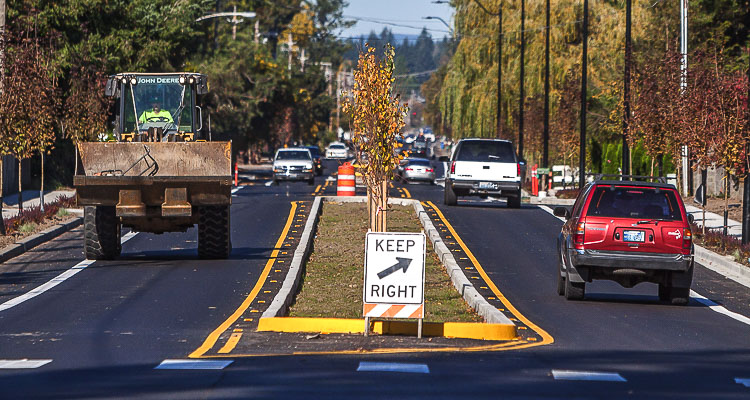
Sales and use tax of 0.1 percent approved by City Council; will go into effect Jan. 1, 2023
On Mon., July 18, the Battle Ground City Council approved Ordinance 22-05; enacting a Transportation Benefit District (TBD), sales and use tax of 0.1 percent. The revised tax rate will go into effect Jan. 1, 2023 and will be used to fund critically needed street projects in the city of Battle Ground.
In 2014, the city established a $20 car tab fee as a means to fund the maintenance, preservation and construction of streets in the city. The tab fee, later repealed by the City Council in June 2020, was collected by the Department of Licensing from residents who live within Battle Ground city limits at the time they renewed or purchased vehicle tabs.
“Share the Road, Share the Load”
The city of Battle Ground serves as the retail hub for North Clark County, to an estimated population of 82,600 people compared to our 21,160 residents. The tab fee only collected funds for vehicles that were registered in the Battle Ground city limits. A significant amount of the traffic occurring on our streets is by vehicles originating from outside of our city limits. The increase to our retail sales tax provides an equitable way to share the cost between our residents and the non-resident motorists traveling our roadways.
Revenue Projections
City staff projects that over the course of the next ten years this sales tax increase has the potential to provide over $11.3 million dollars in revenue, which would be invested exclusively into our streets. This estimate averages out to approximately $1.1 million dollars annually, compared to the roughly $290,000 previously collected per year through the car tab fee.
All from just an additional 10 cents collected from every 100 dollars spent in the city.
Investing in Our Streets
The city recognizes that many of our streets are in need of maintenance and repair. The usable life of a paved street is dependent on when and how it was constructed, how much it is used, its exposure to the elements, and preventive maintenance. Through a comprehensive assessment of city streets, engineers determine the most appropriate and cost-effective method of maintenance and/or repair and the best use of annual TBD revenue.
The Pavement Condition Index (PCI) is a rating system used to indicate the general condition of a section of pavement. Currently, the PCI rating for our roads is 72 out of 100. With a total of $23.28 million in deferred maintenance, an annual investment of 1.1 million in pavement preservation is necessary to maintain a PCI of 72, and to avoid further degradation.
It is our goal to not only maintain, but to improve the “C” rating of our roadways. In addition to the TBD fund, the city continues to seek opportunities such as grant matches, to leverage and enhance the taxpayer’s investment.
Information provided by city of Battle Ground.
Also read:
- Opinion: Were Republican voters just sleeping during the August primary election?
 CCRP Chairman Matt Bumala says 60% of primary no-shows in the 17th and 18th districts were Republicans.
 - High school football: New coach prepares for long-term success at Prairie High School
 James Young-Lewis, a Clark County native who graduated from Evergreen in 2009, became Prairie’s head coach in May after working as an assistant coach across various programs since 2015, joining Prairie’s staff in 2024.
 - Cost to battle 20 wildfires in WA has topped $200M
 Twenty wildfires have cost Washington $207M in one month, more than two-thirds of what DNR spent all last fiscal year.
 - Opinion: WA Cares’ launch showcased care WA Cares did not provide
 Gov. Ferguson showcased a caregiving arrangement at the WA Cares launch that the program had not paid for a single day of.
 - Former State Rep. Liz Pike provides update on husband Neil Cahoon
 Neil Cahoon, a Camas resident, has undergone multiple surgeries including five on Aug. 15 after the Aug. 10 crash near La Center’s Daybreak Airport.
 - Opinion: Portland’s War on Cars Part 4 – A smarter automobile strategy to end gridlock
 O’Toole argues fuel wasted in Portland-area congestion has sextupled since 1982, generating 250,000 tons of extra greenhouse gases annually.
 - $1,000 first prize for Camas Plein Air Art Event honoring Marquita Call on Sept. 26
 Plein air artists compete Sept. 26 in Camas for $1,000 first prize honoring gallery founder Marquita Call.
 wpDiscuz