


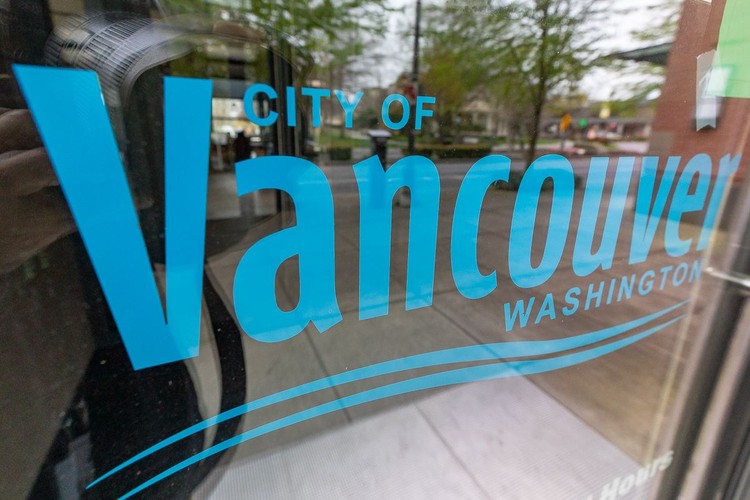
The city attorney, the city manager, and the chief of police gave an explanation to the Vancouver City Council on Monday night in regard to a new, temporary policy that will change the way officers handle low-level crimes
Paul Valencia
Clark County Today
The city attorney, the city manager, and the chief of police all said Monday night that they could have done a better job in communicating the new, temporary protocols for law enforcement dealing with low-level crimes in Vancouver.
They want their message to now be crystal clear:
“It’s not open season in the city of Vancouver,” City Attorney Nena Cook said.
Cook, along with City Manager Lon Pluckhahn and Vancouver Police Chief Troy Price, gave a passionate explanation of what they say will be a temporary change for law enforcement. They gave their presentation in front of the Vancouver City Council at a meeting Monday night.
The subject was not on the meeting’s agenda, but after six days of public outcry over the new protocol, Pluckhahn took his moment during communication time to bring up the policy. That led to a discussion that lasted more than 45 minutes.
Last week, it was revealed that a memorandum was given to Vancouver police officers directing a major change in enforcement on what are described as low-level crimes, such as shoplifting, trespassing, public drug use, etc. The Vancouver Police Officers Guild went public with that directive, decrying what it believed would limit its officers from enforcing laws.
Instead of making an arrest or issuing a citation for those offenses, the crimes will instead be referred to the prosecuting attorney’s office. Charges will then be determined at a later date.
Pluckhahn noted last week that this was a temporary change that was needed to allow more serious crimes to go through the judicial process. A court ruling has limited the number of cases that a public defense attorney can handle, and there are fewer defense attorneys available. That, Pluckhahn said, has led to the dismissal of dozens of cases recently, including 10 misdemeanor domestic violence cases.
This is also a timing issue. If a police officer makes an arrest or serves a citation, the clock starts on a 14-day window in which the suspect must appear before a judge for an arraignment. With a referral instead of a citation, the clock does not start until prosecutors officially charge the suspect.
“What I’m here to say, my office intends to prosecute these cases,” Cook said. “If there is someone (a criminal) out there listening who thinks the doors are wide open in the city of Vancouver, they’re going to learn the hard way.”
Cook did acknowledge that she understands why so many officers thought this was going to invite more criminal activity to the city.
“I am so sorry, on behalf of my office, … and as the city attorney, that I didn’t do my part to communicate better to not only our officers … but to the community and residents of Vancouver,” Cook said.
Vancouver Police Chief Troy Price also took responsibility for the lack of communication.
“We probably could have been a bit more clear,” he said, adding that the new protocol caught some of his officers off guard. “We do recognize that was a failure on our part.”
City Councilor Erik Paulsen wanted officials to understand the concerns of the citizens. He noted that in the past five, 10 years, many prosecuting attorneys in other cities have adopted soft-on-crime policies. Those policies, he said, are believed to have led to an uptick in crime. He wanted assurances that this was not going to happen in Vancouver.
“It is not open season in Vancouver. Charges can still be brought and prosecuted,” Cook said, adding that lower-level crimes are still crimes.
Pluckhahn said this policy was not designed to put people or businesses at risk. It was to address a critical shortage of defense attorneys.
“I know people get concerned that you’re quote-unquote ‘granting people permission to commit crimes.’ That was not the intent. It was to get us through a temporary crunch on attorneys,” he said.
Vancouver Mayor Anne McEnerny-Ogle and her colleagues on the council asked several questions, including what the people of Vancouver can expect moving forward with this policy.
“Vancouver police has not changed in its pursuit of criminal activity and holding people accountable for committing crimes in our city,” Price said. “What has changed is the method by which those people will be held accountable. It might take a little bit more time for them to get in front of a judge, have their case heard.”
Price reiterated that his officers will respond to 9-1-1 calls, even for those lower-level crimes that were described in the memorandum.
“We will come out and address whatever the issue is for the day. We’ll do our best to get that information into the hands of the prosecutors so that they can do what they need to do,” Price said.
“Don’t hesitate. We will respond,” he added.
“Residents should expect and will receive the same level of service from the Vancouver Police Department that they have always received,” Cook said. “What won’t happen is what’s happened in the past few weeks, which is 10 domestic violence cases being dismissed.”
“Our hope is by taking the actions we’re taking right now,” Price said, “fewer of those cases will be dismissed by a judge somewhere down the line.”
“That’s what I want to hear,” Councilor Sarah Fox said.
The councilors and city officials also discussed the lack of defense attorneys and if there are ways to solve this problem. Can the budget be adjusted to increase the amount of money for public defense attorneys? Is there a way to recruit more public defense attorneys?
The mayor and councilors seemed to be in agreement that they appreciated Monday’s discussion — explanation — and for the officials taking responsibility for a missed opportunity with communication.
Still, the problem remains. Even with the explanation, law enforcement is going through a major change in Vancouver, and the city has fewer public defenders.
“What are we going to do to fix it?” Councilor Bart Hansen asked before issuing a challenge to Pluckhahn.
“I think it’s also important that you know how we stand because we are the ones who are inevitably responsible for this. And this is not acceptable,” Hansen said. “So I’m looking to you city manager, my one-seventh of this dais, to say, please, by all means, fix this.”
Also read:
- Cost to battle 20 wildfires in WA has topped $200M
 Twenty wildfires have cost Washington $207M in one month, more than two-thirds of what DNR spent all last fiscal year.
 - Former State Rep. Liz Pike provides update on husband Neil Cahoon
 Neil Cahoon, a Camas resident, has undergone multiple surgeries including five on Aug. 15 after the Aug. 10 crash near La Center’s Daybreak Airport.
 - Auditor, auditor candidate address scrutiny over job title
 Greg Kimsey says roughly 40 county employees hold the deputy county auditor designation Kelly used in his campaign.
 - Ridgefield Waterfront plans meet resistance: Community voices weigh in
 Residents opposing Ridgefield’s waterfront development cite scale, wildlife impact, and inadequate boat launch parking as key concerns.
 - Gunfire at Hockinson Park leaves one dead; BGHS graduate, UW baseball signee charged with manslaughter
 Trent Richardson, 18, died from a gunshot wound at Hockinson Meadows Community Park; James Gill III charged with second-degree manslaughter.
 wpDiscuz