



Decision ends a policy that had been in place since 1991
Maya Homan
Washington State Standard
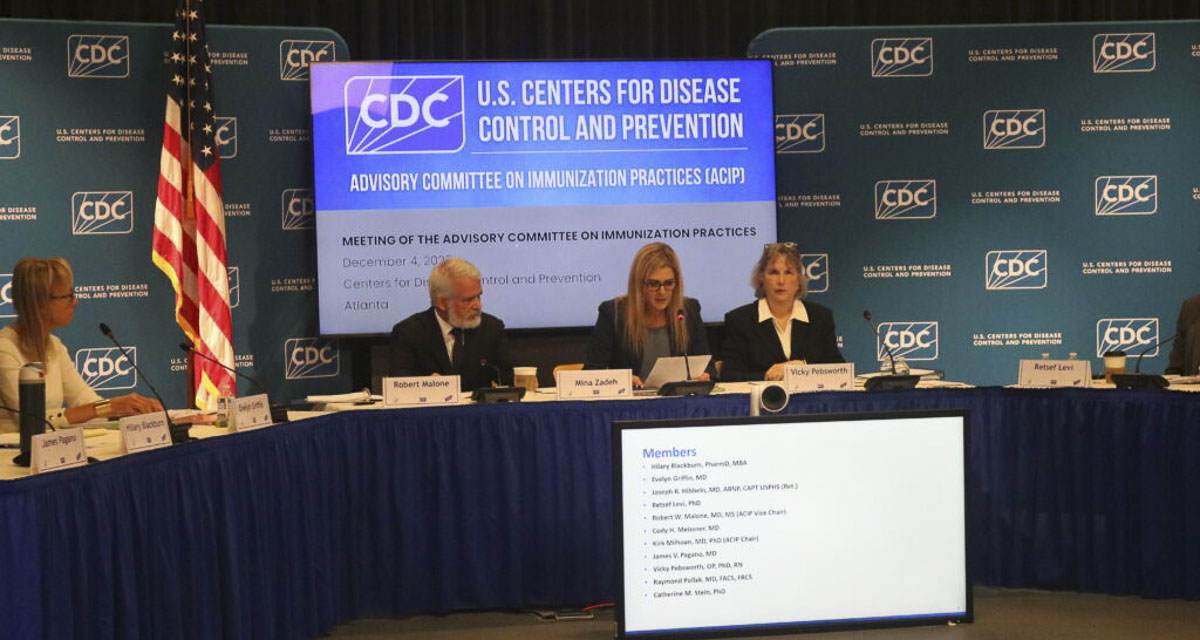
ATLANTA — A Centers for Disease Control and Prevention committee voted to eliminate a recommendation that all newborn babies receive a vaccine against hepatitis B, ending a policy that has been in place since 1991 to protect Americans against an incurable liver disease that can lead to cirrhosis, cancer and liver failure.
The current three-dose series for hepatitis B includes one vaccine administered to infants within 24 hours of birth, and subsequent booster shots given one month and six months after the initial dose. There was a 99% drop in serious infections among children between 1990 and 2019, which is attributed to the universal vaccination policy.
The agency will leave in place a recommendation that babies born to mothers who test positive for hepatitis B receive a vaccine at birth. However, the new guidelines leave the decision in all other cases to “individual-based decision-making.” They also suggest that parents delay the first dose of the vaccine for at least two months after birth.
Friday’s decision comes after an 8-3 vote from a key CDC advisory committee, known as the Advisory Committee on Immunization Practices, which is charged with setting national guidelines around which people should be vaccinated against a wide range of preventable diseases and when those vaccines should be administered. The recommendations play a key role in determining which vaccines insurance companies are willing to cover and how accessible those immunizations are to the public.
Retsef Levi, an ACIP member and professor of operations management at the Massachusetts Institute of Technology, called the updated recommendation a “very positive change in policy.” arguing that blanket vaccine recommendations force newborns to serve as “a safety net for adults’ mistakes.”
But Dr. Cody Meissner, another member of the committee who also serves as a professor of pediatrics and medicine at Dartmouth College, argued that there was no scientific evidence to support the changes implemented by the panel.
“Thoughtful inquiry is always commendable,” he told the committee. “But that inquiry should not be confused with baseless skepticism, which is what I think we’re encountering here.”
The updated recommendation for the hepatitis B vaccine mirrors COVID-19 vaccine guidelines passed by the same panel in September, which places new emphasis on the risks of immunizations, though the CDC’s own data shows that the vaccines are safe and effective for most people. As with the new COVID-19 vaccine recommendations, the updated hepatitis B guidelines will not take effect until being officially signed off by the CDC director.
A second vote, which passed 6-4, encourages parents to discuss using serology testing, a type of blood test that measures antibodies to gauge how well a patient’s immune system has responded to a disease, before allowing their children to receive additional doses of the hepatitis B vaccine.
The changed recommendations will not prevent doctors from administering hepatitis B vaccines to newborns, but may impact which insurance companies are willing to pay for the immunizations. Children enrolled in Medicaid or the Vaccines for Children program, which provides free immunizations to children who are uninsured or underinsured, will continue to be eligible for hepatitis B vaccines at birth under the new recommendations, according to program liaisons.
This story was originally produced by Georgia Recorder, which is part of States Newsroom, a nonprofit news network which includes Washington State Standard, and is supported by grants and a coalition of donors as a 501c(3) public charity.
Also read:
- Vancouver Police arrest barricaded man
 Terry Meyers, 58, faces multiple assault charges after pointing firearm at neighbor and barricading himself.
 - 49th Legislative District Democrats share their reasons for backing state income tax at Town Hall
 Three Democrat legislators defended the new income tax affecting only those earning over $1 million annually.
 - Letter: Freeze the scope and build the bridge
 Vancouver resident calls for project discipline after 22 years of planning and nearly half a billion in costs.
 - Ekklesia Theatre presents ‘Every Brilliant Thing’
 Interactive theatre production donates 50% of ticket sales to local counseling services.
 - Opinion: Public workers’ First Amendment rights are getting attention – in Idaho, not Washington
 Idaho moves to stop public schools from collecting union dues through government payroll while Washington continues favoring unions over worker choice.
 - Opinion: Lawsuit filed against the unconstitutional income tax in Washington state
 Former Attorney General Rob McKenna and Supreme Court Justice Phil Talmadge challenge the 9.9% income tax in Klickitat Superior Court.
 - Vancouver Police investigate domestic violence homicide
 Vancouver Police Major Crimes Unit investigating after woman found dead with knife wounds on NE Oakbrook Circle.
 wpDiscuz
