



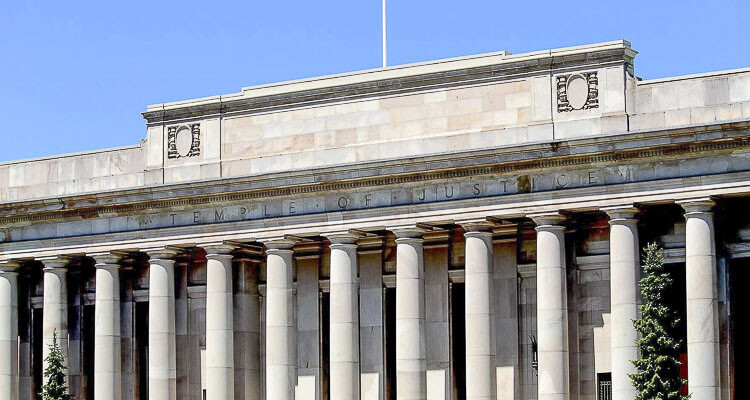
Last March, Douglas County Superior Court Judge Brian Huber ruled the tax was “properly characterized as an income tax … rather than as an excise tax as argued by the State” and struck it down
Brett Davis
The Center Square Washington
The Washington State Supreme Court on Thursday morning heard from both sides on the question of whether or not the state’s new capital gains tax passes constitutional muster.
The state Legislature passed the capital gains tax in 2021, and Gov. Jay Inslee signed it into law. It creates a 7% tax on profits of more than $250,000 from the sale of some assets, such as stocks and bonds.
Last March, Douglas County Superior Court Judge Brian Huber ruled the tax was “properly characterized as an income tax…rather than as an excise tax as argued by the State” and struck it down. The state constitution’s uniformity clause does not allow income to be taxed at different rates.
State Attorney General Bob Ferguson directly appealed the decision to the Supreme Court, which in July agreed to hear the case.
In November, the Supreme Court allowed the state Department of Revenue to begin collecting the tax white it considers the state’s appeal.
State Solicitor General Noah Purcell defended the tax on the grounds that it’s not an income tax, but an excise tax on the sale or exchange of certain capital assets.
“The capital gains excise tax applies only when a person sells certain types of assets, such as stocks and bonds, and receives a gain of over a quarter of a million dollars in a single year,” he told the justices during oral arguments from the court’s temporary chambers in Tumwater. “The tax does not apply to sales of real estate, farmland, retirement assets.”
Purcell explained the state’s reasoning in characterizing a capital gains tax as an excise tax rather than a property tax.
“So, the idea that if something is based on profits it must be a property tax, it has no basis in the case law or in logic,” he said.
He pointed to the state’s real estate excise tax and business and occupation tax in making his case.
“When someone sells real estate – whether it’s their home or rental property – they obviously earn income from selling that property, but nonetheless they owe the real estate excise tax on that transaction,” he said. “When a small business owner like a plumber or an accountant earns their income from their small business but nonetheless they owe the business and occupation tax on the business’ income.”
Purcell went on to say, “The fact that a person generates income by engaging in a transaction does not mean that a tax on that transaction becomes an income tax or a property tax, and the court’s case law is very clear about that.”
He referenced the Washington State Supreme Court’s 1952 ruling in Mahler v. Tremper that held a county tax on the sale of real estate is an excise tax and not a property tax because it’s a tax on the transaction rather than merely ownership.
Paul Lawrence, an attorney for Pacifica arguing on behalf of school districts, educators, and parents, supported Purcell’s argument by saying the court should consider overturning its 1933 decision in Culliton v. Chase that distinguished an income tax from an excise tax and concluded that income is within the state constitution’s broad definition of property.
“As this court has said many times, stare decisis is not a straitjacket, it’s not immutable,” he said. “This court has several times overturned cases that are older than Culliton and its progeny.”
No court in the state of Washington has evaluated the claim that income is property under the state constitution, Lawrence told the justices.
Opponents argued the capital gains tax is not allowed under the state constitution.
“The tax is a nonuniform property tax on individual income,” Callie Castillo, an attorney for Lane Powell representing the plaintiffs, said.
She pushed back on the notion the state is taxing the sale or exchange of certain capital assets.
“The plain language of the statute says that the tax is imposed when an individual recognizes capital gains on their federal income tax forms,” Castillo said. “And that is the subject of the tax: the income, not the transaction.”
She went on to explain further, “But what it establishes is why the tax in its operation and effect is not an excise tax. It is a property tax under this court’s authority, because it is a tax on income.”
Former state Attorney General Rob McKenna, one of the lead attorneys against the capital gains tax, pointed out that all taxing authorities in the U.S., from the Internal Revenue Service to every other state that has a stated opinion on this subject, regard capital gains as income and taxes on them as income taxes.
“In our state, the law is income is property,” he specified. “You can have in income tax if it meets the requirements for property taxes.”
The definition of property is up to the states, McKenna said, referencing the 1937 U.S. Supreme Court decision in Hale v. Iowa State Board of Assessment and Review that cited the Culliton decision, as well as the Washington State Supreme Court’s 1936 decision in Jensen v. Henneford, as examples of a state defining income as property.
In Jensen, the justices ruled that a state tax “on the privilege of receiving income’ violated state uniformity requirements.”
“Culliton court and all of your predecessors since then have held that what matters for our purposes in this state is what our constitution says,” McKenna said.
McKenna referenced a unanimous one-page 1960 state Supreme Court ruling that said don’t ask the court to reverse its numerous rulings prohibiting a graduated income tax, but instead amend the constitution.
“The question is what is the process to be followed?” he asked. “This court observed in 1960…that if you want to tax income, you have to amend the constitution.”
The court didn’t hint at its overall thinking on the capital gains tax, with justices pepperring all speakers with skeptical questions.
Per the court’s November decision, the capital gains tax goes into effect on Saturday.
This report was first published by The Center Square Washington.
Also read:
- POLL: Do you agree with giving a state commission the power to remove an elected sheriff?
 A new poll asks if a state commission—not voters—should have the power to remove an elected sheriff, following concerns raised by Clark County Sheriff John Horch.
 - Opinion: Defending Democracy by denying it?
 Washington voters are blocked from weighing in on new income taxes as state lawmakers and officials bypass public input, drawing criticism from Northwest voices.
 - Camas School District names Ryan Scott as principal of Lacamas Lake Elementary
 Ryan Scott, currently associate principal supporting multiple Camas schools, will become Lacamas Lake Elementary’s new leader following Julie Mueller’s retirement.
 - Ridgefield to host Division I baseball game between UW Huskies and UP Pilots on April 21
 The Ridgefield Outdoor Recreation Complex welcomes two Division I teams this April, offering free entry for local youth players and a rare college matchup in Clark County.
 - Clark County Sheriff shares his concerns with Washington’s new sheriff’s law
 Sheriff John Horch criticizes a new state law allowing a commission to remove elected sheriffs through decertification, arguing it undermines voter authority.
 - VIDEO: Decertified WA sheriffs can now be ousted under controversial new law
 A new Washington law lets an unelected board remove elected sheriffs or police chiefs for misconduct that costs them state certification, raising concerns about free speech and political consequences.
 - Inmate with pending charges in Clark County escapes Western State Hospital
 Joshua Dylan Rice, a Clark County inmate facing robbery and assault charges, escaped Western State Hospital and may have ties to Salmon Creek and North Bend, Oregon.
 wpDiscuz
