



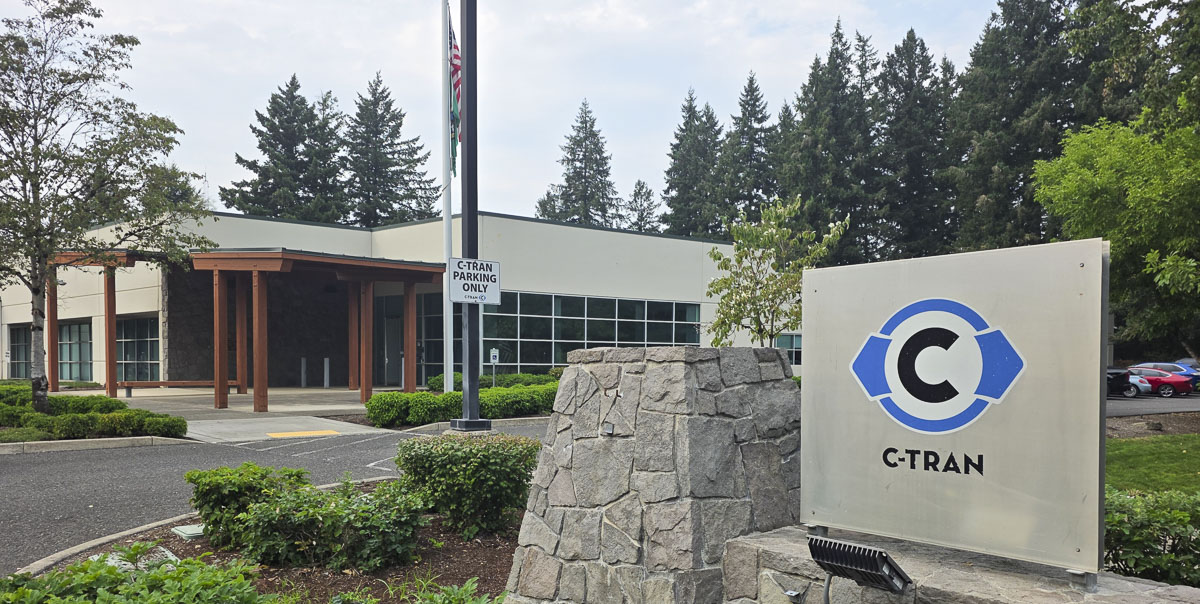
Vancouver and the Vancouver Urban Growth Area residents could be paying for light rail costs, while the smaller cities get protection from those costs; and as part of a compromise, Vancouver and Clark County will get more representation on the C-TRAN board
Paul Valencia
Clark County Today
 See Grok’s analysis of this story
Taxpayers in Vancouver and the Vancouver Urban Growth Area could be on the hook for operations and maintenance costs should Oregon’s light rail extend into downtown Vancouver, but the smaller cities that make up the C-TRAN boundary appear to be protected from those costs.
The C-TRAN Board of Directors once again changed the language on the Modified Locally Preferred Alternative (MLPA) for the Interstate Bridge Replacement Program. The vote took place Tuesday night, with a couple of conditions.
One major condition is that the board would accept the proposal to change its composition, giving the city of Vancouver four seats on the C-TRAN board, three to the Clark County Council, and two seats to be shared by Battle Ground, Camas, La Center, Ridgefield, Washougal and Yacolt. Currently, the board has three from Vancouver, two for Clark County, and four seats shared by the other cities.
Minutes after the C-TRAN board meeting adjourned Tuesday night, the Board Composition Review Committee (BCRC) resumed its meeting and voted to recommend that 4-3-2 proposal.
The one no vote for the change in language and with the 4-3-2 format? That was none other than Michelle Belkot.
It was a year ago this month that Belkot, a Clark County Councilor who was on the C-TRAN board at the time, fought to defend her constituents, hoping to revert to the language of the original MLPA that protected all C-TRAN taxpayers from paying light rail O&M costs. That decision led to her ouster from the C-TRAN board by her colleagues on the Clark County Council, the ones who apparently have no problem requiring the whole county to pay O&M costs for light rail that extends less than two miles into downtown Vancouver.
Belkot might not be on the C-TRAN Board anymore, but she is an alternate. Wil Fuentes was absent from Tuesday’s meeting, so Belkot took the seat in the meeting. Belkot is a member of the BCRC, allowing her to vote on both issues.
This all could be a bit confusing. Here is a recap:
The BCRC has been meeting since late summer 2025 after the Washington State Department of Transportation informed C-TRAN that the composition of its board was out of compliance with state law. WSDOT threatened to withhold grants to C-TRAN. The BCRC came up with a compromise, but WSDOT did not accept.
C-TRAN filed legal action, and a judge did grant a restraining order against WSDOT, keeping WSDOT from withholding grants to C-TRAN.
In the meantime, the BCRC appeared to come up with another compromise. However, if the smaller cities were going to get less representation, they wanted protection against having to pay for light rail costs. That could only be assured by the C-TRAN board, not the BCRC.
Tuesday afternoon, the BCRC met again, but recessed its meeting in hopes of getting new information from the C-TRAN board on Tuesday evening.
The C-TRAN board did vote to accept the new MLPA language on the condition that O&M costs would be from “new money” and not come from outside Vancouver or the urban growth area. The board also agreed to accept the compromise on composition as well as drop the lawsuit against WSDOT.
The BCRC reconvened Tuesday night after the C-TRAN meeting and voted to approve a recommendation to go with the 4-3-2 format for the C-Tran board.
Belkot voted no on the change to the language.
“I don’t agree with us for being taxed for it at all. I don’t think it’s fair that the smaller cities are able to exclude themselves, but the county and the city will bear the burden of it. It’s not fair that these cities are able to opt out,” Belkot said.
No, she does not want the smaller cities to pay for O&M associated with light rail. She wants no one from Clark County to have to pay for something very few want.
In fact, she represents District 2 in Clark County, which covers a lot of the Vancouver Urban Growth Area. She has said for more than a year now that most of her constituents do not want to have to pay for “the corrupt TriMet light rail.”
She also voted no on the BCRC recommendation, saying she believes the C-TRAN board will still be out of compliance with state law because one city will have a majority on the board. If Vancouver gets four seats, and District 3 of Clark County — which covers a lot of Vancouver — gets one of the three Clark County seats, Vancouver will effectively have five representatives on the nine-member C-TRAN board.
“That’s not balanced at all,” Belkot said.
Rian Davis, representing Ridgefield, La Center, and Yacolt on the C-TRAN board, proposed the new language to the MLPA.
From Ridgefield’s point of view, he said, there were three issues to address. 1) how to keep the members of C-TRAN together; 2) how do keep the bridge project a priority; and 3) assuming the bridge is going to have light rail, identify that the money that pays for O&M costs is “new money” and does not come out of current tax revenue designated for C-TRAN services.
Tim Hein, representing Camas, had previously gone on the record with Clark County Today for his passionate support of C-TRAN but his opposition to light rail. This was a compromise that Camas could live with, he said.
“We want to stay a positive member of C-TRAN. The services are valued,” he said. “But the city of Camas does not want to … have its citizens pay for services of light rail.”

This independent analysis was created with Grok, an AI model from xAI. It is not written or edited by ClarkCountyToday.com and is provided to help readers evaluate the article’s sourcing and context.
Quick summary
The C‑TRAN Board of Directors voted to accept new language in the Modified Locally Preferred Alternative that would protect smaller cities from paying light rail operations and maintenance costs, conditioned on changing board composition to a 4‑3‑2 format (four Vancouver seats, three Clark County, and two seats shared by smaller cities). The Board Composition Review Committee later reconvened and recommended the 4‑3‑2 structure. Councilor Michelle Belkot voted no on both actions, arguing the arrangement unfairly burdens Vancouver and urban growth area taxpayers and gives Vancouver effective control.
What Grok notices
- Recounts the sequence of decisions—C‑TRAN’s vote on the MLPA language and the Board Composition Review Committee’s subsequent recommendation—so readers can track how governance and cost‑sharing are being negotiated together.
- Includes quotes from board members (including Rian Davis and Tim Hein, as cited) describing the compromise rationale and the tradeoffs involved in reaching agreement.
- Places the vote in the context of an ongoing representation dispute, including references to WSDOT compliance concerns, litigation developments mentioned in the story, and prior board conflicts involving Belkot.
- Highlights that the “smaller cities” cost‑protection language is conditional and tied to board‑composition changes, which becomes a key leverage point for implementation.
- Emphasizes Belkot’s argument that the revised structure creates an imbalance in representation and shifts cost responsibility in ways she views as unequal.
Questions worth asking
- How might a 4‑3‑2 board composition change voting dynamics and decision-making on future transit projects or service expansions?
- If smaller cities are protected from light rail O&M costs, how will overall cost-sharing be structured, and what does “equity” mean in the context of who benefits and who pays?
- What factors could still trigger compliance disputes or enforcement action from WSDOT regarding governance, representation, or funding rules?
- How do “new money” approaches for O&M, as discussed in the broader debate, address concerns about taxpayer burden—and what questions remain unanswered?
- What role could public input, voter approvals, or additional legal challenges play as the board structure and MLPA language move toward final adoption?
Research this topic more
- C‑TRAN – board agendas, minutes, and MLPA documents
- WSDOT – transit grant compliance and oversight information
- Clark County Council – appointments and representation information
- City of Vancouver – council information and public materials
- Washington State Legislature – transit governance statutes (RCW)
Also read:
- Opinion: Half the road, full stop – Understanding pedestrian right-of-way
 Doug Dahl explains how Washington’s law requires drivers to stop when a pedestrian is within one lane of their half of the road, not just when directly in front.
 - Opinion: What is the cost of a bridge?
 John Ley argues the I-5 Bridge replacement’s soaring cost stems from costly extras like light rail, noting other states deliver larger, toll-free bridges for much less.
 - Letter: Vancouver Mayor Anne McEnerny-Ogle makes several serious and incorrect engineering statements
 Bob Ortblad critiques engineering claims by Vancouver Mayor Anne McEnerny-Ogle, highlighting cost and safety advantages of an immersed tunnel for the I-5 crossing.
 - Washington’s studded tire deadline is March 31
 Drivers must remove studded tires by March 31 or face a $137 fine, with WSDOT urging early action due to busy service centers and no planned deadline extension.
 - VIDEO: WA diesel hits record $6.53, crushing truckers and school budgets
 With diesel nearing $6.53 per gallon in Washington, trucking businesses and school districts now confront sharply higher fuel expenses affecting budgets and workers.
