



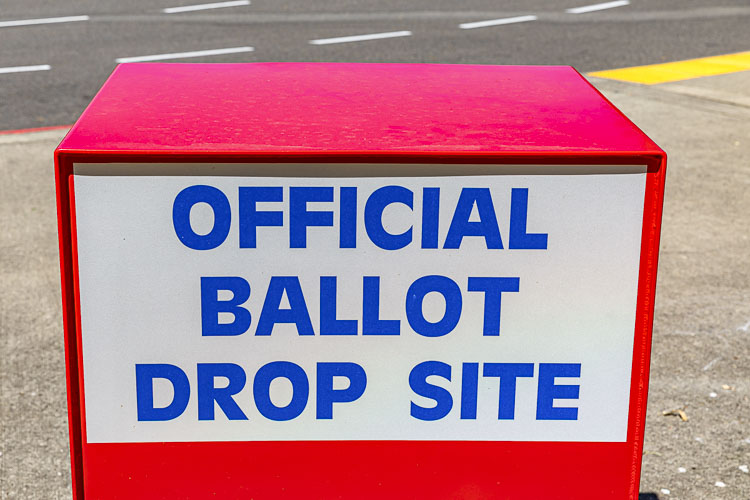
‘It could point to a need to educate election officials regarding the requirements under the law’
Bob Unruh
WND News Center
A new report has revealed that in defiance of routine elections record-keeping strategies, and federal law, more than 90% of the key counties across the nation failed to keep their 2020 elections records.
“The America First Policy Institute made public records requests based on state-specific laws for the top 100 most-populated counties in the traditional 14 swing states that typically determine presidential elections. Ninety-four of the 100 counties did not keep records of who voted in the 2020 election, and only two state-wide election officers had the records preserved. Equally disturbing, even in the six counties that did keep records, there was on average a 2.89 percent discrepancy between the number of people voting and the number of ballots cast,” said the report from John R. Lott, Jr., of the Crime Prevention Research Center, and Steve Smith, of the America First Policy Institute.
It appeared in The Federalist.
“Unfortunately, election officials across the country are not keeping the most basic data to monitor election outcomes. Even when they say they do, the numbers do not come close to matching up,” they explained. “It was a simple goal: match the number of voters with the number of ballots cast. After the last general election there were concerns that ballots were counted multiple times (so that there could be more ballots cast than voters who voted) and that ballots were destroyed (so that there could be more voters who voted than ballots cast). But, through our examination, we learned that it cannot be determined if these discrepancies exist, because most states and counties simply do not keep timestamped records of who voted as required by law.”
They noted, “In Miami-Dade, Florida, the discrepancy was about 1.6 percent — a difference of 16,617 votes. Ninety-two percent of the precincts had more recorded ballots cast than voters (for a total of 15,854), and the other 8 percent had more voters than ballots cast (763). Since 12 percent of precincts were missing records, we didn’t include those. That’s a discrepancy that can very well swing elections. For example, in 2018, Republican Rick Scott won Florida’s U.S. Senate seat by 10,033 votes.”
Further, the report confirmed, “Cobb County, Georgia, had a massive discrepancy of 34,893 votes, or 8.8 percent. All but one of the precincts had more ballots cast than voters. The gap was more than two and half times the 13,471 votes Republican David Perdue fell short of winning in Georgia’s first round Senate race in November 2020. Sen. Jon Ossoff then won the run-off the following January.”
The report notes the Federal Civil Rights Act of 1960 requires that “all records and papers… relating to any… act requisite to voting in such election [for federal office] be kept for 22 months.”
Some county elections officials simply wrote over the original computer file.
“This could be sloppiness, or it could point to a need to educate election officials regarding the requirements under the law. What we know is that data storage is trivially inexpensive, and it would be easy to save a file time stamped on election day.”
Singled out for special criticism was Montana, where the election is all mail-in.
“A January 4, 2021, recount of the 2020 election found 4,592 fewer envelopes than the County Election Office’s tally of 72,491 votes. That is a 6.33 percent difference in votes counted. A second March 28, 2022, recount found only 71 fewer envelopes than votes. During that recount, two more boxes of envelopes were discovered. Questions were raised about whether the two missing boxes were accidentally mislaid or fraud was committed,” the report said.
While a video of election night should answer the question of how many envelopes were opened, Missoula County erased its video.
The report said, “Something needs to be done. Fifty percent of likely U.S. voters think it is likely that ‘widespread cheating will affect the outcome of this fall’s congressional elections,’ including 35 percent of Democrats and 70 percent of Republicans.”
Following the law would help, the report concludes.
“Any discrepancy could quickly and easily be addressed or investigated,” the report said.
Also read:
- Vancouver mayor counters IBR’s proposal for the only light rail stop to be at the waterfront
 Vancouver’s mayor wants light rail extended beyond the waterfront to connect with C-TRAN buses at Library Square.
 - Opinion: ‘Both states know they have seriously flawed voter registration’
 Lars Larson argues Oregon and Washington are suing DOJ to avoid cleaning up fraudulent voter rolls before elections.
 - Letter: Compassion without accountability is failing Clark County
 Sarah Mittelman calls for clear standards and measurable results in homelessness spending.
 - ‘Our new normal’: WA confronts another year of drought
 Casey Sixkiller says every watershed in Washington has dropped below 75% of normal water supply.
 - Schools expect minimal impact with Title IX pacts rescinded
 Federal officials rescinded agreements with six school districts, saying previous administrations misapplied Title IX protections.
 - Area Agency on Aging & Disabilities in Southwest Washington announces the Senior Farmers Market Nutrition Program
 AAADSW opens applications for $80 benefit cards to help eligible seniors buy fresh produce at farmers markets.
 - Free in-person workshops promote composting and sustainable living
 Clark County’s free workshops teach residents worm composting, green cleaning, and smart recycling through April and May.
 wpDiscuz
