



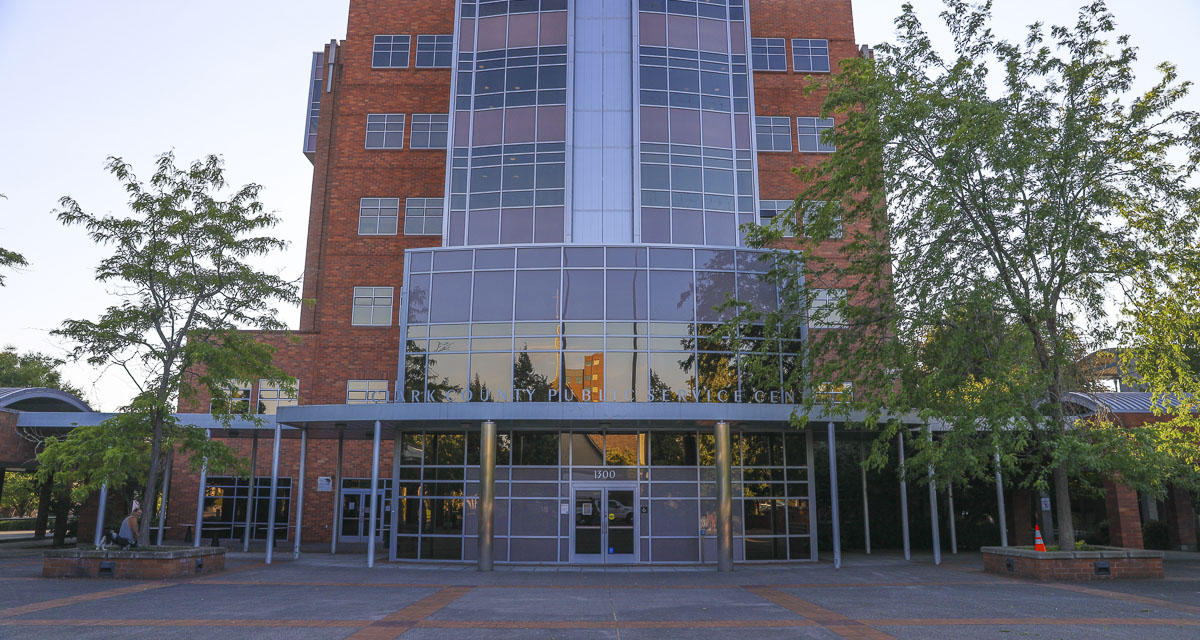
The Clark County Council on Wednesday listened to an expert from C-TRAN explain the process of creating a sub-district that could, by vote of the people, pay for Operations and Maintenance costs for light rail if light rail is part of the proposed new Interstate Bridge
Paul Valencia
Clark County Today
Call it a fact-finding mission for the Clark County Council.
Or perhaps it was the beginning of a long process that could potentially figure out a way to pay for operations and maintenance costs for light rail.
Scott Patterson, the deputy chief executive officer for C-TRAN, gave a presentation Wednesday morning during a Work Session with the Clark County Council. His goal was to inform the council of the options to pay for O&M costs, including the possibility of forming what is described as a sub-district within the C-TRAN boundary.
Outside of Vancouver, there is little support in Clark County to pay for Oregon’s light rail system, should light rail be part of the new Interstate Bridge. A high-capacity transit sub-district could be created, asking those who live and/or have businesses in that sub-district to pay for O&M through an increase of the sales tax and/or employer tax.
Patterson noted that creating a sub-district and getting it ready to go to a vote of the people could take anywhere from 18 months to two years.
“There are a few different taxing options that C-TRAN has available to it,” Patterson said. “All of them require a public vote. That is the case for all public transit agencies in the state of Washington.”
That means an increase to the sales tax for light rail O&M or an employer tax — whether in a sub-district or within the entire C-TRAN boundary — would have to be passed by a vote of the people, Patterson said.
Proponents of light rail would likely be in favor of creating a sub-district, with downtown Vancouver being the center of that sub-district.
“Light rail is much more highly supported by people who live in the inner core, and I think they will largely benefit more from it since it’s going to be closer to them,” Councilor Glen Yung said.
Councilor Wil Fuentes added:
“I think that the sub-district that some of us might consider would be Vancouver and … urban unincorporated Clark County.”
Almost everyone agrees that if the entire C-TRAN boundary — which includes Camas, Washougal, Battle Ground, Ridgefield, La Center, and Yacolt — was asked to vote yes or no to O&M costs for light rail, that would be a resounding no.
Patterson noted that C-TRAN understands what an increase in a sales tax for its entire boundary would collect, but he does not know how much revenue would be generated by a sub-district. That could only be determined after the focus is narrowed down into what would actually comprise the sub-district.
Just downtown Vancouver, for example? All of Vancouver? Vancouver and the Urban Growth Area?
And if it is, just Vancouver, for example, would that increase in sales tax be enough to pay for light rail O&M?
All of those questions would have to be answered, Patterson said.
Councilor Michelle Belkot asked if there would be any protection for Clark County taxpayers if C-TRAN agrees to pay for O&M for a light rail system that is being run by an organization — Oregon’s TriMet — that is “going bankrupt.” TriMet reportedly has a $300 million budget shortfall.
Patterson said there would be time to negotiate language in any agreement with TriMet, to alleviate those fears. A similar agreement was made with TriMet during the Columbia River Crossing era, a project that failed to get a new bridge built.
This is government work, too, so a sub-district would need more … government.
A regional policy committee would have to be formed. Patterson said that likely would be the C-TRAN Board of Directors along with one appointed representative from the Washington State Department of Transportation. That board would then be required to oversee the development of the long-term system and finance plan, a 20- to 30-year forecast.
From there, a creation of an expert review panel appointed by the governor and the chairs of the house and senate transportation committees.
Once the expert review panel completes its work, the regional policy committee could approve the finance plan that would allow a ballot to go in front of the voters.
Sue Marshall, the county chair, invited Patterson to the Work Session to go over how a sub-district could be created.
“This option came up out of concern that the small cities would be obligated to pay for light rail,” she said.
A sub-district could take the smaller cities off the hook.
Patterson said he will also be giving a similar presentation to the C-TRAN Board of Directors at its next meeting, next week.
“A good starting point to get the information out there, start the conversation about what that process would look like going forward,” Patterson said.

Also read:
- ‘Our new normal’: WA confronts another year of drought
 Casey Sixkiller says every watershed in Washington has dropped below 75% of normal water supply.
 - Schools expect minimal impact with Title IX pacts rescinded
 Federal officials rescinded agreements with six school districts, saying previous administrations misapplied Title IX protections.
 - Former WA Supreme Court justice joins legal effort against income tax
 Phil Talmadge and Rob McKenna have joined forces with the Citizens Action Defense Fund to oppose Washington’s new tax on high-income earners, raising legal and constitutional questions.
 - Makeover in store for Congress with flood of lawmakers headed for the exits
 A wave of exits from Congress—over 65 lawmakers—will usher in unfamiliar faces and decrease veteran expertise, shifting the political landscape in Washington.
 - Opinion: Sheriffs fight back
 Four county sheriffs are suing to block a new law giving a governor-appointed board power to decertify and remove sheriffs, bypassing voter oversight in Washington.
 wpDiscuz
