




The federal government stopped making pennies last year but intends to keep the roughly 114 billion pennies in existence in circulation for as long as possible
Jerry Cornfield
Washington State Standard
 See Grok’s analysis of this story
A new Washington state law offers a way to make change in an era without pennies.
The federal government stopped making pennies last year but intends to keep the roughly 114 billion pennies in existence in circulation for as long as possible.
Plenty of retailers aren’t stocking pennies in their tills already. It’s forced states to come up with a solution that offers clear guidelines for merchants and predictability for consumers.
House Bill 2334, signed by Gov. Bob Ferguson on Monday, is Washington’s approach.
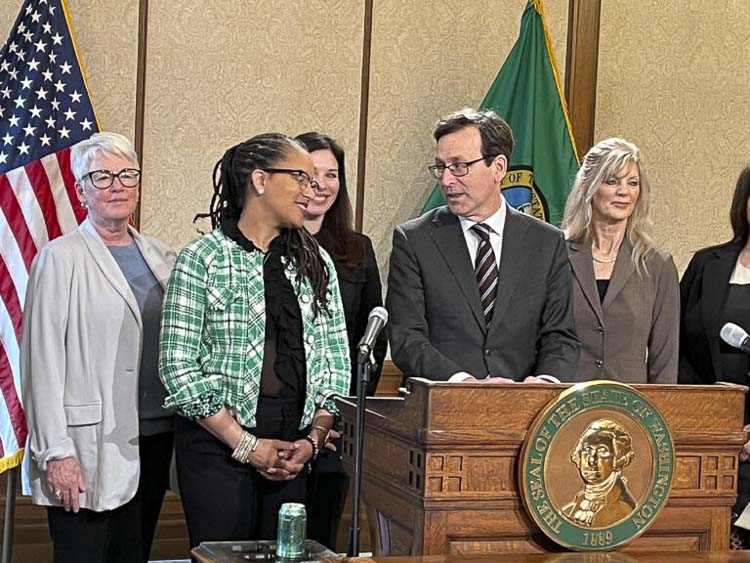
It allows but does not require retailers to round cash purchases up or down to the nearest 5 cents when they make change. Payments with credit or debit cards are not affected.
That means if the total price, including taxes, ends in 1 cent, 2 cents, 6 cents, or 7 cents, the amount is rounded down to the nearest multiple of five. If it ends in 3, 4, 8 or 9 cents, the bill will be rounded up.
For example, if a purchase is $4.97 and a customer hands over $5, the cashier would round down to $4.95 and provide a nickel in change. If the amount is $4.98, the cashier would round up and no change would be paid out.
Rep. April Berg, D-Mill Creek, said she authored the legislation to address “the myriad of issues that consumers will face with the elimination of the currency. The sense of urgency increased around this issue as more and more retailers ran out of pennies to make change for customers.”
Retailers who already started rounding wanted a law to legitimize the process and to make clear how they reconcile the practice with tax reporting requirements. The law spells out that taxes and fees owed by a business are based on the purchase price prior to rounding.
Another key for businesses is clear language that if the purchase amount after rounding is different than a displayed or advertised price, it does not violate the Consumer Protection Act.
The state Department of Revenue estimates up to 400,000 taxpayers with retail sales will be affected. It will need to issue guidance and update relevant information on its website, work the agency says it can cover within its existing budget.
The legislation was passed on final votes of 80-15 in the House and 45-2 in the Senate. It will take effect in mid-June.
Washington isn’t alone in adopting rounding as a method to solve the penny problem. Arizona’s law took effect last week. Florida, Tennessee, Virginia and New York are among the other states taking this path.
The Oregon Legislature passed a rounding law earlier this month. It has an emergency clause and will take effect immediately if signed by Gov. Tina Kotek.
This report was first published by the Washington State Standard.

This independent analysis was created with Grok, an AI model from xAI. It is not written or edited by ClarkCountyToday.com and is provided to help readers evaluate the article’s sourcing and context.
Quick summary
Gov. Bob Ferguson signed House Bill 2334 on March 23, 2026, allowing—but not requiring—Washington retailers to round cash purchase totals up or down to the nearest five cents when making change after the federal government ended penny production. The law keeps tax calculations exact and states that businesses following the law are not violating the Consumer Protection Act.
What Grok notices
- Clearly explains the rounding method with practical examples, helping readers see how cash totals like $4.97 or $4.98 would be handled at the register.
- Emphasizes that the law is optional for retailers rather than mandatory, which means adoption may vary by business type, customer base, or cash volume.
- Separates rounding from tax computation by noting that taxes must still be calculated exactly even if the final cash transaction is rounded for payment purposes.
- Provides broader context by tying the bill to the federal end of penny production and noting that other states have adopted similar rules.
- Highlights strong legislative support and notes that the Department of Revenue plans to issue guidance, suggesting implementation questions will likely center on business procedures rather than major new administrative costs.
Questions worth asking
- How might voluntary rounding affect consumer trust, especially if different retailers adopt different practices or communication methods?
- Could cash rounding improve checkout speed, cash-handling efficiency, or register accuracy for retailers that still process many cash transactions?
- What practical challenges might small businesses face when reconciling rounded cash payments with exact tax reporting and accounting systems?
- How have other states structured consumer protections around rounding, and what complaints or implementation issues have emerged elsewhere?
- What broader effects could the penny’s discontinuation have on cash-heavy consumers, pricing behavior, and the role of physical currency over time?
Research this topic more

Also read:
- Opinion: ‘Just because they got away with it doesn’t mean they weren’t wrong’
 A Skamania County deputy’s report found violations of county rules and the Open Public Meetings Act, but no prosecutor acted on the findings.
 - More drama at Clark County Council in regard to its representatives on the C-TRAN Board
 Councilors debated whether C-TRAN board representatives must follow group mandates, with Michelle Belkot refusing to commit to new voting rules and Glen Yung opposing her nomination.
 - Opinion: Small things grow great by concord
 Washington’s initiative process gives citizens direct power to challenge lawmakers. Failed restrictions and new measures on girls’ sports, parental rights, and citizenship prove the influence of grassroots action.
 - Opinion: California’s $20 fast food minimum wage creates less jobs and lower income
 Study data show California fast food workers now face fewer shifts, higher menu prices, and widespread automation after the $20 wage hike.
 - Gov. Ferguson signs law to undo WA estate tax increase enacted last year
 Washington rolls back its estate tax hike, restoring previous rates and prompting uncertainty around $340 million in expected revenue for education.
