



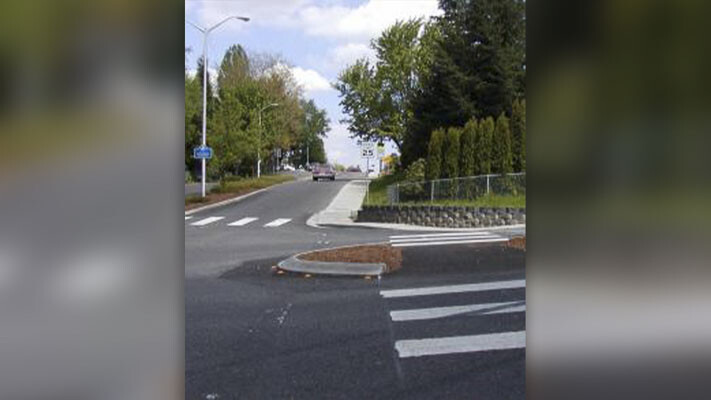
The program will allocate approximately $300,000 for traffic calming projects and has opened the call for project locations phase of the program
VANCOUVER – Vancouver community members are invited to submit traffic concerns and champion project locations for possible selection through the 2023 Neighborhood Traffic Calming Program to help slow traffic and increase street safety in local neighborhoods. The program will allocate approximately $300,000 for traffic calming projects and has opened the call for project locations phase of the program.
Community members interested in pursuing a traffic calming project for their neighborhood street must submit an official request using a simple online web form. Traffic calming applications will be accepted January 1 to February 28, 2023. After project locations are submitted by the end of February, project proponents will work through the program’s evaluation process with final project selection occurring in late October. The comprehensive program document, including timelines and requirements, can be viewed here or online, www.cityofvancouver.us/TrafficCalmingProgram.
The program encourages residents to champion project locations through the competitive selection process for funding and implementation. Past projects have included signing and surface striping, speed cushions/tables, radar feedback signs and street trees.
Vancouver’s Neighborhood Traffic Calming Program works in close partnership with the independent, community-led Neighborhood Traffic Safety Alliance (NTSA). The program offers various resources and project opportunities for community members seeking to slow local traffic, while creating a more livable community. Each year, neighborhood residents are invited to get involved in the program by shepherding projects through the competitive process, working closely with City staff and the NTSA as they proceed.
Guidelines for proposals to the Neighborhood Traffic Calming Program include:
– Residents/neighborhood associations may submit only one application per program year.
– A project proponent must champion the project proposal through the entire evaluation and selection process. If there is no project proponent, the proposal will not be considered for the program.
– Preliminary project cost estimates will be capped at $150,000 per project.
– Infrastructure projects (proposals that include adding a traffic calming device or structure onto or in the street) will be limited to only residential and collector arterial streets.
– Principal arterials will not be considered for the neighborhood program as they have higher traffic volumes and are typically reviewed, evaluated and considered through other City efforts.
– All projects must meet speed/volume criteria and demonstrate community support.
Funding for the Neighborhood Traffic Calming Program is available through a combination of Real Estate Excise Tax (REET), Transportation Benefit District (TBD) fees and multiple other revenue sources. Project costs are coordinated through several different strategies and partnerships within City departments to maximize cost efficiencies.
More details about Vancouver’s Neighborhood Traffic Calming Program, proposal guidelines and project proponent requirements can be found on the City’s website at www.cityofvancouver.us/TrafficCalmingProgram.
Information provided by city of Vancouver.
Also read:
- Opinion: A year in review of news stories from a former sports guy
 Clark County Today reporter Paul Valencia reflects on his evolving role, revisiting major news, community debates, sports moments, and human-interest stories that shaped Clark County in 2025.
 - Names released of person killed and Vancouver officers involved in deadly force incident
 State investigators have released the names of the Vancouver police officers involved in a deadly force incident, and the Clark County Medical Examiner has identified the man who was killed as 44-year-old Perry J. Sellars of Vancouver.
 - These new laws and taxes take effect in Washington state on Jan. 1
 Several new laws and tax increases passed in 2025 take effect Jan. 1 in Washington, impacting unemployment benefits, business taxes, transportation fees, consumer costs and regulatory requirements.
 - Opinion: Ready for another pay decrease from the state? It happens Jan. 1
 Elizabeth New (Hovde) argues that Washington’s Paid Family and Medical Leave payroll tax increase will further reduce workers’ take-home pay beginning Jan. 1.
 - Vancouver rolls out new all-access community center membership
 The city of Vancouver is launching a new all-access membership in January that allows residents to use both Firstenburg and Marshall community centers.
 - Four Western WA counties granted $6.6M in federal funds for road safety programs
 Four Western Washington counties will receive $6.6 million in federal funding for road safety projects, including an EMS pilot program in Clark County.
 - Opinion: Justice for none – Court hands down a mandate without a dime to fund it
 Nancy Churchill argues that a Washington Supreme Court ruling on public defense imposes costly mandates on local governments without providing funding to implement them.
