



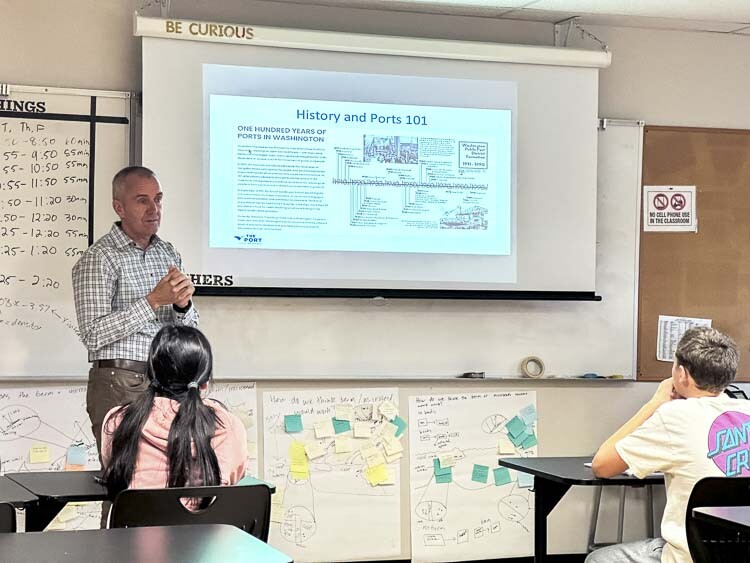
Students participated in a Q&A with David Ripp, the Port of Camas-Washougal chief executive officer
When Physical Science students at Washougal High School asked about flooding and impacts for businesses near the Columbia River, their teacher saw an opportunity to bring in a guest with answers. Students participated in a Q&A with David Ripp, the Port of Camas-Washougal chief executive officer.
The Port maintains levies and manages property near the river with an eye toward sustainability, and focuses on planning for the future. This is one example of how the district brings industry experts into the classroom to facilitate real-world problem solving and job-readiness learning at school.
The conversation was student-led, guided by questions formulated by students ahead of time. Will Baur, science teacher at WHS, facilitated the conversation. Students asked about the local impacts of previous flooding events, current projects and partnerships, future plans for the area, and careers at the Port.
“After introducing my students to the phenomena of sea level rise and how it is impacting coastal communities, they asked a lot of questions about how Washougal would be affected if sea levels continue to rise. To address my students’ questions, I contacted the Port of Camas-Washougal to learn more,” said Baur.
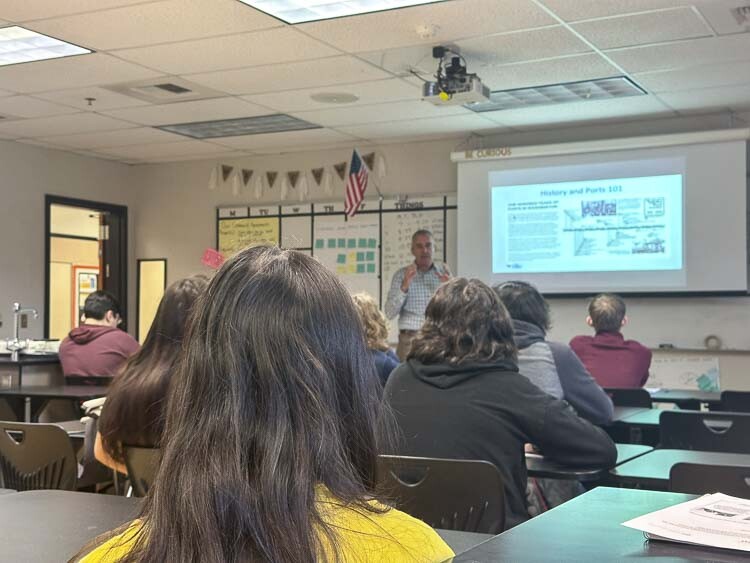
Ripp shared that the Port relies on levies maintained by the port, plus those built and maintained by the Army Corps of Engineers, to protect the port property from flooding. He talked about ways the port was impacted during the major floods of 1996, when the port’s parking area and the basement of the port facility flooded.
Students learned about projects currently underway at the Port, and how the Port works with neighboring properties to mitigate impacts of construction. Ripp talked about the partnership between the Port and surrounding businesses and the Steigerwald refuge, and how the Port is selective with ways they allow business tenants to use leased property to enhance the public facing parts of the port property.
Ripp was asked to share about the favorite part of his job. “I love working with people and sharing information with groups through opportunities like the student presentations.” When asked about the hardest parts of the job, he noted that he is always “on call, which means occasionally getting 3 AM phone calls to respond to issues impacting operations.”
Students learned about the planned developments on the old Hamilton lumber yards, and the ground cleanup that took place to prepare the property for development. Students were interested in the planned mixed-use development, and how many businesses the port expects to be able to welcome. Ripp shared the timeline for phase 1, which will start this summer, including construction of streets, sidewalks, and the first four buildings.
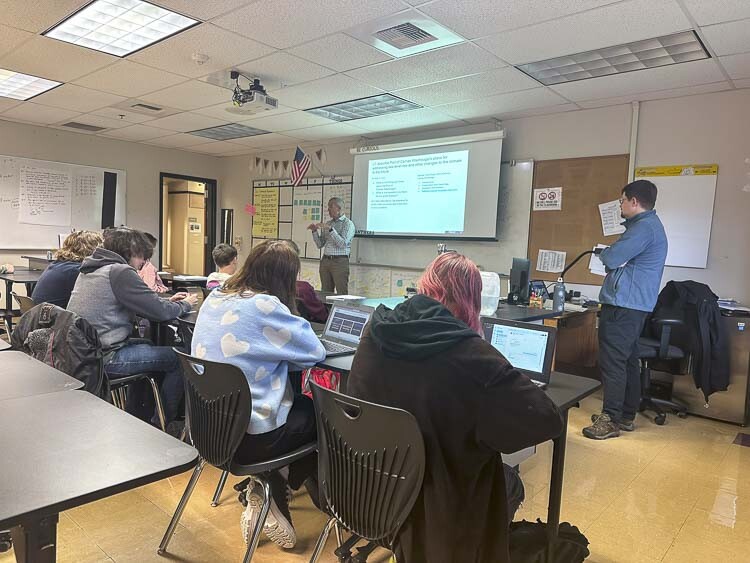
Students asked about sustainability of operations, and what changes the port needs to make to prepare for higher sea levels. “The Columbia River at the Port has very little fluctuation due to sea level but is more impacted by the flow of water released from Bonneville dam,” said Ripp. “Port staff receive information from dam managers to understand how water levels will fluctuate so they can make any needed adjustments.”
“Connecting the science concepts to our local area helps students better understand the standards we are working on, and see purpose in learning more about the ecosystems we are all part of, and how they play a part in shaping the natural world,” said Will Baur.
The Port acts as a business incubator and job creator in the Washougal community, building infrastructure and leasing buildings to support new businesses moving to the area. Ripp highlighted a community solar project being constructed in partnership with Clark Public Utilities, and how this investment will allow the port to both generate carbon-free electricity and minimize future operational costs.
Students asked about employment opportunities at the port, and Ripp shared that the port hires both year-round and seasonal workers. He invited students to apply for summer jobs that pay well and offer up to 20 hours per week of paid work on projects like landscaping, and that these opportunities are available for students 15 and older. Ripp encouraged students interested in this opportunity to reach out to the WHS Career Center, which posts job opportunities for students looking to earn money and build their resume.
Information provided by Washougal School District.
Also read:
- Vancouver Police arrest barricaded man
 Terry Meyers, 58, faces multiple assault charges after pointing firearm at neighbor and barricading himself.
 - 49th Legislative District Democrats share their reasons for backing state income tax at Town Hall
 Three Democrat legislators defended the new income tax affecting only those earning over $1 million annually.
 - Letter: Freeze the scope and build the bridge
 Vancouver resident calls for project discipline after 22 years of planning and nearly half a billion in costs.
 - Ekklesia Theatre presents ‘Every Brilliant Thing’
 Interactive theatre production donates 50% of ticket sales to local counseling services.
 - Opinion: Public workers’ First Amendment rights are getting attention – in Idaho, not Washington
 Idaho moves to stop public schools from collecting union dues through government payroll while Washington continues favoring unions over worker choice.
 - Opinion: Lawsuit filed against the unconstitutional income tax in Washington state
 Former Attorney General Rob McKenna and Supreme Court Justice Phil Talmadge challenge the 9.9% income tax in Klickitat Superior Court.
 - Vancouver Police investigate domestic violence homicide
 Vancouver Police Major Crimes Unit investigating after woman found dead with knife wounds on NE Oakbrook Circle.
