



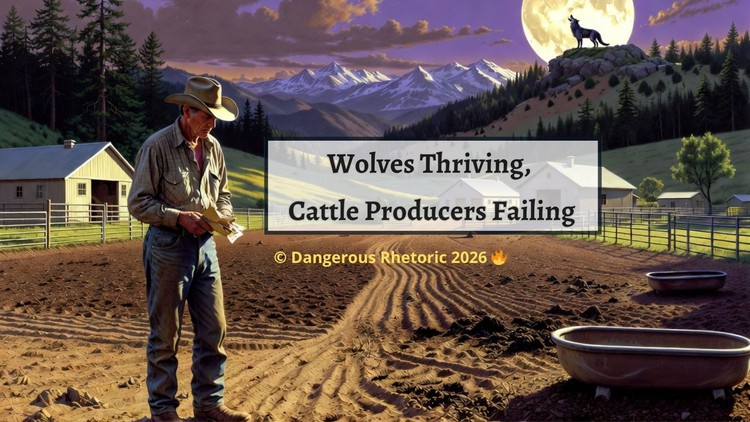
WDFW celebrates 270 wolves in 49 packs while Washington agriculture posts negative $396 million farm income.
🎧 Gray wolves hit record highs as WA agriculture collapses
Nancy Churchill discusses when conservation success becomes rural economic disaster
Nancy Churchill
Dangerous Rhetoric
Washington’s gray wolf population has hit a record high of 270 wolves in 49 packs with 23 successful breeding pairs. That was a staggering 17.4% jump from 230 wolves, 43 packs, and 18 breeding pairs the year before. According to the Washington Department of Fish and Wildlife’s own 2025 annual report, this is the highest count to date.

Nancy Churchill
Yet despite blowing past every numerical recovery target in its own 2011 Wolf Conservation and Management Plan, WDFW refuses to delist them. This is deliberate mismanagement: It ignores nearly impassable physical barriers that make full geographic recovery impossible, compounds the catastrophic collapse of Washington agriculture, and is shielded by Democrat legislators who show zero interest in passing meaningful wolf policy reforms.
The 2011 plan’s clear delisting goals
The 2011 plan was crystal clear. It set a primary delisting objective of 15 successful breeding pairs sustained for at least three consecutive years, distributed as at least four pairs in Eastern Washington, four in the Northern Cascades, four in the Southern Cascades/Northwest Coast region, and three anywhere else. It also provided an alternative trigger: 18 successful breeding pairs documented in a single year, with the same geographic spread (four, four, four, and six anywhere).
We are now at 23 confirmed breeding pairs — well above both thresholds — plus 49 total packs and a minimum count of 270 wolves. The actual count is higher due to difficulties in finding and tracking packs and individual wolves. The confirmed population surged 17.4% in 2025 after a brief 2024 dip.
The recovery plan never called for unlimited, perpetual growth. It set explicit, science-based benchmarks for when protection ends and responsible management begins. WDFW has simply chosen to ignore its own benchmarks.
Physical barriers throttle full geographic recovery
Even worse, distribution remains incomplete because of physical barriers the agency itself now admits exist. During a presentation to the Wolf Advisory Group last week, a WDFW wolf biologist conceded that the I-90 superhighway and the Columbia River are blocking meaningful dispersal into the Southern Cascades Recovery Zone. The few wolves that have trickled south have failed to establish packs.
The 2011 plan assumed natural dispersal would fill every recovery zone. WDFW now knows that assumption was wrong in at least one major region, yet it still hides behind the old geographic targets as an excuse to keep wolves listed forever. This is not science-based management. It is selective adherence to a plan the agency only follows when it suits the perpetual-protection narrative.
Washington agriculture collapses while wolves thrive
Meanwhile, Washington agriculture is in freefall. Drawing from 2024 USDA data, the state now ranks dead last — 50th in the nation — in net farm revenue, posting a jaw-dropping negative $396 million in farm income.
That represents a collapse of more than $1.3 billion in lost revenue from 2023 to 2024. The second-largest economic sector in the state is on its knees, and Olympia’s response has been ideological theater: bills to raise labor costs, pile on new restrictions, and hand anti-farming activists more legal weapons.
At the April WAG meeting, members representing livestock producers challenged the reported 2025 depredations number of 17 confirmed animals. They have heard from their neighbors that some producers lost 17 head in one herd alone. They reported that producers like these have lost confidence in the agency, and are just selling their entire herds because losses are too high. How many producers have been lost? Who’s tracking that number?
At the precise moment farmers and ranchers are fighting livestock losses, higher insurance costs, and the exhausting daily reality of wolves on the landscape, WDFW issues glowing press releases celebrating “record highs” and “successful breeding pairs” while refusing to pull the delisting trigger.
WDFW ignores Its own science and plan
The agency’s 2025 report boasts the “highest count to date” with zero mention of delisting proceedings or management changes, even though the numerical triggers have been met and exceeded. The minimum-count methodology plus the 12.5% adjustment shows undeniable over-recovery in accessible areas. Continued unchecked growth proves WDFW has quietly abandoned every built-in off-ramp the plan provided. It’s no wonder that Washington’s ranchers and cattle producers are in despair over stock losses.
Legislative inaction enables the crisis
Further complicating the crisis, Democrat legislators are completely uninterested in passing legislation to address wolf issues. Year after year, common sense wolf legislation is left to die in committee. One senior Democrat leader told me during the 2026 session, “I can’t help with this problem; go to the feds.”
This legislative indifference leaves WDFW completely unaccountable. No oversight, no deadlines, no pressure to follow its own 2011 recovery criteria. The result is a policy vacuum where ideology reigns and practical, science-based wildlife management dies.
It’s time to declare victory and delist
Washington’s wolves have not only met but exceeded every numerical recovery goal in the 2011 plan. Our conservation plan has worked! Unfortunately, physical barriers make full geographic distribution as originally envisioned very challenging in the Southern Cascades. In the meantime, cattle producers are bleeding out. And key legislators look the other way.
WDFW must initiate delisting procedures immediately per its own plan. It cannot keep citing unmet distribution goals in one unreachable region while celebrating explosive growth everywhere else and ignoring infrastructure and geological barriers its own biologist documented.
Declaring conservation victory and shifting to responsible management is not anti-wolf — it is honest.
Protecting wolves far beyond recovery while rural Washington agriculture collapses and legislators offer nothing but silence is not compassion.
It is deliberate mismanagement, enabled by political neglect. Olympia and WDFW owe the state’s farmers, ranchers, and rural communities real solutions right now. The record numbers don’t lie. It is time to follow the science, follow the plan, and delist the wolves.
Small things grow great by concord: What you can do
It’s time to advocate for a change in Wolf management in Washington state. Little actions, taken by many individuals, can create great changes. One action you can easily take is to make small monthly contributions to your local conservative Republican legislative candidates. You can also follow the efforts of WAGOP to flip key legislative races in western Washington, and send a little funding to those candidates, as well.
Next, you can ask for meetings with key Democrat legislators, to present your personal experiences, and request that they work across the aisle to develop new legislation to protect ungulate herds and livestock. Be respectful but insistent. They need to help preserve agriculture and ranching.
Finally, be like our Founding Fathers: Write relentlessly. Write on social media. Write emails to your friends. Write to producer organization leaders. Write letters to the editor. Do everything you can to share your story, and bring attention to the critical losses being sustained in the Washington state livestock industry. Beat the drum and raise awareness. Fight. Fight. Fight.
Nancy Churchill is a writer, educator, and conservative activist in rural eastern Washington state. She chairs the Ferry County Republican Party and advocates for effective citizen influence through Influencing Olympia Effectively. She may be reached at DangerousRhetoric@pm.me. The opinions expressed in Dangerous Rhetoric are her own. Dangerous Rhetoric is available on Substack and X.

Also read:
