



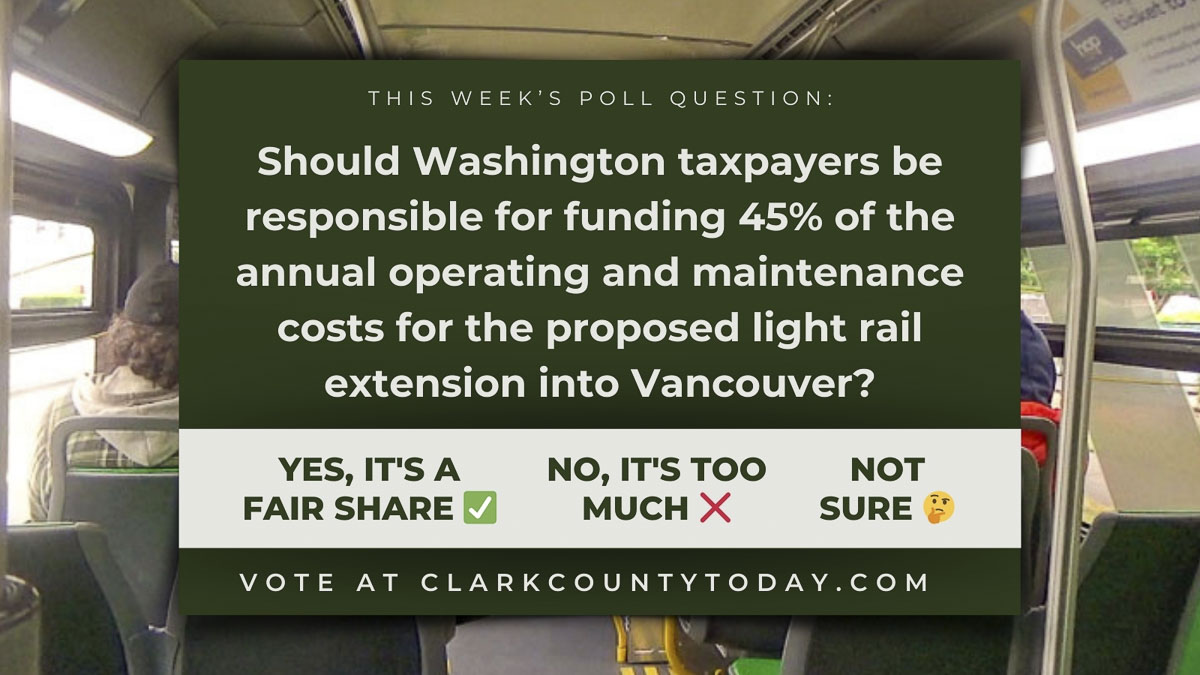
The proposed light rail extension into Vancouver has sparked a heated debate, with questions arising about Washington taxpayers’ responsibility for funding 45% of the annual operating and maintenance costs.
Some argue this cost-sharing is a fair contribution to an infrastructure project that promises regional benefits. Others contend that it places an undue financial burden on Washington residents for a project driven largely by Oregon’s transit needs.
We want to hear from you!
More info here:
Opinion: TriMet should receive the Golden Fleece Award
John Ley critiques TriMet's funding demands for the IBR, calling it a taxpayer fleecing.
Read more
Make your voice heard and join the conversation! Voting is quick and easy—let us know what you think.
Stay informed about this and other pressing issues at ClarkCountyToday.com.
Also read:
- Letter: Vancouver Mayor Anne McEnerny-Ogle makes several serious and incorrect engineering statements
 Bob Ortblad critiques engineering claims by Vancouver Mayor Anne McEnerny-Ogle, highlighting cost and safety advantages of an immersed tunnel for the I-5 crossing.
 - Washington’s studded tire deadline is March 31
 Drivers must remove studded tires by March 31 or face a $137 fine, with WSDOT urging early action due to busy service centers and no planned deadline extension.
 - VIDEO: WA diesel hits record $6.53, crushing truckers and school budgets
 With diesel nearing $6.53 per gallon in Washington, trucking businesses and school districts now confront sharply higher fuel expenses affecting budgets and workers.
 - Opinion: In plain sight – yielding to pedestrians
 Drivers often fail to see pedestrians due to inattentional blindness, which highlights the need for more focused awareness at intersections and stronger safety practices.
 - Expect delays on SR 14 in Vancouver for guardrail repairs Wednesday
 State Route 14 travelers in Vancouver should plan for morning delays as WSDOT will close two eastbound lanes for guardrail repairs, affecting mileposts 6.0 to 7.0.
 wpDiscuz
